Five Practices High-Performing Compliance Teams Use

THIS BLOG WAS WRITTEN BY THE ADHERENT MARKETING TEAM TO INFORM AND ENGAGE. HOWEVER, COMPLEX REGULATORY QUESTIONS REQUIRE SPECIALIST KNOWLEDGE. TO GET ACCURATE, EXPERT ANSWERS, PLEASE CLICK ASK AN EXPERT.
The product companies that consistently outperform their peers have not found a simpler regulatory environment. Across the Fortune 100 manufacturers Adherent works with, the same five operating practices show up again and again, from building compliance into product development on day one to applying AI only where it creates real value. None of the five works well in isolation. Together, they form a single operating model that turns regulatory complexity into a business advantage.
Table of Contents
- Why the Same Five Practices Keep Showing Up
- Practice 1: Build Compliance into Product Development
- Practice 2: Create One Trusted Source of Regulatory Intelligence
- Practice 3: Build Evidence as Work Happens
- Practice 4: Use Compliance to Inform Business Decisions
- Practice 5: Put AI to Work Where It Creates the Most Value
- How the Five Practices Reinforce Each Other
- Frequently Asked Questions
Product compliance has never been simple, but it has become fundamentally more difficult. Products are more complex, supply chains span more countries, and regulatory requirements continue to expand across safety, chemicals, sustainability, cybersecurity, packaging, and product design.
This article is adapted from Adherent’s new playbook, The Ultimate Product Compliance Playbook, which sets out the operating model behind the world’s leading product companies. This piece focuses on the first part of that model: five practices, what each looks like inside a real global product company, and a self-check question for each one, drawn from the playbook’s own scorecard.
Why the Same Five Practices Keep Showing Up
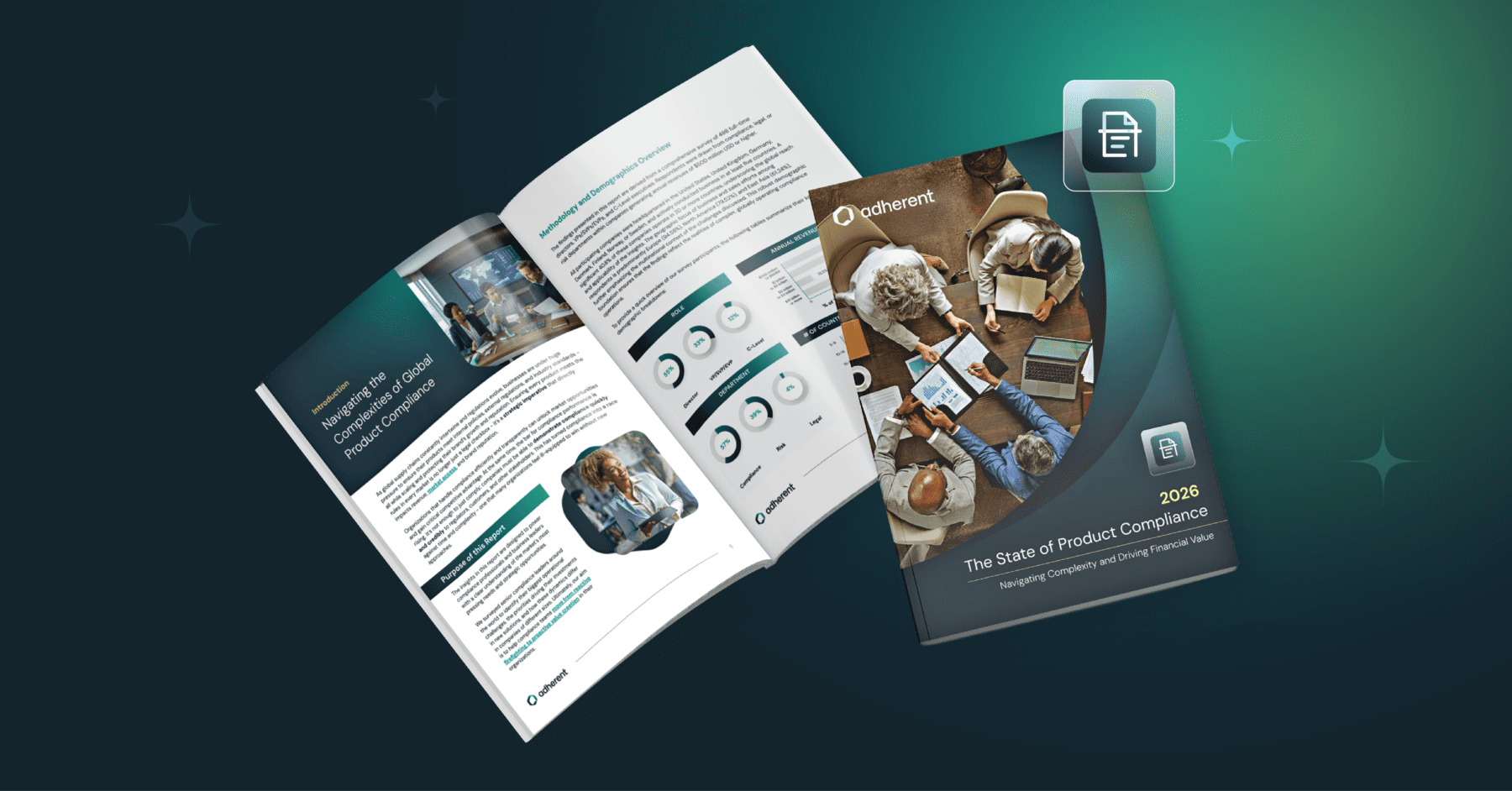
Adherent’s State of Product Compliance 2026 research surveyed nearly 500 senior product, compliance, legal, and regulatory leaders. The results point to an operational problem rather than a technical one.
69% of leaders say remediating compliance issues after they occur is their hardest challenge. Among companies with more than $10 billion in annual revenue, that climbs to 77%.
Providing evidence of compliance to external stakeholders was rated difficult or very difficult by 62% of respondents, and ensuring product design addresses compliance requirements throughout the lifecycle by another 62%. Those numbers describe five recurring failure points inside product companies:
- Compliance arrives too late to influence key product decisions, rather than shaping them from the start.
- Regulatory information is fragmented across product, engineering, sourcing, quality, and legal teams, each working from a different interpretation.
- Evidence isn’t ready when needed, so it gets assembled under pressure during an audit, a customer request, or a launch.
- Compliance rarely shapes business strategy, validating decisions that have already been made instead of informing them earlier.
- Experts spend too much time on routine work, gathering information instead of applying judgment to the decisions that matter.
The five practices below are the direct, observed answer to each of those five points, drawn from how Adherent’s Fortune 100 manufacturing customers actually operate today.
Practice 1: Build Compliance into Product Development
What Changes
Leading companies treat compliance as part of product development from the very beginning, not a gate at the end of it. Regulatory requirements are established before detailed design begins and managed alongside commercial, technical, and quality requirements throughout the product lifecycle.
In Practice
Adherent has seen this firsthand with a global product innovation organization responsible for developing the next generation of consumer technology products. During research and development, its compliance team monitors emerging regulations that could affect products over the coming years and uses those insights to shape product roadmaps before specifications and launch plans are finalized.
Why It Works
The biggest compliance costs come from discovering requirements too late, when a redesign, a new supplier, or additional testing is far more disruptive than it would have been earlier. Companies that bring compliance upstream report:
- Faster product launches
- Fewer late-stage redesigns
- Lower remediation costs
- More predictable product development
- Reduced business disruption
Adherent’s capability of Identifying Compliance Requirements is built around exactly this problem, turning dense regulatory text into requirements that engineering and sourcing teams can act on before a design is locked in.
Practice 2: Create One Trusted Source of Regulatory Intelligence
What Changes
High-performing companies build a single, trusted source of regulatory intelligence that the entire business works from, rather than letting product, engineering, sourcing, quality, and legal each maintain their own interpretation of what applies.
In Practice
One of Adherent’s customers, a Fortune 100 technology company that develops connected hardware for markets around the world, tracks evolving requirements across product safety, batteries, cybersecurity, and connectivity through its legal and compliance teams. The company filters regulatory updates against its own product portfolio, so teams can quickly identify which changes actually matter and which products are affected.
Why It Works
Most compliance delays are not caused by a lack of information. They are caused by inconsistent information, and by the time lost reconciling different interpretations of the same regulation. Companies with a shared regulatory baseline report:
- Faster business decisions
- Greater consistency across teams
- Less duplicate research and analysis
- Increased confidence in compliance decisions
- Stronger cross-functional collaboration
This is the problem Adherent’s applicability and monitoring capabilities are built to solve: mapping regulatory change to specific product profiles so every function works from the same answer.
Practice 3: Build Evidence as Work Happens
What Changes
Leading companies treat compliance evidence as a core operational asset rather than something assembled under pressure. Evidence is created as products are developed, linking decisions, approvals, testing, certifications, and supplier documentation directly to the regulatory requirements they support.
In Practice
Another Adherent customer, a leading global provider of digital products and services, maintains centralized compliance registries that link regulatory requirements directly to internal approvals and supporting evidence. When auditors, customers, or internal stakeholders request evidence, teams retrieve an existing record instead of reconstructing product history from emails, spreadsheets, and shared drives.
Why It Works
Companies that wait until an audit or a customer request often discover missing documentation at the worst possible moment, when a launch or shipment is already on hold. Building evidence continuously delivers:
- Protected market access by demonstrating compliance on demand
- Reduced risk of enforcement actions, fines, and product disruptions
- Faster evidence production for customers, regulators, and auditors
- Complete traceability from requirement to evidence
In highly regulated categories such as medical devices, the challenge is rarely whether the evidence exists. It’s whether it can be produced quickly, completely, and with full traceability on demand.
Practice 4: Use Compliance to Inform Business Decisions
What Changes
The most effective companies use regulatory intelligence to guide business decisions long before products reach the market, rather than using it only to validate decisions that have already been made.
In Practice
In one recent customer engagement, a global private-label product company evaluated regulatory requirements alongside commercial opportunity before expanding into new markets. Product teams reviewed certification timelines, labeling requirements, and chemical restrictions alongside the commercial case, helping leadership prioritize markets and build regulatory work into the roadmap before major investment decisions were made.
Why It Works
Regulatory intelligence is most valuable before decisions are made, not after. Companies that use it this way report:
- Better-informed market entry decisions
- Reduced late-stage redesign and rework
- More predictable product launch timelines
- Faster expansion into new markets
- Stronger alignment between compliance and business strategy
It also reframes how the investment case gets made: compliance teams tend to build the case on effort saved, while executives fund risk removed and revenue protected. By prioritizing your business risk, your team can rank regulatory changes by urgency, exposure, and business impact so leadership can see the trade-offs before committing.
Practice 5: Put AI to Work Where It Creates the Most Value
What Changes
High-performing companies apply agentic AI selectively: automating repetitive, high-volume work while preserving expert judgment for the decisions that carry real risk. AI supports monitoring regulatory change, assessing applicability, and preparing recommendations, freeing compliance specialists to spend more time interpreting risk.
In Practice
AI performs a first pass each day, reviewing new regulatory activity, identifying which changes may affect the organization’s products, and preparing summaries with supporting evidence. Compliance specialists then validate those recommendations, confirm applicability, assess business risk, and determine the appropriate response.
Why It Works
Agentic AI doesn’t replace compliance expertise here; it changes where that expertise gets applied. That value depends entirely on recommendations that are explainable, traceable, and grounded in trusted regulatory intelligence, consistent with the principles of the National Institute of Standards and Technology’s AI Risk Management Framework. Companies applying AI this way report:
- Less time spent monitoring and triaging regulatory change
- More time for strategic compliance work
- Faster, better-informed decisions
- Higher confidence in AI-assisted recommendations
- Greater organizational capacity without increasing headcount
How the Five Practices Reinforce Each Other
Why No Practice Works Alone
Compliance built into product development only works if there is one trusted source of regulatory intelligence to build it from. That intelligence only translates into speed if evidence is captured continuously rather than reconstructed later, under pressure. Evidence and intelligence together are what let compliance inform business strategy rather than simply validate it after the fact. AI only earns its place once the first four practices give it something reliable to monitor, assess, and act on.
The Continuous Compliance Operating Model
Adherent’s playbook calls this the Continuous Compliance Operating Model: a loop of prioritizing what matters, coordinating stakeholders, producing evidence continuously, and executing across the business, with each cycle feeding insight back into the next. No single platform manages every part of this end to end, and leading companies don’t expect one to. Instead, they connect capabilities across six areas:
- Regulatory intelligence to continuously monitor change
- Product compliance operations to determine applicability and prioritize action
- Product lifecycle management to manage specifications and engineering changes
- Quality and compliance management to track testing and certifications
- Supplier and product data to manage declarations and materials
- Workflow and collaboration to coordinate reviews and approvals across functions
Regulatory intelligence sits at the foundation of that ecosystem: it identifies what has changed, determines what applies to specific products and markets, and delivers requirements the rest of the stack can act on.
Every product company faces the same regulations. What separates the leaders isn’t what they know. It’s how they operate.
Frequently Asked Questions
- What are the five practices of high-performing product compliance teams?
1. Building compliance into product development from the start
2. Creating one trusted source of regulatory intelligence
3. Building evidence continuously as work happens
4. Using compliance to inform business decisions
5. Applying AI selectively to repetitive work while keeping expert judgment central - Do companies need to adopt all five practices at once?
No. Adherent’s playbook maps these five practices to a five-stage maturity model and recommends starting with the single practice creating the most friction today, inside one product family, rather than attempting an enterprise-wide transformation at once. - How do I know which practice to focus on first?
The playbook’s appendix includes a 20-statement scorecard, four self-check statements per practice, scored from 1 to 5. Whichever practice scores lowest for your organization is generally the one worth tackling first. - Why does compliance evidence matter as much as the compliance decision itself?
Because regulators and customers increasingly expect companies to demonstrate compliance on demand, not just achieve it. If evidence has to be reconstructed from emails and spreadsheets, product launches and shipments can be delayed even when the underlying compliance work was done correctly. - Does using AI in compliance replace the need for human experts?
No. The practice observed across high-performing companies is agentic AI handling repetitive monitoring and first-pass assessment, with compliance specialists validating recommendations and making the final risk and business decisions. AI-generated outputs do not constitute legal, regulatory, or professional advice.
This article is adapted from Adherent’s guide, The Ultimate Product Compliance Playbook (published August 17, 2026). Further developments may have occurred after publication. Download the full playbook for the maturity model, the full 20-statement scorecard, and the 90-day roadmap, or speak to Adherent about applying these five practices to your own compliance operations.
See Adherent in Action
Discover how agentic AI is reshaping product compliance for global enterprises.


The Ultimate Product Compliance Playbook
What the World’s Leading Product Organizations Have Figured Out About Product Compliance