

Regulatory Focus
Environmental, Social and Governance (ESG) Reporting

ESG Reporting
195
Countries Covered
28
Languages
729
Regulatory Sources
We are witnessing a profound change in the corporate reporting landscape, with ESG moving from the shadows to centre stage. ESG Reporting is no longer a nice to have or the preserve of large or listed companies, but is now a strategic and statutory priority, placed on the same footing as financial reporting.
ESG Reporting Content Overview
ESG Reporting requires companies, both publicly traded/listed undertakings and private companies, to report on environmental, social and governance matters, as well as in areas such as human rights, bribery and corruption. There are growing reporting obligations in this field to enable a company’s ESG activities to be measured, thereby promoting greater transparency and comparability between companies regarding their claims of “sustainability” and to prevent greenwashing. Importantly, this also assists in the redirection of capital away from unsustainable enterprises to more sustainable ones, a key aim of EU climate policy.
What we are witnessing is a profound shift in the corporate reporting landscape where ESG reporting is:
- Transitioning from niche to mainstream
- No longer the preserve of listed/large companies
- No longer nice to have, but a strategic & statutory priority
- Is being placed on the same footing as financial reporting
This change is happening due to a global concern for our climate and the environment, as we can see with COP 26 & the EU goal to be carbon neutral 2050, to which policy makers and regulators are responding. Accurate information regarding a company’s ESG activities is critical to ensuring investment is directed towards sustainable companies. This is reinforced by obligations under the Sustainable Financial Disclosure Regulation whereby financial market participants are obliged to disclose sustainability information to end-investors, i.e. the “greenness” of their products. Further, companies can no longer afford to ignore the growing link between green credentials and ability to secure investment, as well as how a green profile is key to attracting and retaining customers and employees.
It is worth noting that ESG is related to but differs from corporate social responsibility (CSR). Both are concerned with companies having a positive social and environmental contribution, however, whereas CSR impacts internal processes and company culture, ESG is a measurable set of criteria which investors and external partners can look at in their evaluation of a company.
We provide global coverage of mandatory global ESG reporting law, regulations and standards, proposed, enacted & amended as well as voluntary ESG reporting frameworks (eg. TCFD, GRI) guidance documents and fact sheets. We do not cover voluntary national standards.
Our coverage includes requirements for companies to obtain assurance for their ESG reports (audit/assurance). However, we do not cover sources specifically addressing auditors themselves, such as those related to their internal organization or professional training. ESG sources that apply to financial and investment institutions/companies and the public sector are not covered.
Adherent’s coverage of ESG Regulations and Standards is historically comprehensive and includes, but is not limited to:
- Brazil: Establishing the Brazilian Sustainable Taxonomy, Decree No. 12705/2025
- Brazil: Preparation and Disclosure of the Sustainability Financial Information, Resolution CVM No. 193, 2023 – Amendment – (on removing mandatory reporting and introducing requirements for voluntary reporting) Resolution CVM No. 244, 2026
- Canada: Sustainability Disclosure Standard CSDS 1 – General Requirements for Disclosure of Sustainability-related Financial Information, Standard, December 2024
- China: Sustainability Disclosure Standards for Business Enterprises – Basic Standards (Trial), December 2024
- China: Sustainability Reporting for Major Listed Companies, Guidelines, April 2024
- EU: Annual Financial Statements, Consolidated Financial Statements and Related Reports of Certain Undertakings, Directive 2013/34/EU & Others – Amendment – (on corporate sustainability reporting), Directive (EU) 2022/2464 [Corporate Sustainability Reporting Directive, CSRD]
- EU: Sustainability Reporting Standards (ESRS), Regulation, July 2023
- EU: European Sustainability Reporting Standard (ESRS) 1 General Requirements, Standard, July 2023 – Proposed Amendment – (on simplification and reduction of data points) Draft Standard, July 2025
- EU: Sustainability Taxonomy Regulation (EU) 2020/852
- EU: Content and Presentation of Information to Be Disclosed by Undertakings subject to Articles 19a or 29a of Directive 2013/34/EU, Regulation (EU) 2021/2178 and Others – Amendment – (on simplifying disclosures and technical screening criteria) Regulation (EU) 2026/73 (Taxonomy Omnibus Amendment)
- EU: Corporate Sustainability Due Diligence (CSDDD), Directive (EU) 2024/1760 and Others – Amendment – (on reducing companies in scope and deleting sector specific ESRS requirement) Directive (EU) 2026/470 (Omnibus Content Amendment)
- EU: Omnibus Package, Q&A Document, February 2025
- EU: Voluntary Sustainability Reporting for Non-Listed Small and Medium Sized Enterprises, Recommendation (EU) 2025/1710
- EU: ESRS for Certain Non-EU Undertakings in Accordance with Article 40a of the Accounting Directive, Exposure Draft Standard, July 2026
- France: Corporate Sustainability Reporting, Ordinance No. 2023-1142
- Germany: Corporate Sustainability Reporting, Draft Law, July 2025
- Germany: Corporate Due Diligence In Supply Chains Act, BGBl. 2959, 2021 – Proposed Amendment – (on reporting and penalties) Draft Law, August 2025
- Hong Kong (China): General Requirements for Disclosure of Sustainability-related Financial Information, Hong Kong Financial Reporting Standard S1, 2024
- ISSB: General Requirements for Disclosure of Sustainability-Related Financial Information, Standard IFRS S1, 2023
- India: Business responsibility and sustainability reporting by listed entities Circular SEBI/HO/CFD/CMD-2/P/CIR/2021/562
- Japan: Theme-based Sustainability Disclosure Standard on General Disclosures, Standard No. 1, March 2025
- Japan: Adoption of the Japanese Sustainability Disclosure (SSBJ) Standards, Notice No. 3, 2026 – Amendment – (on updating the designated SSBJ standards to reflect IFRS S2 amendments on greenhouse gas emissions disclosures) Notice No. 21, 2026
- Indonesia: Implementing Mandatory Sustainability Disclosures Based on Disclosure Standards PSPK 1 and 2, Draft Regulation, February 2026
- Norway: Reporting of Sustainability Information, Regulation No. 2354, 2022
- South Korea: Sustainability Disclosure Standards – General Requirements, KSSB Standard No. 1, 2026
- Turkey: Sustainability Reporting Standard TSRS 1 and TSRS 2, Decision, December 2023
- Turkey: Sustainability Reporting Standard TSRS 1 and TSRS 2, Decision, December 2023 – Amendment – (on increasing the thresholds for companies subject to mandatory reporting) Decision, January 2026
- UK: General Requirements for Disclosure of Sustainability-related Financial Information, Standard SRS S1, February 2026
- UK: Climate-related Disclosures, Standard SRS S2, February 2026
We cover key ESG standards related to the content areas in your subscription as a part of our Corporate Sustainability Solution.
Connection with other regulatory content:
Our ESG Reporting regulatory content focuses on laws and regulations requiring companies to produce a report (in a similar way that they are required to produce a financial report) on their ESG performance, generally, annually. The report will encompass items such as how they are doing in terms of environmental protection, social responsibility and treatment of employees, respect for human rights, anti-corruption and bribery, diversity on company boards (in terms of age, gender, educational and professional background).
Other content, such as Climate Change or Human Trafficking and Slavery, may also contain regulations requiring companies to report or disclose information in the ESG space or to perform due diligence e.g. under the UK Modern Slavery Act companies must disclose the steps they are taking to address slavery in the supply chain. Where the regulations are focused on one aspect, for instance human slavery, they will only fall under the Human Trafficking & Slavery content, as it does not involve an obligation to produce a report on the overall company’s ESG performance.



Intelligent Resources

Automate the work of managing regulatory change.
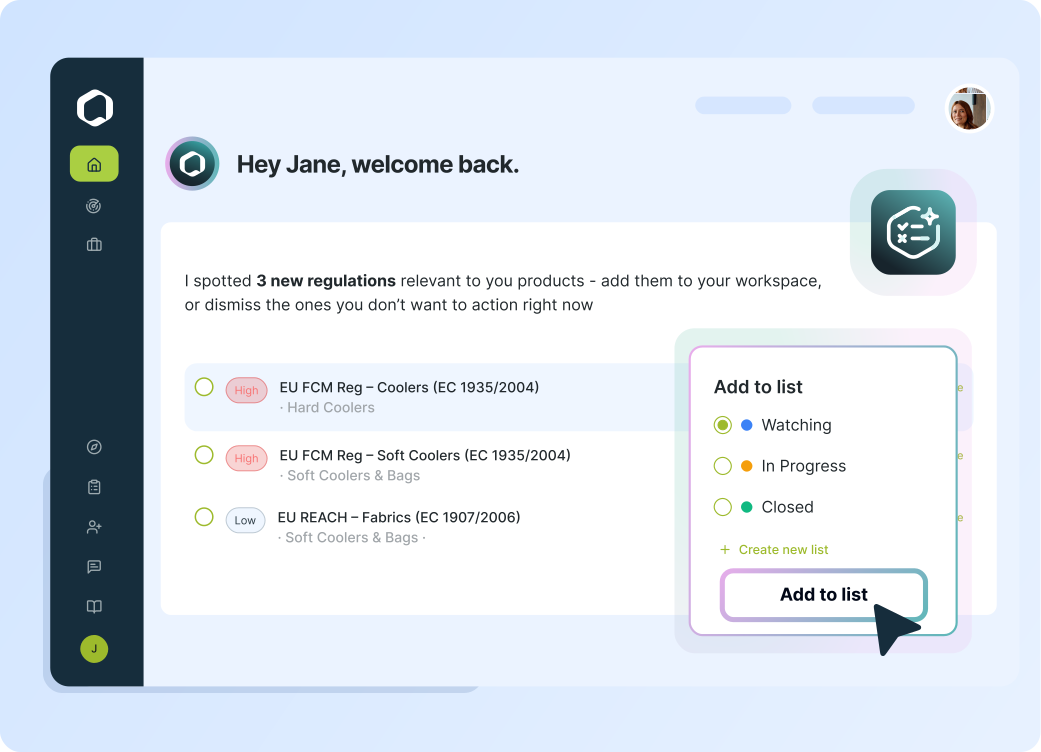
Let AI agents do the heavy lifting of monitoring regulations, mapping requirements to products, extracting obligations, and surfacing the risks that need attention first.
Monitor Product Compliance
Stay Ahead of Regulatory Change
Get early visibility into changes that could affect your products, supply chain, or market access—so you can act proactively, not reactively.
Assess Regulatory Applicability
Map Regulations to Your Products
Eliminate manual research and cut through regulatory noise by surfacing only the requirements relevant to your business, markets, and product categories.
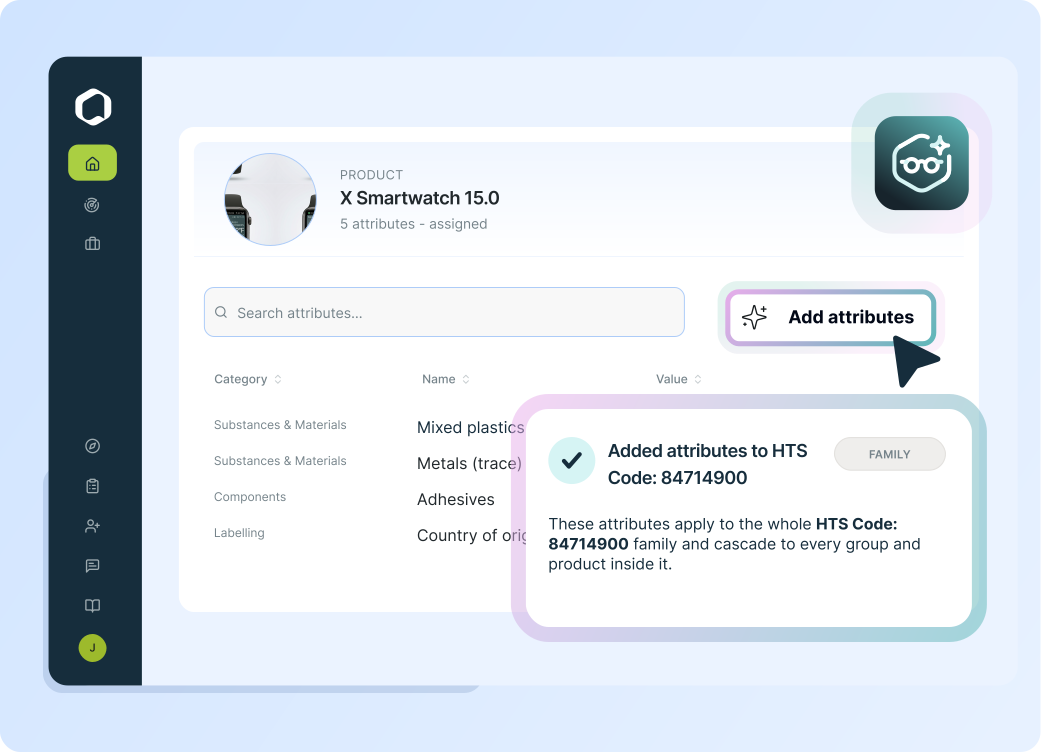
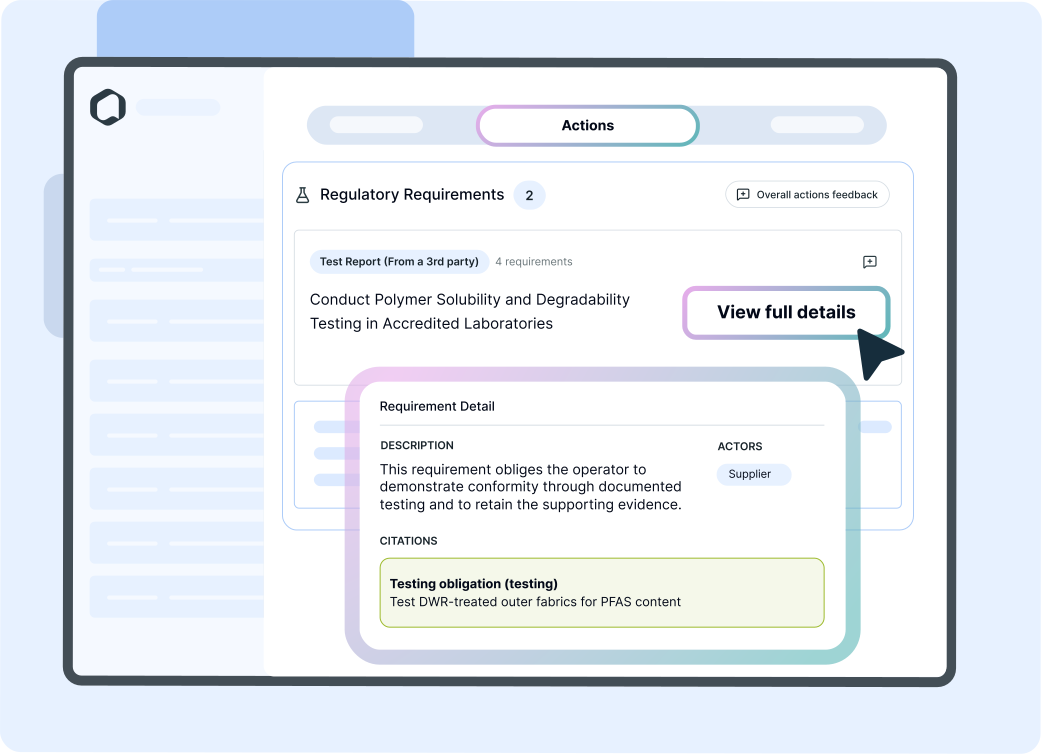
Identify Compliance Requirements
Turn complex regulations into clear, actionable tasks.
Give your teams instant clarity as AI agents transform dense legal and regulatory text into structured, easy-to-understand requirements.
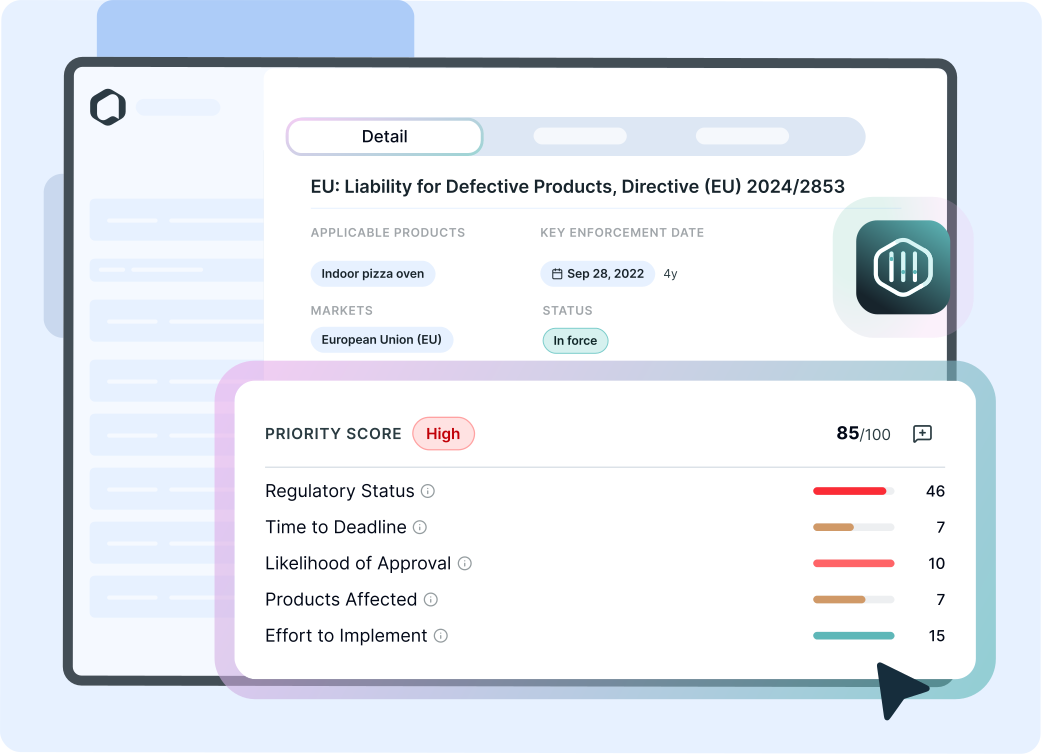
Prioritize Business Risk
Focus Where Risk Is Highest
Make faster, risk-informed decisions with confidence as AI agents automatically rank regulatory changes based on urgency, business impact, compliance deadlines, and product exposure.
Spotlight
Turning Compliance into Value


The State of Product
Compliance 2026
Discover how 500+ global leaders are shifting product compliance from a cost-centre into a strategic driver of growth, with key benchmarks like 69% of teams calling remediation their biggest challenge.
Frequently Asked Questions
-
Companies in scope must publish sustainability information aligned with the EU Sustainability Reporting Standards (ESRS), covering environmental, social, and governance topics. Reporting must be included in the management report, follow specified disclosure formats, and assurance depending on the stage of implementation.
-
The ESG reporting requirements that apply to your company depend primarily on where you are listed or incorporated, your group structure, and your size (revenue, employee count, balance sheet total). Your corporate profile must be mapped against all ESG reporting regulations such as the EU CSRD, the UK SDR, ISSB-based rules, and jurisdiction‑specific listing requirements to establish which obligations are in scope today and which will apply in the future.
-
While the IFRS sustainability disclosure standards, which are in the process of being implemented in jurisdictions around the globe, provide a global baseline focused on financial materiality (how sustainability affects the company’s value for investors), the EU CSRD and ESRS mandate double materiality, requiring companies to also report their external impacts on people and the planet. Structurally, the ESRS are more detailed and prescriptive, encompassing a wider range of mandatory social and governance topics beyond the IFRS’s current primary focus on climate. Despite these differences, the two frameworks are working towards a high level of ‘interoperability’ for climate disclosures, allowing companies to use similar core data points to satisfy both standards.
-
Double materiality means companies must assess and report on sustainability topics from two perspectives: financial materiality (how environmental, social and governance matters affect the company’s value) and impact materiality (how the company affects people, the environment and society). Under the CSRD and ESRS, a topic must be reported on if it is material from either perspective, or both, and companies must disclose the process they use to identify material impacts, risks and opportunities. This approach requires a structured double materiality assessment that often looks beyond the company’s own operations to its value chain and stakeholder impacts.
-
The UK is developing its own Sustainability Disclosure Requirements, which will draw heavily on the ISSB’s IFRS S1 and S2. They are intended to be mandatory for large listed and capital‑market‑oriented entities and financial institutions. Under this framework, the UK government plans to create UK Sustainability Reporting Standards (UK SRS) by assessing and endorsing the global IFRS sustainability standards for use in the UK.
-
In 2024, China issued trial standards for sustainability disclosures, followed by trial standards for climate disclosures in December 2025. While reporting under these frameworks is currently not mandatory, the government intends to establish a unified mandatory reporting system by 2030. In addition, certain Chinese stock exchanges already require listed companies to disclose sustainability information.
More
Regulatory
Topics
Supply Chain Due Diligence
Regulatory Focus ESG: SUPPLY CHAIN DUE DILIGENCE 28 Languages Supported 28 Languages 600 R…
Sustainable Resource Use
Regulatory Focus Sustainable Resource Use 195 Countries Covered 28 Languages 533 Regulator…
Anti Bribery & Corruption
Regulatory Focus ESG: Anti Bribery & Corruption in C2P 195 Countries Covered…
Labor & Employment
Regulatory Focus Labor & Employment 195 Countries Covered 28 Languages 5166 Regulatory…
Human Rights – Affected Communities
Regulatory Focus Human Rights – Affected Communities 195 Countries Covered 28 Languages 26…
Climate Disclosures
Regulatory Focus Climate Disclosures 195 Countries Covered 28 Languages 670 Regulatory Sou…
Human Trafficking & Modern Slavery Compliance
Regulatory Focus Human Trafficking and Slavery (HTS) 195 Countries Covered 28 Languages 40…
Environmental, Social and Governance (ESG) Reporting
Regulatory Focus ESG Reporting 195 Countries Covered 28 Languages 729 Regulatory Sources W…
Comply with Chemical Safety Requirements
Regulatory Focus Chemicals and EH&S: Occupational Health & Safety 195 Countries Co…
Circular Economy Solutions
Regulatory Focus Circular Economy 195 Countries Covered 28 Languages 2748 Regulatory Sourc…
Climate Change
Regulatory Focus Climate change 195 Countries Covered 28 Languages 5653 Regulatory Sources…
Conflict Minerals Regulatory Compliance
Regulatory Focus Conflict Minerals 195 Countries Covered 28 Languages 348 Regulatory Sourc…
Carbon Footprint
Regulatory Focus Carbon Footprint 195 Countries Covered 28 Languages 393 Regulatory Source…
Textiles
Regulatory Focus Textiles 195 Countries Covered 28 Languages 3333 Regulatory Sources Adher…