

Regulatory Focus
Climate Disclosures

Climate Disclosures
195
Countries Covered
28
Languages
670
Regulatory Sources
Our global coverage includes mandatory laws, regulations, and standards—both proposed and enacted—that require companies to report on climate impacts, risks, and opportunities. We also cover voluntary frameworks, guidance, and factsheets, excluding voluntary national standards.
Corporate reporting on climate change requires companies to disclose their overall climate mitigation and adaptation strategies, governance, and risks, creating obligations for transparency, investor accountability, and compliance with evolving disclosure standards.
Companies typically must disclose their greenhouse gas (GHG) emissions across Scope 1, 2, and 3, and report on their strategies and progress toward limiting global warming to 1.5°C under the Paris Agreement. They also need to assess and disclose climate-related physical risks and their adaptation plans to reduce those risks. Climate change mitigation reporting focuses on emissions and reduction efforts, while adaptation reporting covers how companies are preparing for and responding to climate-related hazards.
Scope 1, 2 and 3 emissions are defined as follows:
- Scope 1 – GHG emissions directly owned or controlled by a company (e.g. emissions from a company’s owned vehicles, boilers, etc.).
- Scope 2 – emissions caused indirectly by the company which come from the energy a company purchases or uses for electricity, heating, and cooling
- Scope 3 – all indirect emissions that occur in the company’s upstream and downstream value chain and are not included in Scope 1 and 2 emissions.
Disclosure of climate-related risks and opportunities may be required to follow the double materiality principle i.e. the EU CSRD. These are:
- Financial materiality: assessing to what extent climate-related risks and opportunities would have a significant impact on the company’s financial performances, including cashflow, assets, positions, etc.
- Impact materiality: assessing to what extent climate-related risks and opportunities would have a significant impact on the society and the environment, especially in relation to the company’s value chain.
Our coverage includes mandatory and voluntary climate disclosure frameworks, reporting standards, and guidance used by regulators and financial authorities worldwide. This includes national and regional laws, sustainability reporting standards, and internationally recognized frameworks such as ISSB, TCFD, and TNFD.
- ISSB: Climate-Related Disclosures, Standard IFRS S2, 2023
- ISSB: Climate-Related Disclosures, Standard IFRS S2, 2023 – Amendment – (on clarifying GHG emissions measurement and providing additional relief) Standard, 2025
- Australia: Corporations Act, 2001, and Others – Amendment – (on climate-related financial disclosures) Act No. 87, 2024
- Australia: Climate-related Disclosures, Australian Sustainability Reporting Standards (ASRS) 2, September 2024
- Brazil: Approving Technical Pronouncement No. 02 on Climate-Related Disclosures, Resolution CVM No. 218, 2024
- California (USA): Climate Corporate Data Accountability, Senate Bill 253 Enacted, 2023
- California (USA): Climate Related Financial Risk Disclosures Checklist, Guidance Document, November 2025
- California (USA): Climate Corporate Data Accountability, Senate Bill 253 Enacted, 2023 and Other – Amendment – (on delayed deadline for implementing regulations, consolidation of disclosures at parent company level, etc.) Senate Bill 219 Enacted, 2024
- California (USA): Climate-Related Financial Risk Reporting, Senate Bill 261 Enacted, 2023
- California (USA): Corporate Greenhouse Gas Reporting and Climate-Related Financial Risk Disclosure Initial Regulation, 17 CCR 96070-96077, February 2026
- Canada: Sustainability Disclosure Standard CSDS 2 – Climate-related Disclosures, Standard, December 2024
- Canada: Disclosure of Climate-related Matters, Draft Statutory Instrument No. 51-107, October 2021
- Chile: Establishing the Integrated Annual Report, General Standard (NCG) No. 461, 2021 -Proposed Amendment- (on incorporating IFRS S1 and S2 references), Draft Standard, August 2024
- EU: Sustainability Reporting Standards, Delegated Regulation, July 2023 (specifically ESRS E1 Climate change)
- EU: European Sustainability Reporting Standard (ESRS) E1 Climate Change, Standard, July 2023 – Proposed Amendment – (on simplification and reduction of data points) Draft Standard, July 2025
- EU: Corporate Sustainability Due Diligence (CSDDD), Directive (EU) 2024/1760 and Other – Amendment – (on postponement of deadlines for corporate sustainability reporting and due diligence requirements) Directive (EU) 2025/794 (Stop-the-clock)
- EU: Corporate Sustainability Due Diligence (CSDDD), Directive (EU) 2024/1760 and Others – Amendment – (on reducing companies in scope and deleting sector specific ESRS requirement) Directive (EU) 2026/470
- EU: Content and Presentation of Information to Be Disclosed by Undertakings subject to Articles 19a or 29a of Directive 2013/34/EU, Regulation (EU) 2021/2178 and Others – Amendment – (on simplifying disclosures and technical screening criteria) Regulation, July 2025
- EU: Omnibus Package, Q&A Document, February 2025
- EU: Platform on Sustainable Finance Report: Simplifying the EU Taxonomy to Foster Sustainable Finance, Report, February 2025
- Hong Kong (China): Enhancement of Climate-related Disclosures Under the Environmental, Social and Governance (ESG) Framework, Consultation Conclusions, April 2024
- Hong Kong (China): Implementation Guidance for Climate Disclosures Under the ESG Reporting Framework, Guidance Document, April 2024
- Hong Kong (China): Climate-related Disclosures, Hong Kong Financial Reporting Standard S2, 2024
- Illinois (USA): Corporate Emissions Reporting, House Bill 3673, 2025
- Indonesia: Climate-Related Disclosures, Sustainability Disclosure Standard PSPK 2, 2025
- Japan: Theme-based Sustainability Disclosure Standard on Climate-related Disclosures, Standard No. 2, March 2025
- Japan: Theme-based Sustainability Disclosure Standard on Climate-related Disclosures, Standard No. 2, March 2025 – Amendment – (on alignment with IFRS S2 amendments to greenhouse gas emissions disclosures) Standard, March 2026
- Jordan: Climate-Related Disclosure, Guidance Document, December 2024
- New Jersey (USA): Climate Corporate Data Accountability Act, Senate Bill 4117, February 2025
- New Zealand: NZ CS 1 Climate Standard 1 – Climate-related Disclosures, 2022
- New Zealand: NZ CS 2 Climate Standard 2 – Adoption of Aotearoa New Zealand Climate Standards, 2022
- New Zealand: NZ CS 3 Climate Standard 3 – General Requirements for Climate-related Disclosures, 2022
- New Zealand: Principles for Creating, Keeping, and Maintaining Proper Climate-related Disclosure Records, Guidance Document, October 2023
- New Zealand: Climate-related Disclosures, Guidance Document, May 2023
- South Korea: Sustainability Disclosure Standards, Draft Standard, April 2024
- Switzerland: Mandatory Climate Reporting Obligation for Certain Companies, Ordinance, November 2022
- TCFD: Recommendations of the Task Force on Climate-related Financial Disclosures, Report, June 2017
- TNFD: Nature-Related Risk and Opportunity Management and Disclosure Beta Framework Recommendations, September 2023
- UK: Climate-related Disclosures, Standard SRS S2, February 2026
- UK: Limited Liability Partnerships (Climate-related Financial Disclosure) Regulations, SI 2022/46
- UK: Companies (Strategic Report) (Climate-related Financial Disclosure) Regulations, SI 2022/31
- USA: Enhancement and Standardization of Climate-Related Disclosures for Investors, Final Rule, March 2024




Intelligent Resources

Automate the work of managing regulatory change.
Let AI agents do the heavy lifting of monitoring regulations, mapping requirements to products, extracting obligations, and surfacing the risks that need attention first.
Monitor Product Compliance
Stay Ahead of Regulatory Change
Get early visibility into changes that could affect your products, supply chain, or market access—so you can act proactively, not reactively.
Assess Regulatory Applicability
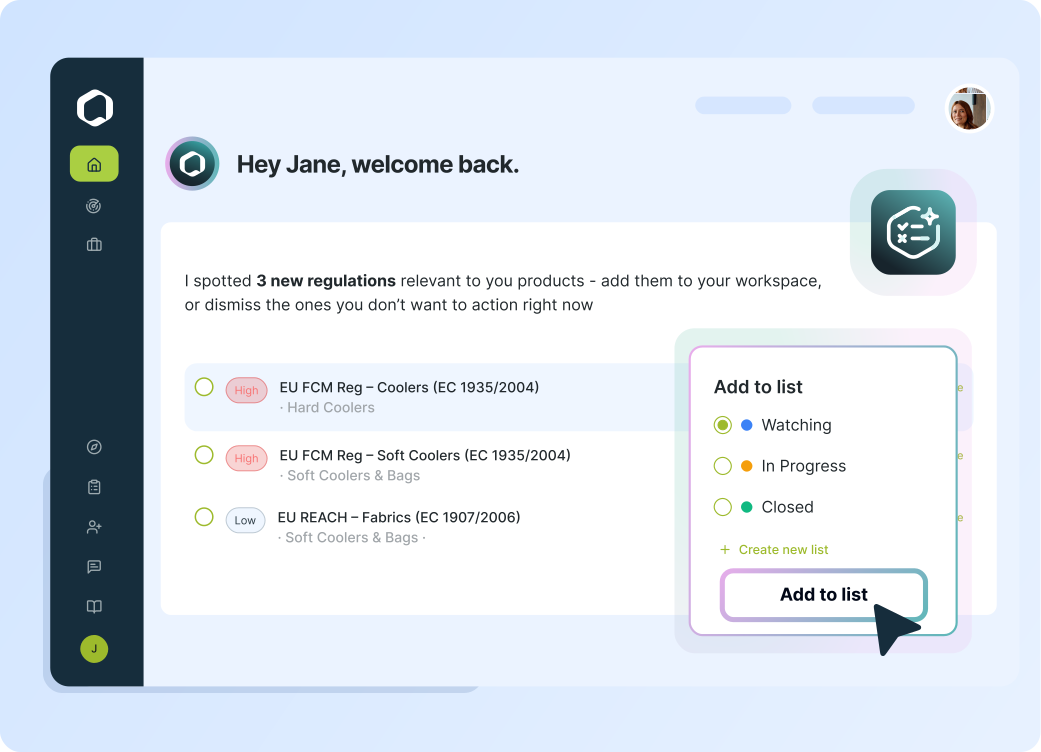
Map Regulations to Your Products
Eliminate manual research and cut through regulatory noise by surfacing only the requirements relevant to your business, markets, and product categories.
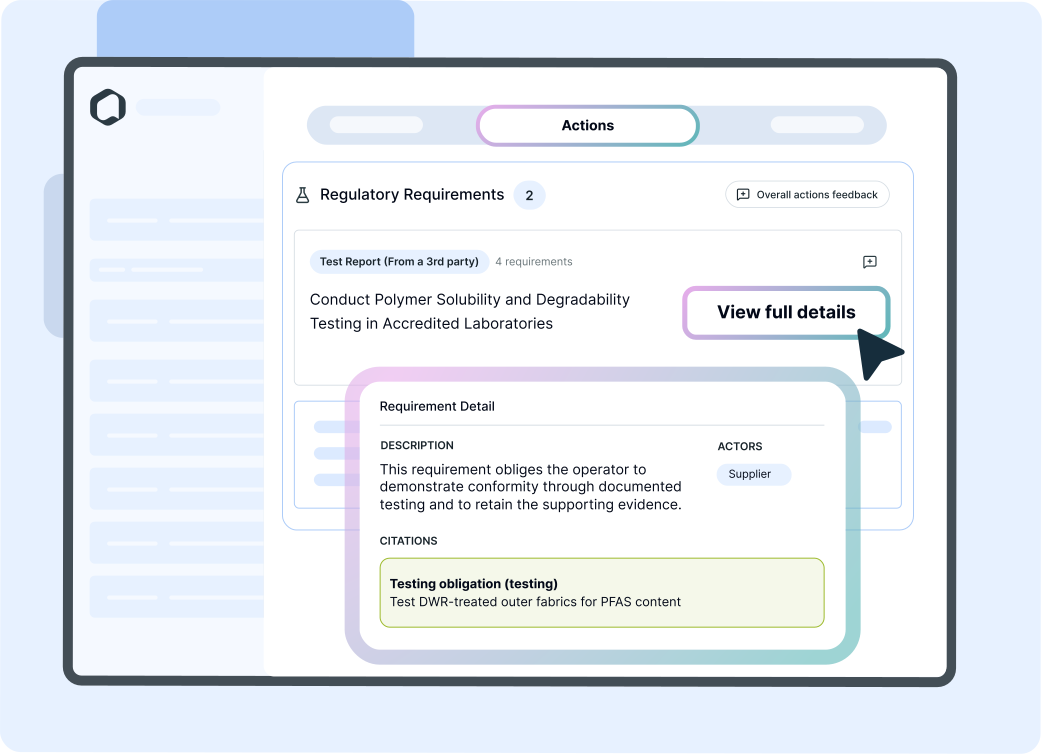
Identify Compliance Requirements
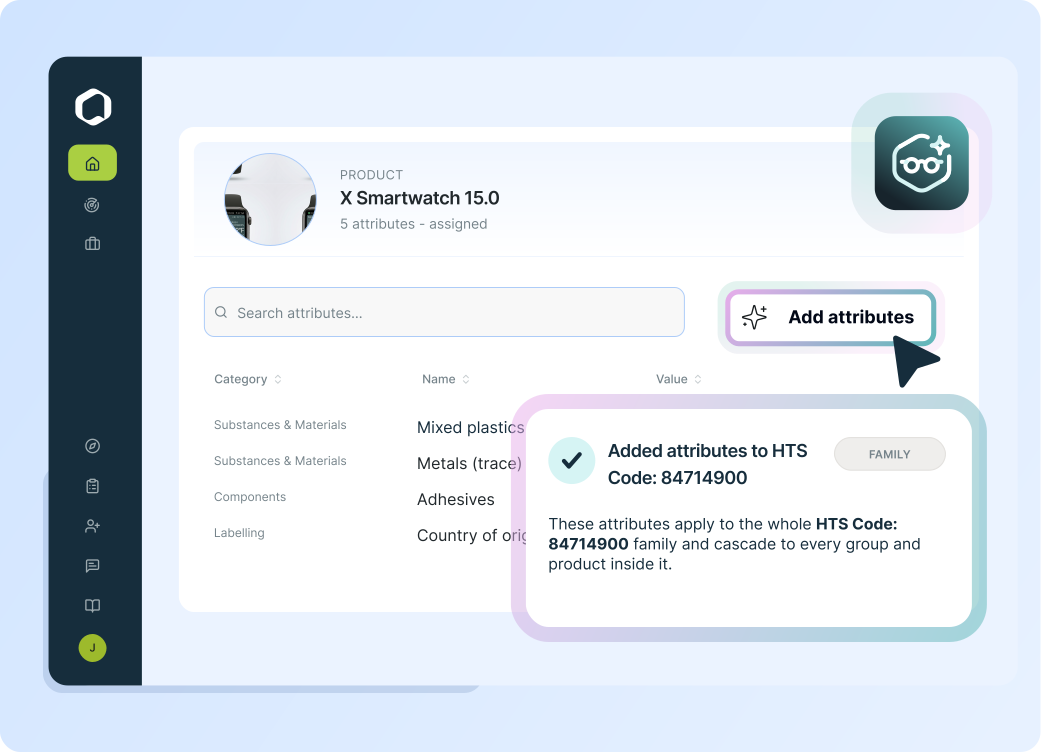
Turn complex regulations into clear, actionable tasks.
Give your teams instant clarity as AI agents transform dense legal and regulatory text into structured, easy-to-understand requirements.
Prioritize Business Risk
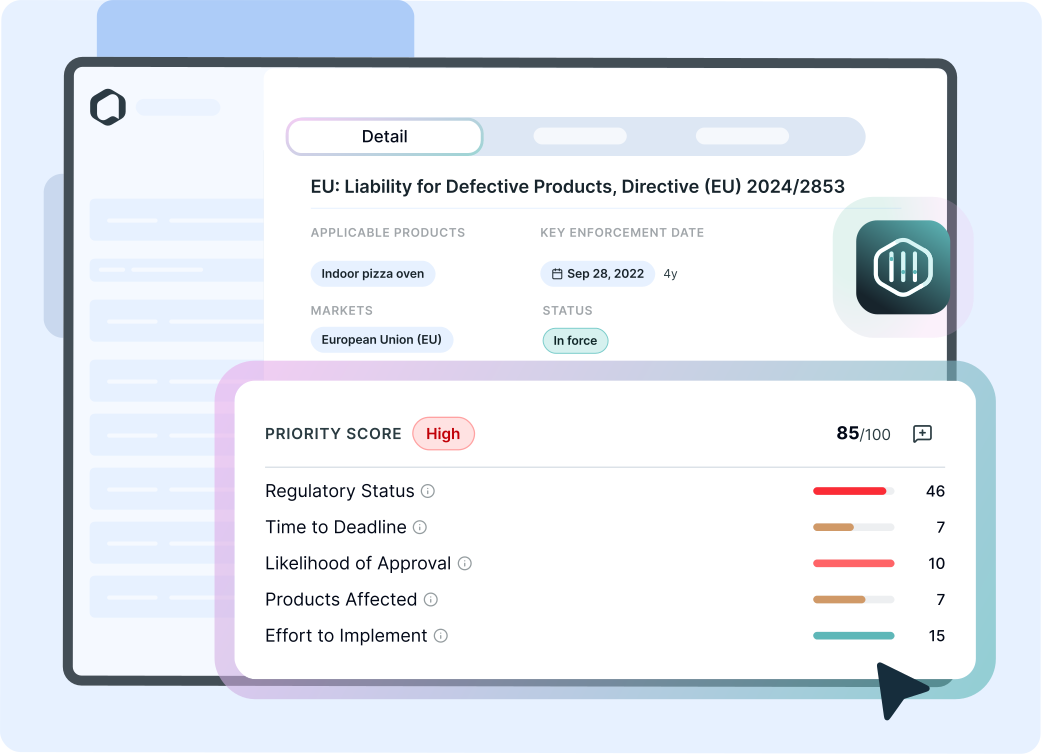
Focus Where Risk Is Highest
Make faster, risk-informed decisions with confidence as AI agents automatically rank regulatory changes based on urgency, business impact, compliance deadlines, and product exposure.
Spotlight
Turning Compliance into Value


The State of Product
Compliance 2026
Discover how 500+ global leaders are shifting product compliance from a cost-centre into a strategic driver of growth, with key benchmarks like 69% of teams calling remediation their biggest challenge.
Frequently Asked Questions
-
The primary global standards and frameworks include the ISSB IFRS S2 (Climate-Related Disclosures) and the TCFD recommendations, both widely referenced by regulators and investors. Many jurisdictions also implement local standards aligned with these frameworks, such as the EU ESRS E1, UK SRS S2, Australia ASRS 2, and Japan’s Climate-related Disclosures Standard No. 2.
-
Companies are generally required to disclose governance, strategy, risk management, and metrics/targets related to climate change, including Scope 1, Scope 2, and Scope 3 GHG emissions. Disclosure obligations also cover climate-related risks, opportunities, transition plans, and alignment with frameworks such as ISSB/TCFD, as well as jurisdiction-specific rules in the EU, US, UK, Japan, Australia, Canada, and others.
-
Climate disclosures are mandated in California by SB 253 Enacted or the Climate Corporate Data Accountability Act and SB 261 Enacted or the Climate Related Financial Risk Act. SB 253 requires US-based companies doing business in California with revenues more than $1B to disclose their Scope 1, 2 and 3 emissions whereas SB 253 requires similar companies with a lower revenue threshold of $500M to disclose climate-related financial risks. Currently, the California Air Resources Board (CARB) is finalizing the implementing rules for both SB 253 and SB 261 while SB 261’s enforcement is on pause pending a US District Court ruling.
-
It depends on the jurisdiction and their approach. Some countries and regions focus on listed companies and thus regulate disclosures by mandating sustainability reports in addition to regular financial reports submitted to the equivalents of securities exchange committees (SEC). Other jurisdictions take a more expansive approach and regulate such disclosures targeting all public-interest companies by producing regulations from environmental protection competent authorities like the California Air Resources Board (CARB).
-
Not necessarily. Regulations and laws on climate disclosures often require companies who need to report to submit climate-related risks and opportunities along with emissions data to governmental databases but often these reporting obligations also mention a duty to publish the reports online or in other publicly accessible means.
More
Regulatory
Topics
Climate Change
Regulatory Focus Climate change 195 Countries Covered 28 Languages 5653 Regulatory Sources…
Supply Chain Due Diligence
Regulatory Focus ESG: SUPPLY CHAIN DUE DILIGENCE 28 Languages Supported 28 Languages 600 R…
Environmental, Social and Governance (ESG) Reporting
Regulatory Focus ESG Reporting 195 Countries Covered 28 Languages 729 Regulatory Sources E…
Sustainable Resource Use
Regulatory Focus Sustainable Resource Use 195 Countries Covered 28 Languages 533 Regulator…
Labor & Employment
Regulatory Focus Labor & Employment 195 Countries Covered 28 Languages 5166 Regulatory…
Anti Bribery & Corruption
Regulatory Focus ESG: Anti Bribery & Corruption in C2P 195 Countries Covered…
Human Rights – Affected Communities
Regulatory Focus Human Rights – Affected Communities 195 Countries Covered 28 Languages 26…
Human Trafficking & Modern Slavery Compliance
Regulatory Focus Human Trafficking and Slavery (HTS) 195 Countries Covered 28 Languages 40…