Options to Step Up EU Action Against Deforestation
Overview Following on from the EC study published in 2013, a new feasibility study was published in January 2018 on options to step up EU action against deforestation (focusing on 12 forest risk commodities (FRCs[1])), as a test of the EU’s commitment to halve deforestation by 2020. Deforestation is the permanent conversion of forest land into other land-uses. The EC study from 2013 on the impact of EU consumption on deforestation reported that the EU27 both imported and consumed approximately 7-10% of the global consumption of crops and livestock linked to deforestation. The study’s objective was to inform the EU on how to create a more coherent and comprehensive approach to deforestation. The report concluded that due to the complexity of the problem, any potential EU initiatives designed to deliver zero deforestation would need to address both supply and demand side measures as well as finance and investment within potential interventions whilst also building on government and private sector commitments. These changes will have a significant impact on businesses sourcing FRCs. One factor driving deforestation is the growth of urban markets and industrialization within sectors that rely on forest resources (e.g. pulp and paper). The consumption of paper and board will grow by approximately 150 Mt by 2020 (compared to 2011; Indufor, 2012). Figure 1. Global forecasts for paper and board consumption 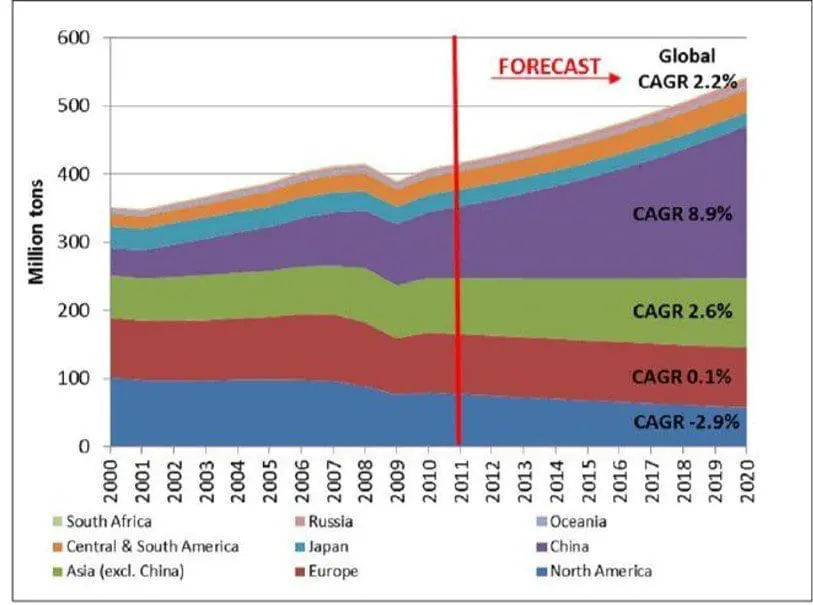 Possible EU interventions to achieve deforestation free supply chains by 2020[2]
- Building on existing measures and legislation (including supporting jurisdictions to improve monitoring, governance and land use planning, expanding transparency platforms and better assistance to small holders).
- Introducing new, non-legislative actions (such as using jurisdictional REDD+ projects to promote sustainable deforestation free agricultural production, encouraging private sector initiatives, encourage lower consumption of FRCs and consumer information campaigns).
- Introducing new legislative actions such as placing mandatory due diligence on companies importing and consuming FRCs, to improve supply chain traceability.
What are the risks for companies?
- There is a concern that deforestation free policies are displacing the negative impacts of deforestation from sourcing commodities to other locations and therefore are not that effective.
- Companies may face a reputational risk as sustainable behaviours are increasingly reported against and a poor performance against good intended actions can lead to criticism.
- Due to a growing number of new initiatives monitoring FRCs, company information is also being disclosed. Therefore, companies need to act quickly to ensure reduced exposure of supply chain information and/or production areas.
- There is also a risk associated with the cost and difficulty of attracting finance to change and move towards sustainable behaviours.
NGO Response In response to the feasibility study, several organisations have reflected on the importance and the impacts that the new study could have for reducing deforestation with interest increasing leading to the 2020 commitments[3]. Several environmental NGOs have all repeatedly called on the EU to act in order to meet its international commitments to halt deforestation by 2020[4]. NGOs have stressed the importance of social considerations in EU policies such as tenure rights and support to communities[5]. Additionally, they stress the urgent requirement for environmental regulation as voluntary commitments to zero deforestation do not work alone. The 2015 Modern Slavery Act is a key example of an introduced legislation that has had a key impact on companies. Traceability is also a key issue, with only 2% of palm oil companies and 14% of soy companies in 2016 tracing their products back to its origin[6]. Conclusions Currently, it is not known how the EC will follow up on this publication to address negative social and environmental impacts associated with the imports and consumption of agricultural products. Moreover, it is unclear on how future legislation may impact companies, but there is a clear shift towards an awareness of sustainability and consequently the challenges. Please let us know if you have any questions or comments to this article at info@efeca.com. [1] These include; palm oil, soya, rubber, beef (meat/ leather), maize, cocoa, coffee, natural rubber, tropical non-coniferous timber, pulpwood, wood pellets, biodiesel feedstock and bioethanol feedstock. [2] For a full list of interventions see page 17-20 of the 2018 feasibility study [3] http://www.ngoforestcoalition.org/european-commissions-studies-on-tackling-deforestation-and-impact-of-palm-oil [4] https://eia-international. org/eyes-european-commission-crucial-eu-decision-deforestation-due-matter-weeks/ [5] https://www. euractiv. com/section/climate-environment/opinion/commission-study-shows-path-to-end-agricultural-deforestation-now-it-must-act/ [6] Progress on the New York Declaration on Forests. Eliminating Deforestation from the Production of Agricultural Commodities. Goal 2 Assessment Report. November 2016. If you would like to find out how you can stay on top of regulatory issues related to illegal logging, sign up to our newsletter here.

Sign up to our

Monthly Market Insights
Our Connect Newsletter delivers the latest regulatory developments, trends and expert insights straight to your inbox.