Getting Leadership to Say Yes: The Compliance Business Case

THIS BLOG WAS WRITTEN BY THE ADHERENT MARKETING TEAM TO INFORM AND ENGAGE. HOWEVER, COMPLEX REGULATORY QUESTIONS REQUIRE SPECIALIST KNOWLEDGE. TO GET ACCURATE, EXPERT ANSWERS, PLEASE CLICK ASK AN EXPERT.
Quick Answer
Compliance leaders lose funding not because the risk is small but because the case is written in regulatory language for people who make commercial decisions. A business case that survives scrutiny contains four things: the specific decision you are asking for, the quantified commercial consequence of not making it, two or three options with costs, and a recommendation. Regulatory detail belongs in an annex. The body should read as a commercial proposal.
Table of Contents
- Key Takeaways
- What Does a Compliance Business Case Need to Contain to Survive Scrutiny?
- How Do You Present Compliance Risk to Decision-Makers Who Do Not Live in it?
- How Do You Resolve Common Objections to a Compliance Business Case?
- How Do You Reach One Agreed Compliance Level Across All Markets?
- FAQ
Key Takeaways
- A compliance business case wins on the commercial consequence of the decision, not on the regulatory detail behind it.
- Every case needs four things: the decision being asked for, the quantified consequence of inaction, the options with costs, and a recommendation.
- Present risk in the decision-maker’s currency: revenue at stake, market access, time to remediate. Not regulation names and article numbers.
- The recurring objections are predictable, so pre-answer them inside the case rather than in the meeting.
- One agreed compliance level across markets usually means governing to the strictest applicable requirement, with documented exceptions where the cost is not justified.
What Does a Compliance Business Case Need to Contain to Survive Scrutiny?
Four parts:
- The specific decision you are asking leadership to make.
- The quantified commercial consequence of not making it.
- Two or three options with costs and trade-offs.
- A clear recommendation.
Lead with the decision, not the regulation
Name exactly what you need: a budget figure, a headcount, a policy position, or a go or no-go on a market. A case that opens by explaining a regulation asks the reader to work out what is being requested, and most readers will not.
Quantify the consequence commercially
Revenue at risk, market access lost, recall and penalty exposure, time to remediate, and the cost of delay. A number with a stated range and a sourced assumption behind it is worth more than a severity rating, because it can be compared against other things competing for the same money.
Always present options
Do nothing, minimum viable, and recommended is usually enough. Leadership approving a single demand is a weaker outcome than leadership choosing between priced alternatives, and the choice is what creates ownership of the result.
Four things make a case survive scrutiny specifically: assumptions that are sourced rather than asserted, ranges rather than false precision, a named owner, and a decision deadline tied to an actual regulatory date. That last one is the difference between a request and a decision that has to be made.
Keep the regulatory detail in a supporting annex. It should be available and it should not be the argument. The body reads as a commercial proposal; the annex proves you did the work.
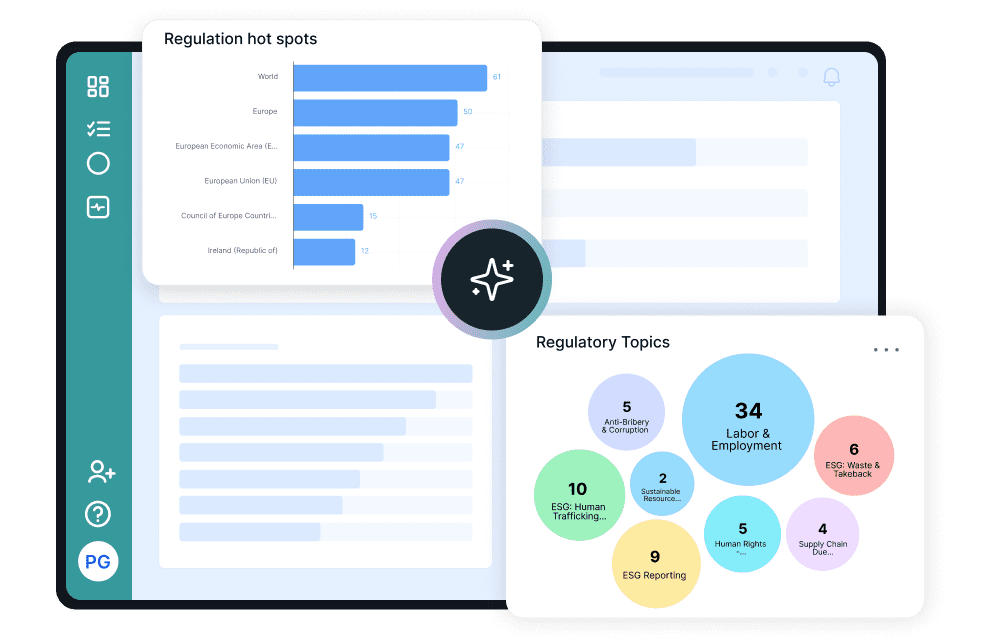
The consequence numbers depend on knowing which requirements actually apply to which products, which is why the applicability picture underneath matters. Adherent’s figures put the average at 1,002 regulations for a new product entering a single market, and a case built on a guess about which of those bite will not survive a finance review.
How Do You Present Compliance Risk to Decision-Makers Who Do Not Live in it?
Present risk in the decision-maker’s currency. Translate regulatory exposure into money, market access, time, and reputation, and leave the statute names out of the pitch entirely.
Anchor with one concrete example rather than a catalogue. A comparable recall, market ban, or enforcement action in your own category does more work than a list of regulations, because it makes the abstract consequence real to someone who has never read one. The real cost of non-compliance sets out how that exposure compounds once a launch is committed.
Use a single headline figure with a defensible range. A wall of regulations reads as complexity, which executives discount. One number with a visible method reads as analysis, which they can act on.
Frame the decision as a comparison: cost of acting against probable cost of not acting. That framing is what turns a spending request into an investment decision, and it is the shift from cost center to competitive edge describes.
Tailor by audience. Finance wants exposure and return. Product wants timeline impact and what it does to the roadmap. The chief executive wants market access and reputational consequence. The same case usually needs three different first slides.
State your confidence and what would change it. Compliance leaders often over-claim certainty to sound authoritative, which backfires the first time a number moves. Saying which assumption is soft, and what monitoring would firm it up, builds more credibility than precision you cannot defend.
That last point is where continuous monitoring earns its place in the argument. Adherent tracks an average of 217 regulatory changes per month globally, and being able to say what changed this month and what it costs is what turns “we think” into a position. Compliance monitoring covers how that intake is structured.
How Do You Resolve Common Objections to a Compliance Business Case?
Pre-answer them inside the case. The recurring objections are predictable enough that meeting them live is a choice rather than a necessity.
Five come up almost every time.
Is the risk real? Answer with enforcement precedent and confirmed applicability, not conviction. The strongest version names a comparable action against a comparable company, and shows the specific products of yours that are in scope.
Why now? Tie it to a regulatory effective date and show the cost of delay. Where the date is fixed and lead times are long, the decision window closes well before the compliance date, and that gap is the argument. Regulatory forecasting what makes the window visible early enough to use.
Can we wait? Show what waiting costs in compounding terms: shorter remediation windows, fewer options, higher cost per option. Waiting is a decision with a price, and pricing it is more persuasive than warning against it.
Can we do it cheaper? Present the minimum viable option honestly, and be explicit about what it forfeits. A team that has already costed the cheap option is trusted on the recommended one.
Is this not legal’s job? Clarify ownership and the cross-functional dependency. Compliance owns the requirement and the evidence. Design, sourcing, and quality own the changes. Legal owns interpretation where scope is genuinely contested.
Handle the no-data objection directly rather than defensively. Acknowledge the uncertainty range and name what would close it.
Put a short objections and responses section in the written case. It signals the thinking is done, and it moves the meeting from interrogation to decision.
How Do You Reach One Agreed Compliance Level Across All Markets?
One agreed level usually means governing to the strictest applicable requirement, with documented exceptions where the cost in a specific market is not justified.
The reason to default to the strictest is operational rather than moral. Maintaining different product specifications, evidence standards, and controls per market multiplies cost across design, manufacturing, and documentation. A single higher standard is often cheaper than several lower ones once the coordination overhead is counted, and a regulatory crosswalk across overlapping frameworks is how you find where the strictest line actually sits.
The reason to allow exceptions is that the rule is not universal. Where meeting the strictest standard in a small market would require a separate product variant or a disproportionate testing programme, an exception can be the better decision. It just has to be a decision.
Document each exception with its market, its rationale, its accepted exposure, and its owner. An exception recorded this way is a governed position. The same exception undocumented is a gap that will read as an oversight when someone finds it.
Getting to one agreed level is mostly a sequencing problem. Bring the level decision to leadership once, with the exceptions proposed inside it, rather than returning market by market. Repeated small asks train an organisation to treat compliance as a stream of interruptions. A single governed decision with named exceptions is one conversation and one artifact.
The artifact itself is small: a one-page compliance level statement per market and product family, with the reasoning and a signature. It is what you point to when the question comes back in a year, and it is what makes the next case shorter, because the framework is already agreed and only the numbers are new.
FAQ
- How long should a compliance business case be?
Short enough that the decision, the consequence, the options, and the recommendation fit on one or two pages. Everything else is an annex. Length signals thoroughness to the author and cost to the reader. - What if leadership approves less than the recommendation?
Record what was approved and what exposure was accepted as a result. A documented accepted risk is a legitimate governance position, and it is also the fastest route to a different answer next cycle when circumstances change. - Should the case include a regulatory summary?
In the annex, yes. In the body, no. The body answers what happens to the business, and the annex proves the regulatory basis for those numbers. - Who should present it?
Compliance should own the case and present it, with finance validating the numbers beforehand. Cases presented by finance on compliance’s behalf tend to lose the market-access argument, which is usually the strongest part. - What is the most common reason a case fails?
No specific ask. Cases that describe a risk without naming the decision produce discussion rather than approval, and the discussion rarely reconvenes.
See Adherent in Action
Discover how agentic AI is reshaping product compliance for global enterprises.

The Ultimate Product Compliance Playbook
What the World’s Leading Product Organizations Have Figured Out About Product Compliance