Built to be Trusted: The AI Architecture Behind Adherent

This blog was originally posted on 22nd June, 2026. Further developments may have occurred after publication. To keep up-to-date with the latest compliance news, sign up to our newsletter.
AUTHORED BY ERIC FARR, CHIEF TECHNOLOGY OFFICER, ADHERENT
Three patent-pending innovations that make product compliance defensible at scale.
When I joined Adherent four and half years ago, I learned quickly what a tough job product compliance teams have. The stacks of dense regulatory documents pile up relentlessly. We were doing a great job of making sure our customers never missed one, but as a technology optimist, I wanted to give our users a list of what to do instead of a stack of PDFs to read. The initial release of Adherent platform delivers vision. The first and most important step is getting the assessment right. Which regulations apply to this product?
Most alternatives in the market today cannot even answer the simpler question that comes first: What regulations exist? They rely on whatever the language model happened to absorb during training, supplemented with live internet search, and call that coverage – meaning the regulation that matters to your product may simply never enter the conversation. And even when one does, the answer is a probabilistic guess generated fresh each time the system is asked, with no guarantee that the same question will return the same answer.
Adherent starts from the opposite foundation: a curated, comprehensive regulatory database of 120,000+ regulations across 195 countries, and an architecture in which every applicability decision against it is traceable and repeatable.
When we set out to build Adherent – the platform succeeding the regulatory intelligence system Compliance & Risks has run for global enterprises – we made a different bet. We built the platform around the premise that AI must produce deterministic artifacts under deterministic constraints, and that every applicability decision must be traceable to specific words in a specific document. Today, alongside the platform’s general release, we are also disclosing the three patent applications we have filed on the technology that makes this possible.
Innovation 1: A Canonical Logical Gate Model
Our first filing covers the logical gate model: a structured, schema-constrained representation that distills a regulation into a small, ordered set of decision points. Each regulation we ingest is converted into a canonical sequence of normalised logical structures from within the regulatory text. The model applies schema-level constraints to ensure consistent interpretation and execution across jurisdictions and regulatory domains. Each logical element is linked directly to supporting evidence in the source material, including citations, identifiers, and quoted text. The framework is deliberately extensible: new forms of regulatory logic can be added over time without changing the underlying structure that keeps assessments consistent, explainable, and repeatable.
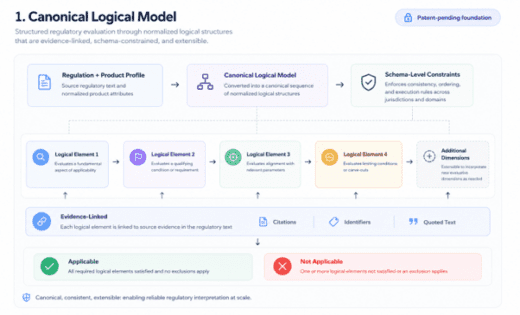
The logical gate model distills our twenty-five years of regulatory expertise into a tight structure that enables an AI reasoning model to quickly assess a regulation’s applicability to a product. Through our testing, we have found this to be the fastest and most accurate way to match regulations to products.
For a compliance team, this means every applicability decision the platform produces is traceable to specific words in a specific regulation.
Innovation 2: A Validator-Enforced Refinement Loop
Producing those gate models reliably is a challenge in its own right. A language model on its own will sometimes invent gates that are not supported by the source text, omit exemptions, or violate the canonical ordering.
Trusting the first draft – or even the third – is exactly how compliance systems fail in production.
Our second filing covers the Architect / Critic / Fixer refinement loop. An Architect model generates a candidate gate model. A deterministic validation suite then checks it against six independent constraints – schema, gate ordering, reachability, required gates, evidence integrity, and outcome shape. If errors are extensive, a Critic model produces a structural patch addressing the validator’s findings. If only a small number of minor errors remain, a lightweight Fixer model applies surgical corrections. The validator re-runs after every patch, the loop is bounded with plateau detection, and any artifact that does not converge is routed for manual review rather than allowed downstream.
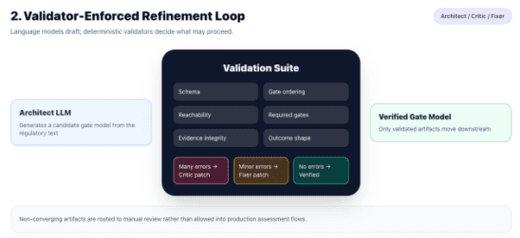
The architectural point is subtle but important: we do not ask the language model to be correct. We require that any artifact moving downstream has already passed deterministic verification. Hallucination is contained at the system boundary, not at the prompt.
This allows our users to trust that the decision logic at the heart of our regulatory assessments is sound and free of dreaded hallucinations.
Innovation 3: Isolated, Repeatable, Parallel Assessments
Our third filing covers the assessment execution model: how those gate models are actually used to determine applicability across a real compliance estate. Each regulation’s gate model is generated once and persisted, along with the structured attributes we maintain for each regulation. Assessment then proceeds in two stages.
First, deterministic filters operating on those regulation attributes rule out the regulations that can be eliminated without reasoning. Multiple filter passes eliminate many of the regulations without invoking AI at all.
For the regulations that survive the filters, a reasoning model then evaluates the canonical gate model against the product profile, producing a structured applicability outcome along with the rationale and source evidence used to reach it. The outcome is persisted, so subsequent queries against the same regulation and product profile draw from the stored result rather than re-invoking AI.
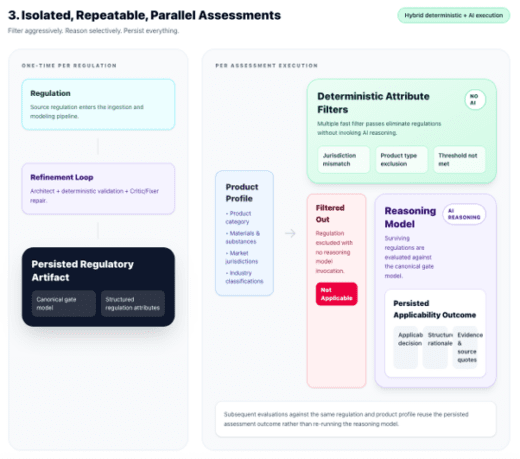
This isolation is what lets us run a single product profile against tens of thousands of regulations in parallel, and what lets a compliance officer pull up an assessment from two years ago and see exactly why a regulation was found applicable – anchored to the specific gate, the specific evidence, the specific source quote. Cross-regulation reasoning happens above this layer, on top of a foundation that holds still.
For a compliance team, this means we can handle hundreds of products being assessed against thousands of regulations without compromising accuracy.
What This Unlocks
These three innovations are not academic. The platform has processed roughly 45,000 regulatory documents, totaling 1.2 million pages, and will support hundreds of thousands of product profiles across our customer base. Every applicability outcome in that corpus is anchored to a specific gate in a specific gate model, with the source evidence a single click away.
For a compliance leader, this changes what the tool is for. It is not a faster search interface. It is an assessment system whose outputs you can put in front of a regulator, an auditor, or a customer’s procurement team – and trust. For a technical evaluator looking at the platform, it is the answer to the question that has quietly killed every previous wave of AI-in-compliance: how do you know it didn’t just make this up?
Foundation, Not Finish Line
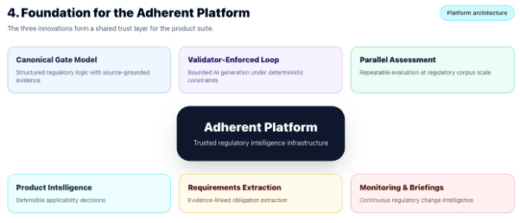
The three patent filings are the floor we are building on, not the ceiling. Sitting atop this architecture are the product intelligence agents, the requirements-extraction pipelines, and the monitoring layers that translate applicability into action. That’s the next crucial step our team has built to deliver on “tell me what to do, not what to read” for our customers, and will be the subject of future posts.
What we wanted to make clear at launch is this: Adherent did not bolt AI onto a compliance product. We crafted our decades of product compliance knowledge into an innovative AI architecture designed to give the compliance team what it most needs: actionable insight it can trust. The first three patents we have filed represent some of the most important investments we’ve made. I’m as proud of the team that invented it as I am of the product we’ve delivered… and we’re just getting started!
Welcome to Adherent.
See Adherent in Action
Discover how agentic AI is reshaping product compliance for global enterprises.


The Ultimate Product Compliance Playbook
What the World’s Leading Product Organizations Have Figured Out About Product Compliance