EU Digital Battery Passport Breakdown
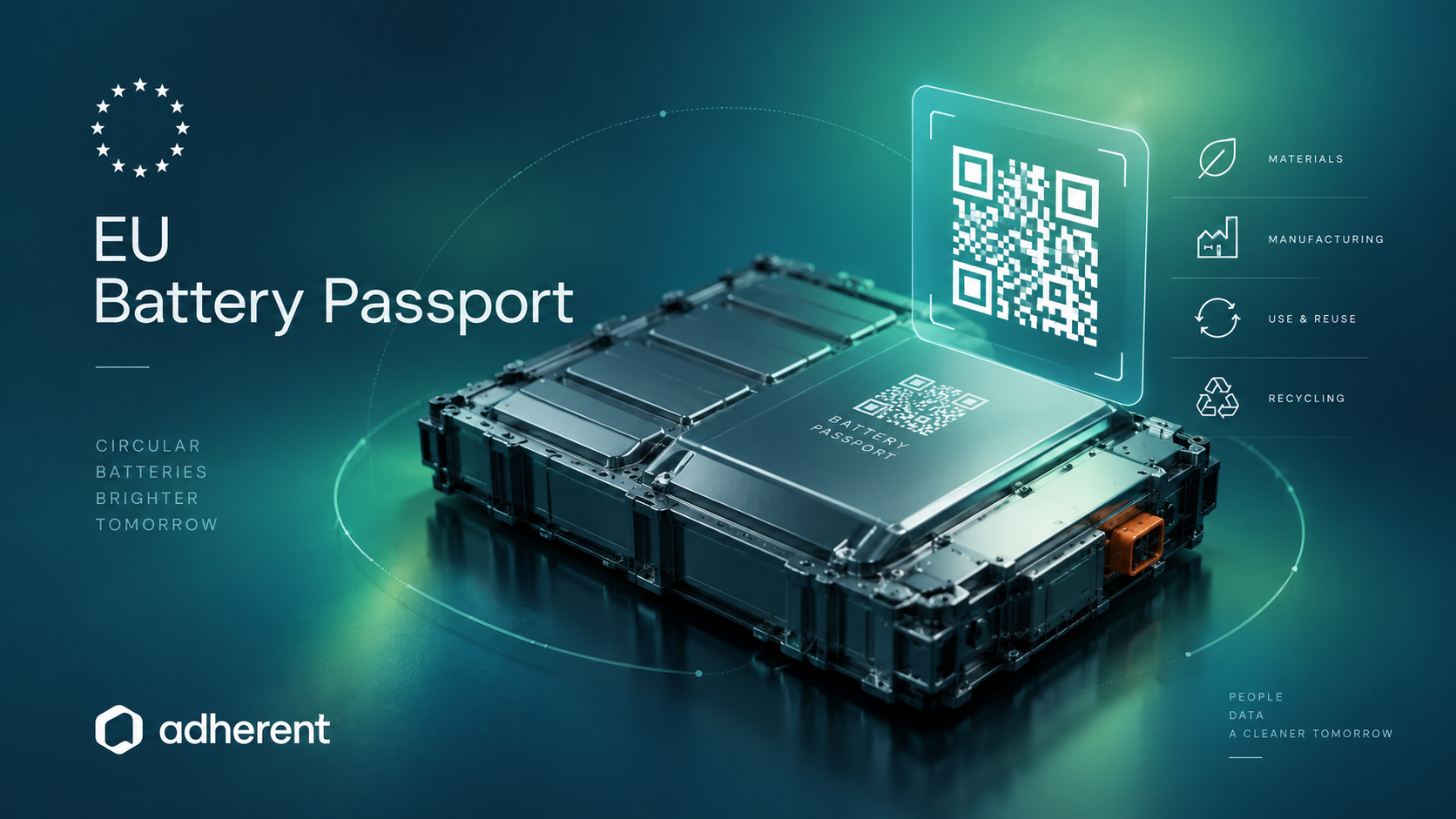
This blog was originally posted on 15th September, 2026. Further regulatory developments may have occurred after publication. To keep up-to-date with the latest compliance news, sign up to our newsletter.
AUTHORED BY ANDREW O’NEILL, REGULATORY COMPLIANCE SPECIALIST, ADHERENT
Table of Contents
- Introduction
- Mock Lithium-Ion Industrial Battery Passport
- Battery Identification
- Performance and Durability
- Sustainability and Materials
- Conformity and End-of-life Information
- Restricted Technical Information
- Regulatory Test Information
- Individual Battery – Current Condition
- Lifecycle and Status History
- Example Future Status Change
- What the Public-facing Passport Could Look Like
- How the Passport is Structured
Introduction
The EU Battery Passport is set to become one of the most significant new digital compliance requirements introduced under Regulation (EU) 2023/1542 concerning batteries and waste batteries. From 18 February 2027, electric vehicle batteries, light means of transport batteries and industrial batteries with a capacity above 2 kWh will need to be accompanied by a digital battery passport containing structured information about the battery’s identity, composition, performance, sustainability characteristics, compliance status and lifecycle.
Unlike a traditional label or technical document, the Battery Passport is designed to remain connected to the battery throughout its life. Some information will be publicly accessible, while more detailed technical, dismantling and compliance data will be restricted to parties with appropriate access rights. Certain data may also change over time, such as state of health, remaining capacity, cycle count and battery status, meaning that the passport must function as a living digital record rather than a one-off declaration.
While the Regulation defines the information that must be made available, it does not prescribe a single visual template that every manufacturer must use. This creates an important implementation question for businesses: what should a compliant Battery Passport actually look like in practice?
In this article, we use a mock lithium-ion industrial battery passport to illustrate how the required information could be structured. We then break down each section to explain what information belongs in the passport, who should be able to access it, and how the different data layers work together to create a complete digital record of the battery.
Mock Lithium-Ion Industrial Battery Passport
| PowerCore 48-100 Rechargeable lithium-ion industrial battery Battery category: Industrial battery (>2 kWh) Chemistry: Lithium-ion – NMC Rated energy: 4.8 kWh Status: Original |
Illustrative example – not an official EU form
The EU Batteries Regulation does not prescribe a single visual passport layout. This report shows one practical way to organise the required information and access layers. All companies, identifiers, specifications and lifecycle values in this example are fictional.
Why This Battery Needs a Passport
From 18 February 2027, each light means of transport battery, each electric vehicle battery and each industrial battery with a capacity greater than 2 kWh that is placed on the EU market or put into service must have an electronic battery passport. This worked example uses a 48 V, 100 Ah industrial battery rated at 4.8 kWh.
The passport combines model-level information with information specific to the individual battery. It also separates public information from restricted technical information and from compliance evidence reserved for authorities.
Battery Identification
This section establishes the digital identity of the battery and links the physical product to its electronic record. The individual battery is distinguished from the broader model through its serial number and unique identifier.
| Battery manufacturer | Example Energy Systems GmbH |
| Manufacturer address | Example-Strasse 20, 20457 Hamburg, Germany |
| Manufacturer contact | batteryinfo@example-manufacturer.eu |
| Battery model | PowerCore 48-100 |
| Battery category | Industrial battery |
| Battery technology | Rechargeable lithium-ion |
| Battery chemistry | Lithium-ion – Nickel Manganese Cobalt (NMC) |
| Nominal voltage | 48 V |
| Rated capacity | 100 Ah |
| Rated energy | 4.8 kWh |
| Battery weight | 42.5 kg |
| Serial number | PC48100-270315-001234 |
| Manufacturing date | 15 March 2027 |
| Manufacturing location | Hamburg, Germany |
| Passport responsible operator | Example Energy Systems GmbH |
| Unique battery identifier | DEMO-EU-BAT-PC48100-001234 |
| QR code and unique identifier The passport is accessed through the QR code required by Article 13(6). The QR code links to a unique identifier attributed to the battery by the economic operator placing it on the market. The identifier shown here is a non-production demonstration value. |
Performance and Durability
Performance data gives users a technical baseline for the battery when new and provides a reference point against which the condition and residual value of the individual battery can later be assessed.
| Rated capacity | 100 Ah |
| Nominal voltage | 48 V |
| Maximum voltage | 54.6 V |
| Minimum operating voltage | 39 V |
| Rated energy | 4.8 kWh |
| Original power capability | 5 kW continuous |
| Peak power capability | 8 kW |
| Expected cycle life | 6,000 cycles |
| Reference end-of-life capacity | 80% of original capacity |
| Initial round-trip energy efficiency | 94% |
| Initial internal resistance | 18 mOhm |
| Recommended charging temperature | 0 C to 45 C |
| Recommended discharge temperature | -20 C to 55 C |
| Recommended storage temperature | -10 C to 35 C |
| Commercial warranty | 5 years / 4,000 cycles |
| Model-level baseline The values on this page describe the battery model at market placement. Individual-battery performance can then be compared against this baseline as the battery ages, changes status or enters a second-life use. |
Sustainability and Materials
The passport also acts as a structured location for sustainability and material information. Not every future-facing field will necessarily contain a value on the first day of the passport obligation; the system should be designed to accommodate data as the relevant requirements become applicable.
| General chemistry | Lithium-ion – NMC |
| Critical raw materials present | Lithium, cobalt, nickel, graphite |
| Carbon footprint declaration | Field reserved for applicable carbon-footprint information |
| Carbon footprint supporting study | Public link to be provided when applicable |
| Recycled content – cobalt | Field reserved for applicable declaration |
| Recycled content – lithium | Field reserved for applicable declaration |
| Recycled content – nickel | Field reserved for applicable declaration |
| Responsible sourcing | Due-diligence information linked when applicable |
| Hazardous substances | See applicable substance declaration |
| Suitable extinguishing agent | Refer to battery-specific fire response and safety documentation |
Public Versus Restricted Composition
General chemistry and relevant material information can be exposed in the public layer. Detailed composition – including the materials used in the cathode, anode and electrolyte – belongs in the legitimate-interest access layer under Annex XIII.
Conformity and End-of-life Information
The passport can operate as a digital gateway to conformity, safety and end-of-life information. It does not replace the underlying technical documentation; rather, it connects users to the applicable records.
Conformity information
| EU Declaration of Conformity | Reference: EU-DOC-PC48100-2027-01 |
| Declaration status | Valid |
| Applicable battery legislation | Regulation (EU) 2023/1542 concerning batteries and waste batteries |
| CE marking | Present |
| Separate collection symbol | Present |
| QR code | Present and linked to battery passport |
| Technical documentation | Maintained by responsible economic operator |
| Safety instructions | Available through passport documentation area |
End-of-life snapshot
| Battery type | Rechargeable lithium-ion industrial battery |
| Disposal route | Do not dispose of with unsorted municipal waste |
| Recommended treatment | Specialist lithium-ion battery recycling |
| Collection / take-back | Return through an appropriate battery collection or take-back system |
| Removal before treatment | Follow authorised dismantling instructions |
| Recoverable materials | Includes lithium, nickel, cobalt, copper, aluminium and other materials |
| Responsible producer | Example Energy Systems GmbH |
Restricted Technical Information
Annex XIII reserves detailed composition, replacement-spare information, dismantling information and safety measures for persons with a legitimate interest and the Commission. A practical implementation therefore needs role-based access controls.
Detailed composition
| Cathode | Lithium nickel manganese cobalt oxide; detailed percentages restricted |
| Anode | Graphite-based anode; detailed percentages restricted |
| Electrolyte | Lithium-ion organic electrolyte; formulation restricted |
| Cell configuration | 15S configuration |
| Cell type | Prismatic rechargeable lithium-ion cell |
| Number of cells | 15 |
| Component part numbers | Restricted technical dataset |
| Replacement spare sources | Restricted technical dataset |
Illustrative disassembly sequence
| Step 1 | Isolate the battery from all external power sources. |
| Step 2 | Verify battery voltage and state of charge. |
| Step 3 | Disconnect the service isolation connector. |
| Step 4 | Remove upper enclosure fasteners using specified insulated tools. |
| Step 5 | Disconnect Battery Management System communication harness. |
| Step 6 | Remove busbar protection covers and electrically isolate cells. |
| Step 7 | Remove cell-retaining brackets and cells in the specified sequence. |
| Safety warning High-current lithium-ion battery. Do not dismantle while energised. Do not puncture, crush or short-circuit cells. Damaged cells can present thermal-runaway and fire hazards. Dismantling should be performed only by appropriately trained personnel. |
Regulatory Test Information
Annex XIII reserves test-report results proving compliance with the Batteries Regulation and relevant delegated or implementing acts for notified bodies, market surveillance authorities and the Commission.
| Compliance evidence | Mock record |
|---|---|
| Performance & durability test | TEST-PC48-001 – Pass |
| Electrical safety test | TEST-PC48-002 – Pass |
| Battery conformity assessment | TEST-PC48-003 – Pass |
| Durability verification | TEST-PC48-004 – Pass |
Individual Battery – Current Condition
The values below show how a passport might record the condition of this specific battery two years after first use, compared with its original baseline.
| Parameter | Current | Original |
|---|---|---|
| State of health | 92% | 100% |
| Maximum available capacity | 92 Ah | 100 Ah |
| Available energy | 4.42 kWh | 4.8 kWh |
| Power capability | 4.8 kW | 5.0 kW |
| Internal resistance | 20.1 mOhm | 18 mOhm |
| Round-trip efficiency | 92.8% | 94% |
| Estimated remaining useful life | 3,900 cycles | 6,000 cycles |
Snapshot date: 20 March 2029 Date first placed in service: 28 March 2027
Lifecycle and Status History
The passport is not necessarily a one-time record created at the factory. Annex XIII includes individual-battery information resulting from use, including charging and discharging cycles, negative events, operating environmental conditions and state of charge.
| Total charge/discharge cycles | 1,842 |
| Equivalent full cycles | 1,614 |
| Average state of charge | 67% |
| Current state of charge | 78% |
| Highest recorded operating temperature | 46.2 C |
| Lowest recorded operating temperature | -7.4 C |
| Average operating temperature | 24.8 C |
| Accident history | No recorded accidents |
| Thermal runaway events | None |
| Critical BMS faults | None |
Negative events
| Date | Event |
|---|---|
| 17 July 2028 | Temperature exceeded recommended range for 8 minutes – low severity |
| 2 January 2029 | Deep-discharge event – medium severity |
| CURRENT STATUS: ORIGINAL Other Annex XIII status values are repurposed, re-used, remanufactured and waste. |
Example Future Status Change
A battery passport can continue to support the battery after its first use. The example below shows how the individual record could reflect repurposing into a second-life stationary application.
| Status date | 15 September 2033 |
| New status | Repurposed |
| Original application | Industrial backup-power system |
| New application | Stationary solar-energy storage |
| State of health at repurposing | 78% |
| Repurposing operator | Example Second Life Batteries GmbH |
| Previous passport | Linked to original record |
| New passport | Linked to predecessor lifecycle record |
What the Public-facing Passport Could Look Like
The public interface does not need to expose every underlying field. A clean landing page can prioritise identity, core specifications, sustainability and conformity information while keeping restricted data behind access controls.
| POWERCORE 48-100 | BATTERY PASSPORT |
| Battery | Industrial lithium-ion – NMC |
| Rating | 48 V | 100 Ah | 4.8 kWh | 42.5 kg |
| Manufacturer | Example Energy Systems GmbH – Hamburg, Germany |
| Model / serial | PowerCore 48-100 / PC48100-270315-001234 |
| Expected lifetime | 6,000 cycles |
| Critical raw materials | Lithium | Nickel | Cobalt | Graphite |
| Compliance | EU Declaration of Conformity | CE marking | end-of-life information |
| Restricted areas | Repair & dismantling | detailed composition | battery health | test evidence |
How the Passport is Structured
The most useful way to think about the Battery Passport is not as one large public form, but as one electronic record with several access layers behind a common identifier.
| PUBLIC Consumers & general users | LEGITIMATE INTEREST Repair / second life / recycling | AUTHORITY ACCESS Notified bodies / authorities |
One QR code can resolve different information according to the user’s access rights.
| Implementation takeaway The practical challenge is not the QR code itself. Companies need to map model-level and individual-battery data, assign internal data owners, establish access rights, support updates over the battery lifecycle and keep the record accurate, complete and up to date. |
Official Sources
Regulation (EU) 2023/1542 concerning batteries and waste batteries
Article 13(6), Article 77, Article 78 and Annex XIII.
eur-lex.europa.eu/eli/reg/2023/1542/oj
European Commission – Digital Product Passport: Batteries
Implementation timeline and Digital Batteries Passport data-point guidance. The Commission page identifies 18 February 2027 as the mandatory passport date for the relevant battery categories and shows the data-point guidance as last updated 15 August 2026.
single-market-economy.ec.europa.eu/…/digital-product-passport/batteries_en
Prepared as an illustrative regulatory communication example. All product and company details are fictional.
See Adherent in Action
Discover how agentic AI is reshaping product compliance for global enterprises.
Authors


Andrew O'Neill
Regulatory Compliance Specialist
Global regulatory compliance for batteries and toys outside of Europe, interpreting and applying safety, chemical, labelling, sustainability, and market access requirements across North America, Asia, Latin America, Africa, and the Middle East.


The Ultimate Product Compliance Playbook
What the World’s Leading Product Organizations Have Figured Out About Product Compliance