EU Machinery Regulation: The Anxious Wait for Harmonised Standards
This blog was originally posted on 16th October, 2026. Further regulatory developments may have occurred after publication. To keep up-to-date with the latest compliance news, sign up to our newsletter.
AUTHORED BY Livia Kecerova, Senior Team Leader, Adherent
Key Insight
The EU Machinery Regulation will apply from 20 January 2027, but manufacturers are still awaiting the first list of harmonised standards supporting it. Even when published, a standard’s citation may not provide presumption of conformity for every applicable Essential Health and Safety Requirement (EHSR). Manufacturers should assess standards coverage, identify gaps and review their conformity-assessment options now.
Table of Contents
- Old, new or revised: which standard applies?
- The CEN-CENELEC gap analysis: not merely an administrative exercise
- Addressing uncertainty: the European Commission’s turn
- When a standards gap becomes a conformity-assessment problem
- Clock is ticking: calm before the storm
- What should manufacturers do while awaiting the new list?
- Frequently Asked Questions
Old, new or revised: which standard applies?
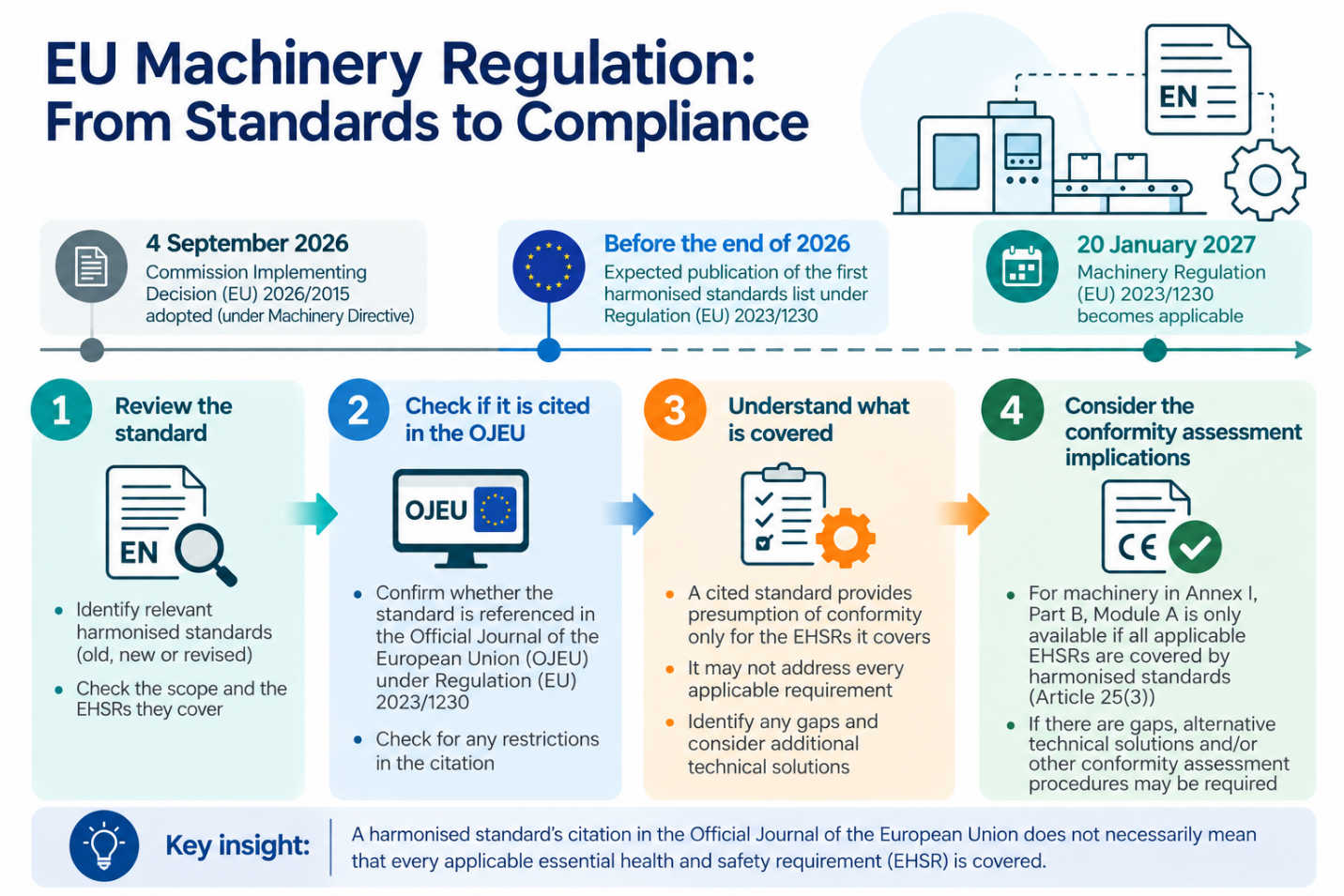
The EU Machinery Regulation (EU) 2023/1230 (MR) will apply from 20 January 2027, replacing Machinery Directive 2006/42/EC. With just three months to go, one important aspect of the transition awaits finalization – the list of harmonised standards supporting the new Regulation.
On 4 September 2026, the European Commission adopted Implementing Decision (EU) 2026/2015, updating references to harmonised standards (HAS) under the outgoing Machinery Directive, which remains applicable during the transition period. For instance, the Decision includes standards addressing industrial robots, autonomous agricultural machinery, industrial trucks and other machinery categories.
These new references will not, however, automatically confer the presumption of conformity with the Machinery Regulation. For a standard to confer presumption of conformity under the new Regulation, its reference must be published in the Official Journal of the European Union (OJEU). Even then, the presumption applies only to the EHSRs covered by the cited standard or its relevant parts, subject to any restrictions attached to the citation. Many existing harmonised standards do not yet fully reflect the new or modified Essential Health and Safety Requirements (EHSRs) introduced by this Regulation.
This creates an unusual situation: manufacturers face a fixed compliance deadline, but the precise standards framework on which many rely has yet to be approved.
The absence of a standard citation in the OJEU does not postpone the application of the Machinery Regulation or remove the obligation to comply with its applicable EHSRs. Harmonised standards are voluntary, after all, and manufacturers may use alternative technical solutions supported by appropriate risk assessments, verification, validation and technical documentation.
This flexibility, however, can be a double-edged sword. Developing and demonstrating the suitability of alternative solutions is not always easy or affordable in practice.
The CEN-CENELEC gap analysis: not merely an administrative exercise
Against the backdrop of growing uncertainty and time pressure, CEN-CENELEC explained the progress of its work during a webinar on 14 September 2026.
Since 2023, technical committees had been reviewing hundreds of European standards developed in support of the Machinery Directive to assess how adequately they address the new Regulation, particularly the new and modified EHSRs in Annex III.
Undoubtedly, this has been a substantial undertaking, involving more than 700 standards.
Among the provisions of the MR receiving particular attention were:
CEN-CENELEC also explained its revised approach to Annex ZA/ZZ, the informative annex used to describe the relationship between a European standard and the Regulation’s EHSRs.
Under the new template, intended to improve transparency, standards developers must identify which EHSRs are covered, not covered or not relevant within the scope of the standard. See the example below:
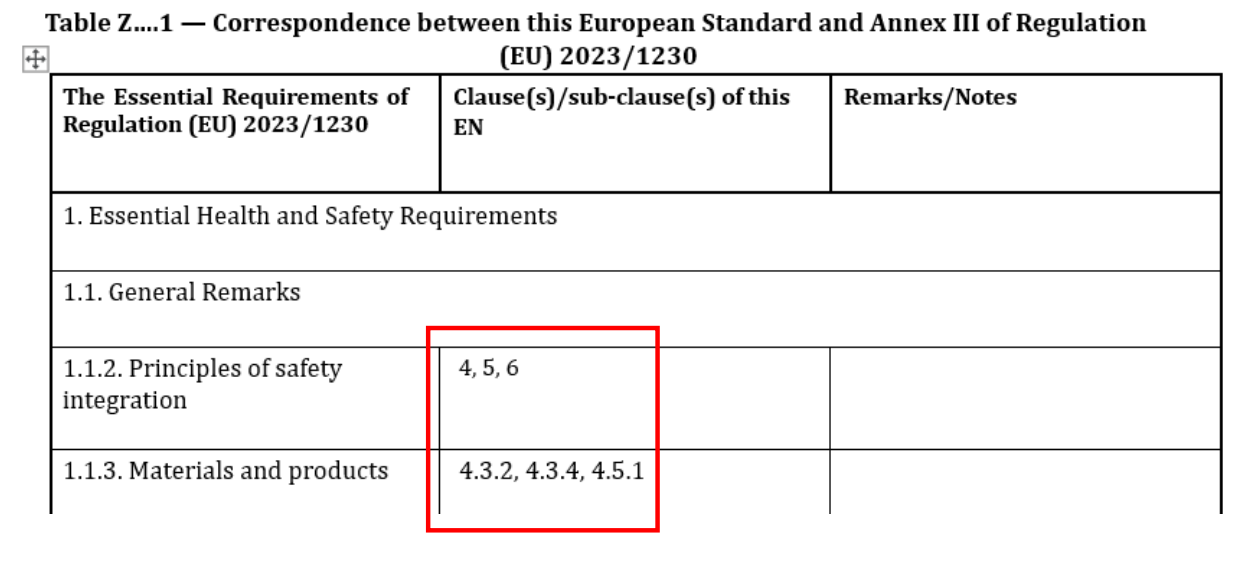

This should make it easier for manufacturers and other stakeholders to understand the extent to which a standard supports compliance with the Regulation – and where additional technical measures may be necessary.
Addressing uncertainty: the European Commission’s turn
The gap analysis results were subsequently submitted to the European Commission for an additional check-up in three batches – with the latest one sent in August 2026. CEN-CENELEC further noted that to save time, their analysts also included standards that had not previously been cited but had received a formal vote.
Following the submission, the results were subject to further examination, including review by Harmonised Standards (HAS) consultants, before the European Commission could determine which references should be published under the new Regulation.
During the September webinar, CEN-CENELEC reported that the Commission was preparing a new Implementing Decision and intended, in principle, to carry over the harmonised standards already cited under the Machinery Directive for which gap analyses had been completed.
However, the outcomes for individual standards may differ.
In practical terms, the assessment and citation process may result in three scenarios:
- Standards cited in the OJEU as is: where the standard is considered suitable for citation under the Regulation.
- Standards being considered affected by some of the new EHSRs, but are already covering them: where the assessment indicates that a standard sufficiently addresses relevant new or modified requirements and may therefore be cited in the OJEU;
- Standards being affected by some of the new EHSRs but not addressing them sufficiently: these may be cited in the OJEU with restrictions.
A restricted citation does not necessarily make the standard unsuitable. It means manufacturers must pay attention to which EHSRs are, and are not, covered by the presumption. The main consideration for standard revision and carry-over is how far its content reflects the state of the art in the view of the responsible technical committee.
Technical committees decided not to carry out a gap analysis for certain harmonised standards. These standards are therefore unlikely to be included or cited under the Machinery Regulation, although the final decision rests with the European Commission.
When a standards gap becomes a conformity-assessment problem
Recent discussions among machinery-safety professionals reveal a recurring tension. Standards translate legislative requirements into recognised engineering solutions. They help manufacturers establish design criteria, carry out verification and document compliance consistently.
For smaller machinery builders, developing and validating alternative technical solutions may demand specialist knowledge, additional time and resources, potentially resulting in unexpected expenditure.
Under Article 25(3) of the Machinery Regulation, manufacturers of machinery or related products listed in Annex I, Part B may use the internal production control procedure (Module A) only when the applicable conditions are satisfied.
In particular, the machinery must be designed and constructed in accordance with harmonised standards or common specifications specific to the relevant machinery category and covering all relevant EHSRs.
The issue is particularly challenging where an existing product standard does not adequately address a new requirement, and no suitable harmonised technical solution is available.
During the CEN-CENELEC webinar, a useful clarification was offered: the necessary EHSR coverage does not necessarily have to come from one product-specific Type-C standard. A combination of appropriately cited standards may be relevant where they collectively address the applicable requirements.
However, manufacturers must still verify that the combination satisfies the precise conditions of Article 25(3), including the requirement for category-specific standards or common specifications.
Where those conditions are not met, manufacturers of Annex I, Part B machinery cannot simply assume that Module A remains available. They must select another conformity-assessment procedure permitted by Article 25(3).
This distinction is important because the implications may extend to notified-body availability, assessment costs and product-launch planning.
The additional conformity-assessment concern is specific to the machinery categories listed in Annex I. For machinery outside Annex I, Article 25(4) provides for internal production control under Module A set out in Annex VI, although manufacturers must still demonstrate compliance with all applicable EHSRs.
Clock is ticking: calm before the storm
The review and analysis carried out so far represent a substantial effort to preserve the continuity between the Machinery Directive and Regulation. The Commission is hard at work on the new implementing decision and has indicated that the first list will be made available before the end of 2026. Manufacturers should expect re-cited standards with restricted presumption of conformity, revised standards that arrive after January 2027, and new requirements for which harmonised technical solutions are still developing.
The core discussion revolves around the availability of standards for a particular machine, whether they sufficiently cover the applicable EHSRs, and what manufacturers and other interested parties should do when they do not.
Two standards have received a lot of traction in recent industry discussions.
- EN ISO 12100, the fundamental Type-A standard for machinery risk assessment and risk reduction. Its revision is particularly significant because the standard underpins the risk-assessment methodology used across a wide range of machinery.
- EN 50742, being developed to address explicit safety requirements related to protection against corruption of safety-related hardware, software and data, notably under EHSRs 1.1.9 and 1.2.1.
At the time of writing, it is unclear whether these standards under preparation will be published as HAS under the Regulation in time. For responsible entities, the process of aligning with the provisions of the MR should not halt while awaiting their publication. In relation to cybersecurity, existing technical standards and recognised engineering approaches may be applied and may help to demonstrate how safety-related cybersecurity risks have been addressed. One such accepted state-of-the-art technical guidance is IEC 62443.
The machinery notified-body Recommendation for Use (RfU) CNB/M/11.073, discussed in industry exchanges in May 2026, also identified these best available technical approaches as relevant for the safety components and logic units within its scope.
What should manufacturers do while awaiting the new list?
There is no need to wait for the first Machinery Regulation harmonised standards list before reviewing the implications for individual products.
A practical approach would be to:
- Review the applicable EHSRs in Annex III. Identify the requirements relevant to each product, paying particular attention to those introduced or modified by the Regulation.
- Map the standards currently applied against those requirements. Establish which EHSRs are addressed by existing Type-A, Type-B and Type-C standards, and where coverage may be incomplete.
- Identify alternative or supplementary technical solutions. Where harmonised coverage is missing, assess what additional risk-reduction measures, standards, tests or technical evidence may be needed.
- Review the conformity-assessment implications. For machinery listed in Annex I, Part B, determine whether the conditions for using Module A are likely to be met. Where this is uncertain, consider the implications of notified-body involvement sufficiently early.
- Reassess the position once the new references are published. Check not only whether a standard is listed, but also its precise reference, any restrictions and the requirements for which it provides presumption of conformity.
The first publication of harmonised standards supporting Regulation (EU) 2023/1230 will be a welcome development. It should provide much-needed clarity about which existing standards can continue to support manufacturers under the new legal framework.
Nevertheless, manufacturers will still need to understand the scope of the cited standards, any limitations to their presumption of conformity and the practical consequences of requirements that remain uncovered.
FAQ
- When will the EU Machinery Regulation apply?
The EU Machinery Regulation (EU) 2023/1230 will apply from 20 January 2027, replacing Machinery Directive 2006/42/EC. - Will harmonised standards cited under the Machinery Directive automatically provide presumption of conformity under the new Regulation?
No. A standard’s reference must be published in the Official Journal of the European Union under the Machinery Regulation. Even then, presumption of conformity applies only to the EHSRs covered by the cited standard or its relevant parts, subject to any restrictions. - Can manufacturers comply with the Machinery Regulation without harmonised standards?
Yes. Harmonised standards are voluntary. Manufacturers may use alternative technical solutions supported by appropriate risk assessments, verification, validation and technical documentation to demonstrate compliance with applicable EHSRs. - Does a gap in harmonised-standard coverage prevent the use of Module A?
For machinery or related products listed in Annex I, Part B, Module A is available only where the conditions in Article 25(3) are satisfied. Where those conditions are not met, another permitted conformity-assessment procedure must be used. For machinery outside Annex I, Article 25(4) provides for internal production control under Module A. - What should manufacturers do while waiting for the new harmonised-standards list?
Manufacturers should review applicable EHSRs, map existing standards against those requirements, identify technical gaps and supplementary solutions, assess conformity-assessment implications, and recheck the position when the new references are published.
See Adherent in Action
Discover how agentic AI is reshaping product compliance for global enterprises.
Authors


Livia Kecerova
Senior Team Leader, Global Regulatory Compliance
Leading global regulatory compliance with expertise in industrial machinery, gas appliances and power generation equipment, alongside extensive experience in product safety, market access and emerging regulatory requirements.

The Ultimate Product Compliance Playbook
What the World’s Leading Product Organizations Have Figured Out About Product Compliance