Product Compliance Maturity Model: 5 Stages Explained

This blog was originally posted on 2nd October, 2026. Further regulatory developments may have occurred after publication. To keep up-to-date with the latest compliance news, sign up to our newsletter.
THIS BLOG WAS WRITTEN BY THE ADHERENT MARKETING TEAM TO INFORM AND ENGAGE. HOWEVER, COMPLEX REGULATORY QUESTIONS REQUIRE SPECIALIST KNOWLEDGE. TO GET ACCURATE, EXPERT ANSWERS, PLEASE CLICK ASK AN EXPERT.
Key Insight
Most compliance maturity models are built for corporate governance and risk, not for the work of getting a physical product into a market. Adherent’s playbook sets out five stages specific to product compliance operations, from Reactive to Strategic, each defined by a typical operating model and by the single constraint holding an organization at that stage. Knowing your stage matters less than knowing your constraint, because the constraint is what you actually work on next.
Table of Contents
- Why Product Compliance Needs Its Own Maturity Model
- Stage 1: Reactive
- Stage 2: Structured
- Stage 3: Integrated
- Stage 4: Optimized
- Stage 5: Strategic
- How to Place Your Own Organization
- Moving Between Stages
- Frequently Asked Questions
Every organization manages product compliance differently. Some still rely on reactive, manual processes. Others have embedded compliance into product development and strategic decision-making. Most are somewhere in between, and are not entirely sure where.
This article is adapted from Adherent’s playbook, The Ultimate Product Compliance Playbook. Companion articles cover the five practices high-performing compliance teams use, the metrics that actually matter, and a 90-day plan for fixing your operating model. This piece is the diagnostic: five stages, what defines each one, and how to work out which is yours.
What Why Product Compliance Needs Its Own Maturity Model
Plenty of compliance maturity models already exist. Almost all of them were built for corporate governance, risk and ethics programmes: policy coverage, training completion, whistleblowing channels, board reporting. Useful work, but a different discipline from deciding whether a battery chemistry is permitted in a market you plan to enter next year.
Product compliance maturity is defined by different things. Whether requirements arrive before design decisions or after them. Whether engineering, sourcing and legal work from one regulatory baseline or four. Whether evidence exists as a by-product of development or gets assembled under pressure. Whether regulatory intelligence shapes which markets you enter, or merely confirms the ones you already chose.
A maturity model is only useful if it tells you what to do next. Each stage below names the constraint holding an organization there, and the step that resolves it.
Stage 1: Reactive
Typical operating model
Compliance is primarily a downstream activity. Teams respond to regulatory issues after product decisions have been made, and much of the function’s energy goes into managing consequences: redesigns, supplier changes, additional testing, relabelling.
The constraint
Compliance has little opportunity to influence product outcomes, because it enters the process too late. This is not a competence problem. A team can be expert and still be structurally unable to affect anything, simply because of when it is consulted.
Your next step
Move compliance earlier into product planning and development. That usually means agreeing a small number of gates where a compliance answer is required before work proceeds, rather than attempting to change the whole process at once.
Stage 2: Structured
Typical operating model
Repeatable processes exist. People know how work gets done and it happens consistently. But regulatory information is still fragmented across teams and systems, with product, engineering, sourcing, quality and legal each maintaining their own view of what applies.
The constraint
Time is lost reconciling information and maintaining multiple versions of the truth. Most compliance delays at this stage are not caused by a lack of information but by inconsistency in it, and by the effort of establishing which interpretation is correct before anyone can act.
Your next step
Establish a single trusted source of regulatory intelligence and evidence that the whole business works from. This is the point where assessing applicability centrally, once, rather than repeatedly in each function, starts to return significant time.
Stage 3: Integrated
Typical operating model
Compliance is embedded in product development, and evidence is created throughout the lifecycle rather than reconstructed at the end. Requirements are managed alongside commercial, technical and quality requirements as a matter of course.
The constraint
Maintaining consistency becomes increasingly difficult as products, markets and teams grow. What works for one product family and three markets starts to strain at twelve product families and thirty markets, and local variations creep in.
Your next step
Standardize operating practices across the organization, so that a requirement reaching any team arrives in the same form and means the same thing regardless of who is handling it.
Stage 4: Optimized
Typical operating model
Automation and connected workflows support continuous monitoring and reduce manual effort. Regulatory change is tracked systematically and filtered against the product portfolio rather than reviewed in full by people.
The constraint
The challenge shifts from processing information to prioritizing what matters. When monitoring is automated, volume stops being the problem and relevance becomes it. Teams can find themselves reviewing a great deal that is technically accurate and practically irrelevant.
Your next step
Refine workflows so experts focus on judgment, risk and business decisions. This is where prioritizing by business risk does more for a team than any further increase in coverage.
Stage 5: Strategic
Typical operating model
Compliance informs product strategy, market expansion and executive decision-making. Regulatory intelligence is an input to where the business goes next, not a check applied to where it has already decided to go.
The constraint
There is no structural constraint left to remove. The focus is no longer transformation but continuous improvement and business optimization, which is a different kind of work and easy to neglect once the obvious problems are solved.
Your next step
Measure business outcomes and continuously improve operating performance. The metrics that matter become the mechanism for holding the stage rather than reaching it.
How to Place Your Own Organization
Reading five descriptions and picking the one that sounds most familiar is a reasonable start, and it is usually wrong by about half a stage in the flattering direction.
The playbook’s appendix provides a more honest route. Twenty statements, four for each of the five practices, each rated from 1 (never or rarely true) to 5 (consistently true across the organization). The total, out of 100, maps directly to the five stages:
Two things make the scorecard more useful than self-assessment by description. It forces a judgement on twenty specific operational statements rather than one general impression. And if several people complete it independently, the spread in their answers is itself the finding. Where compliance scores a practice at 4 and engineering scores it at 2, the gap is usually the most informative thing on the page.
Moving Between Stages
Three things are worth understanding about movement through these stages.
- You cannot skip one. Each stage’s constraint has to be resolved before the next one becomes the binding problem. Automating monitoring at Stage 2 produces automated delivery of inconsistent information, which is faster but no more decisive. A single trusted baseline has to exist before automation has anything reliable to act on.
- Different parts of a business can sit at different stages. A consumer electronics line with a mature process and an apparel line run largely on spreadsheets can coexist in the same company. Score them separately. The 90-day approach of starting with one product family exists precisely because of this.
- Stages describe operating models, not effort. A Stage 1 team can work extremely hard and a Stage 4 team can look comparatively relaxed, and the second will still produce better outcomes. This is the point that most often needs making to leadership, because effort is visible in a way that operating models are not.
The goal is to continuously move compliance earlier in the product life-cycle, reduce manual effort, and strengthen compliance’s contribution to business performance.
FAQ
- What are the five stages of product compliance maturity?
Reactive, where compliance responds after product decisions are made. Structured, where repeatable processes exist but regulatory information is fragmented. Integrated, where compliance is embedded in development and evidence is created throughout. Optimized, where automation and connected workflows reduce manual effort. Strategic, where compliance informs product strategy and executive decision-making. - How is this different from a general compliance maturity model?
Most existing models were built for corporate governance, risk and ethics programmes and measure things like policy coverage and training completion. Product compliance maturity is defined by operational questions instead: when requirements arrive relative to design decisions, whether functions share one regulatory baseline, whether evidence is created continuously, and whether regulatory intelligence informs market entry. - How do we work out which stage we are at?
The playbook’s appendix contains a twenty-statement scorecard, four statements per practice, each rated 1 to 5. The total out of 100 maps to the five stages, from below 40 for Reactive to 86 and above for Strategic. Having several people score independently is more revealing than a single assessment, because the disagreements identify where the operating model is inconsistent. - Can an organization skip a stage?
Not usefully. Each stage’s constraint has to be resolved before the next becomes the binding problem. Automating regulatory monitoring before establishing a single trusted baseline, for example, delivers inconsistent information faster rather than producing better decisions. - Should every organization aim for Stage 5?
Not necessarily, and not everywhere at once. The practical goal is to identify the constraint holding you at your current stage and resolve it, one product family at a time. Organizations with narrow portfolios in few markets may find Stage 3 or 4 entirely sufficient for their business.
This article is adapted from Adherent’s guide, The Ultimate Product Compliance Playbook (published August 17, 2026). Further developments may have occurred after publication. Download the full playbook for the complete maturity model, the 20-statement scorecard, and the 90-day roadmap, or speak to Adherent about assessing your own compliance operations
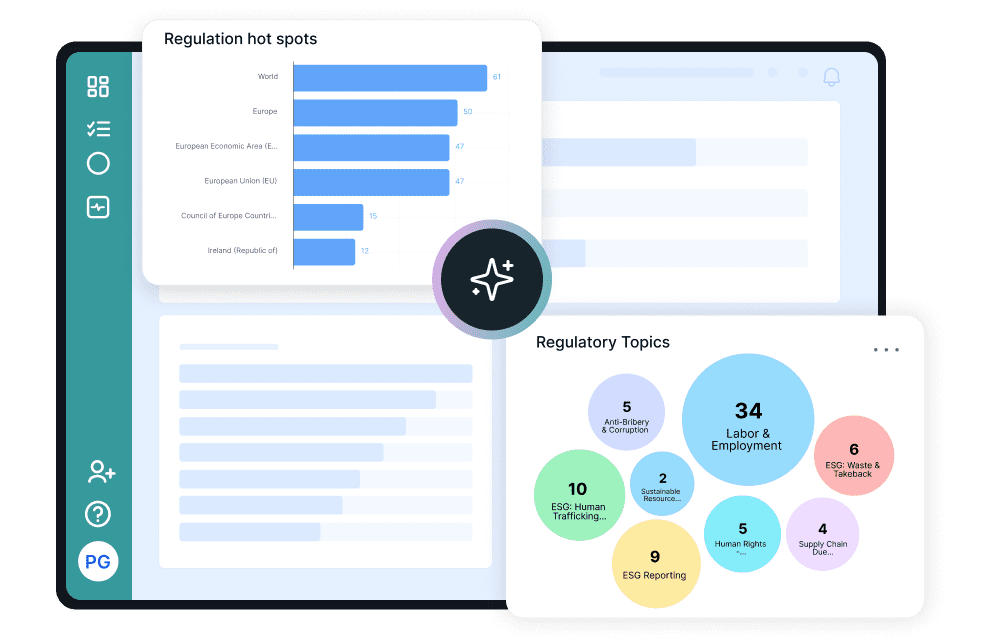
See Adherent in Action
Discover how agentic AI is reshaping product compliance for global enterprises.

The Ultimate Product Compliance Playbook
What the World’s Leading Product Organizations Have Figured Out About Product Compliance