Regulatory Trends in Textiles: 12–18 Month Outlook


This guide was published on 1st July, 2026. Further regulatory developments may have occurred after publication. To keep up-to-date with the latest compliance news, sign up to our newsletter.
A practical 12–18 month roadmap for textile and apparel manufacturers who need to move fast, without losing control of compliance.
Regulatory Trends in Textiles: 12–18 Month Outlook
Textile regulations are evolving rapidly, particularly regarding chemical prohibitions, labeling rules, greenwashing restrictions, extended producer responsibility (EPR) and ecodesign requirements.
Per- and polyfluoroalkyl substances (PFAS), historically favored for water, oil, and stain resistance, remain a primary target of global regulatory enforcement, with bans taking effect across multiple jurisdictions. At the same time, emerging eco-design requirements, most notably under the EU’s Ecodesign for Sustainable Products Regulation (ESPR), are shifting product design and material sourcing strategies toward durability, reusability, and recyclability.
In addition, the EU textile labeling regulation (EU) 1007/2011 is undergoing a review to align with the EU’s broader circular economy objectives. This will likely lead to updates to fiber identifications, digital labelling, new symbols and the integration of sustainability disclosures.
Extended Producer Responsibility (EPR) schemes represent another critical challenge. While several EU Member States, including France, the Netherlands, Latvia, and Hungary, have already established national frameworks, Directive (EU) 2025/1892 requires that all Member States implement harmonized EPR rules by 17 June 2027. Meanwhile, California, one of the world’s largest economies, is beginning to operationalize its Responsible Textile Recovery Act (SB 707) in 2026.
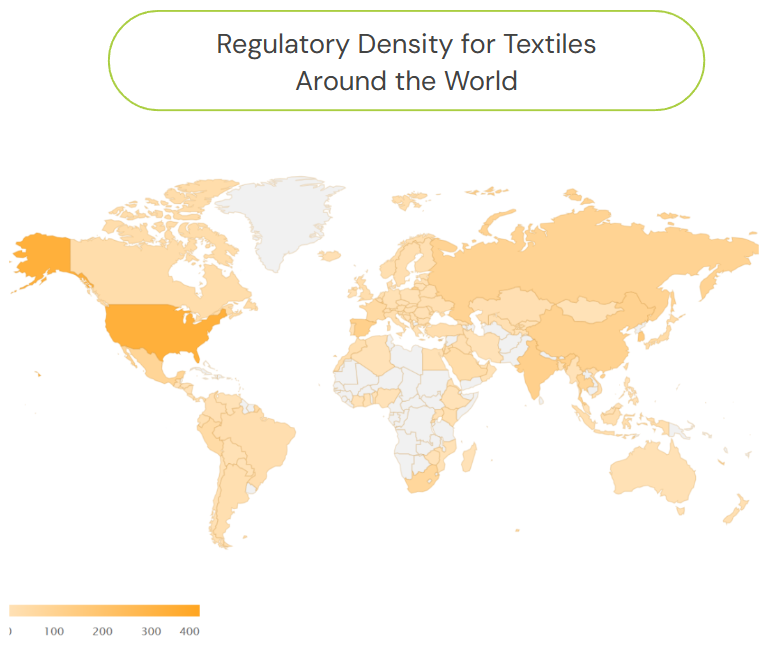
(Source: C2P by Adherent)
This Guide Covers
- The 9 regulatory topics affecting textiles, banded by importance
- Textile EPR under Directive (EU) 2025/1892 and the 17 June 2027 deadline for Member State implementation
- California’s Responsible Textile Recovery Act (SB 707) and its 2026 start
- The review of EU textile labelling Regulation (EU) 1007/2011 and the changes it could bring
- A world map of textile regulatory density
- 15 key regulations expected to affect your business over the next 12-18 months