Why Human Oversight Isn’t Just a Feature. It’s Our Foundation.

This blog was originally posted on 23rd June, 2026. Further developments may have occurred after publication. To keep up-to-date with the latest compliance news, sign up to our newsletter.
AUTHORED BY JOANNE O’DONNELL, HEAD OF GLOBAL REGULATORY COMPLIANCE, ADHERENT
Artificial intelligence is rapidly reshaping the regulatory compliance landscape.
Across every industry, companies are under pressure to move faster – to launch products into new markets, manage increasingly complex supply chains, respond to accelerated regulatory changes, and prepare for new regulatory obligations. AI promises to help compliance teams keep pace.
In highly regulated environments, however, speed alone is insufficient; transparency and trust are foundational. That is why every regulatory compliance professional, legal counsel, and regulator will eventually ask: who is accountable when an AI-generated regulatory compliance recommendation is wrong? Given the high legal, financial, and reputational risks of regulatory non-compliance, relying on “the algorithm told me so” is not an acceptable defense.
Penalties are becoming increasingly severe and are now often tied to a company’s financial turnover. For instance, the UK’s Competition and Markets Authority can fine companies up to 10% of their global turnover for misleading green claims while in the EU, companies can be fined up to 4% of their annual turnover in the EU member state where the infringement occurred.
US industry research from the Ponemon Institute estimates the average annual cost of regulatory non-compliance at $14.8M–$15M, compared to just $5.5M to maintain compliance – making non-compliance almost three times more expensive. This critical difference fundamentally dictates that organizations must evaluate AI for regulatory intelligence by prioritizing governance and accountability, not simply automation.
The Real Differentiator in Regulatory AI Is the Data
Not all regulatory AI tools are created equal. Many AI tools entering the market today rely heavily on 100% scraped internet content, generalized language models, or unverified public data sources. While these tools can generate answers quickly, they often do so without context, provenance, validation, or transparency, thereby creating a serious risk for companies that rely on them.
Speaking as a lawyer with over 23 years experience, and following conversations with other lawyers and regulatory experts on our Adherent team and amongst our customers, it is clear that regulatory compliance is not – and cannot – simply be about retrieving information fast. It must also involve interpreting obligations accurately, understanding applicability and non-applicability, capturing legal nuances that AI is unable to spot, tracking existing and emerging regulatory changes, knowing that regulations do not operate in a vacuum but exist as part of a larger, co-dependent regulatory ecosystem, and making decisions that organizations can confidently rely on.
This requires more than an AI tool that scrapes websites; it requires a trusted regulatory foundation. High-quality, compliant and trustworthy data must therefore be the true intelligence layer underpinning any successful AI system.
This is where Adherent stands out.
Our regulatory intelligence is built on more than two decades of proprietary human-curated regulatory data covering 120,000+ regulations and supporting documents across 195 countries. This intelligence has been continuously validated, structured, maintained, and contextualized by a global team of lawyers and regulatory experts to support real-world regulatory decision-making.
AI is only as reliable as the regulatory intelligence it is built upon. When the underlying data lacks validation, consistency, traceability, or regulatory context, the outputs become difficult – and sometimes impossible – to defend. Human oversight and governance is therefore what makes our agentic AI product compliance platform a trusted compliance capability.
Compliance Requires Judgment, Not Just Generation
Our almost 25 years experience of regulatory monitoring, tracking and horizon scanning has demonstrated that legislation is never static – it continuously evolves. The same regulation does not always lead to the same regulatory experience. Implementation of a regulation may differ from one EU member state to another in terms of execution and enforcement. Jurisdictional nuances mean that definitions and enforcement priorities shift across borders, where a single obligation can be interpreted differently based on industry sector, product category, or supply chain exposure. Understanding how legislation works in practice – not just on paper – is therefore key.
In Europe, organizations are currently preparing for the application of ‘big ticket’ regulations such as the Empowering Consumers for the Green Transition Directive, Deforestation Regulation, the Forced Labor Regulation, the Right to Repair Directive as well as the applicability of the digital product passport to certain categories of products under the Ecodesign for Sustainable Products Regulation.
In the United States, ’fragmentation’ is the key theme where a patchwork of differing, diverging and disjointed state-level PFAS, right to repair and packaging EPR regulations exist in response to US federal regulations that are either non-existent or have been rolled back, watered down or are simply not enforced. Organizations that sell products across the US are therefore struggling to stay on top of conflicting state-level requirements.
Across Asia-Pacific, regulators are moving aggressively on various regulatory topics such as human rights due diligence, circular economy, and AI governance – particularly in major markets including China, Singapore, Japan, South Korea, and Australia.
At the same time, industries around the world are facing mounting pressure around:
- PFAS and chemical restrictions
- Battery and packaging regulations
- Supply chain due diligence requirements
- ESG reporting and sustainability substantiation
- Product environmental footprint disclosures
- Cybersecurity and connected product obligations
- AI transparency and risk management requirements
- Forced labor and human rights due diligence
- Extended producer responsibility (EPR) frameworks
These are not simple search queries but represent highly contextual regulatory challenges that require interpretation, validation, and explainability. Consequently, regulatory compliance teams need AI systems that are capable of delivering recommendations they can stand behind – supported by human-backed and verified evidence, rationale, traceability, and governed regulatory intelligence.
Explainability Is Becoming a Regulatory Requirement
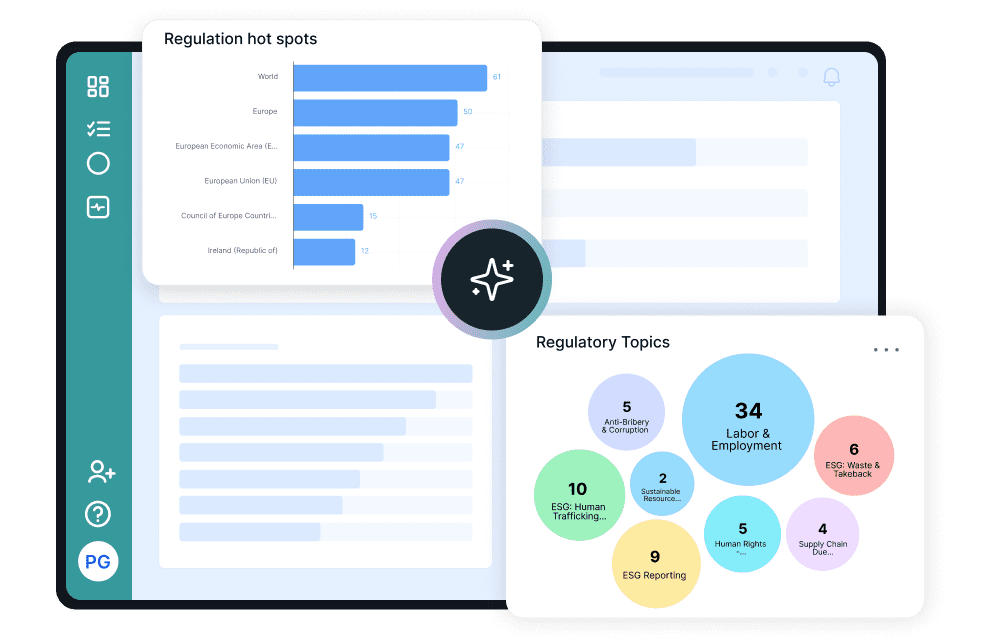
The irony of AI adoption in compliance is that the technology itself is becoming increasingly regulated as evidenced by the surge in interest in our AI regulatory topic coverage.
Organizations are facing growing regulatory obligations to demonstrate how AI-driven decisions are made, what data informs them, how outputs are validated, and who remains accountable for the outcome. Regulators across the globe are already signaling this direction clearly through emerging frameworks focused on transparency, explainability, human oversight, and risk governance.
The organizations best positioned for this future will not be those using the most aggressive automation. They will be the ones building accountable AI governance models now which means prioritizing:
- Validated regulatory datasets
- Human-governed intelligence workflows
- Traceable decision-making
- Explainable outputs
- Continuous expert oversight
- Audit-ready compliance evidence
What Compliance Teams Should Be Preparing For Next
Over the next 12-18 months, several regulatory developments are likely to define the global regulatory compliance agenda.
1. Operationalization of AI Regulation
While the EU Council and Parliament recently agreed to postpone application of the EU AI Act to 2 December 2027 for High-Risk AI Systems and to 2 August 2028 for AI embedded in regulated products, companies must nonetheless start thinking about establishing AI governance structures, risk classifications, documentation processes, and oversight mechanisms. Other jurisdictions will follow with their own AI governance models, creating fragmented compliance obligations across regions.
2. ESG Enforcement Will Intensify
While recent changes to the EU Corporate Sustainability Reporting Directive (CSRD) and Corporate Sustainability Due Diligence Directive (CSDDDD) have increased applicability thresholds and therefore reduced the number of companies in scope, organizations should still expect continued scrutiny around sustainability claims, emissions reporting, greenwashing, supply chain disclosures, and product environmental data.
3. Supply Chain Transparency Will Become Mandatory
Human rights due diligence, forced labor restrictions, sourcing transparency, and supplier accountability requirements will continue to expand globally. The EU Forced Labor Regulation will apply in December 2027 and mandatory human rights due diligence regulations are ramping up in other regions, most notably Asia and South America, thereby demonstrating that global regulators are continuing to shift from voluntary towards mandatory, enforceable accountability.
4. Product Compliance Will Converge with Digital Regulation
Connected products, smart devices, and digitally enabled supply chains are continuing to blur the boundaries between traditional product compliance, cybersecurity, data governance, and AI regulation. As AI advancements continuously and rapidly evolve, AI embedded products will also evolve in line with the technology. Regulatory compliance cannot therefore be viewed as a once-off static process but must be monitored and tracked to align with – and indeed stay ahead of – technological advancements. Synergies between existing regulations where overlapping responsibilities often exist such as the EU AI Act, GDPR, and digital safety legislation should also be tracked.
Organizations therefore need more integrated compliance intelligence models to manage these convergences and synergies effectively.
5. Regulatory Velocity Will Continue Accelerating
One of the biggest lessons that we have learned from speaking with and helping leading global corporations stay on top of their existing and emerging regulatory obligations is that the greatest challenge for compliance teams is never just one isolated regulation.
It is the pace of simultaneous regulatory change across jurisdictions – the infamous ‘regulatory avalanche’. The volume, complexity, and interconnected nature of global obligations will continue to outpace manual compliance approaches – increasing demand for AI-enabled intelligence grounded in trusted regulatory expertise.
The Future of Compliance Requires Trust
To conclude, there is no doubt that AI will absolutely transform regulatory compliance.
However, it is trust that will determine which AI platforms organizations are willing to rely on when accountability matters most. This trust cannot come from opaque outputs generated from unverified sources – instead, it must come from:
- Explainability,
- Governance,
- Traceability,
- Proven regulatory intelligence and
- Decisions supported by evidence that organizations can confidently defend.
That is why our agentic AI product compliance platform does not just simply layer human oversight onto AI. We have built our platform to ensure that human oversight is the foundation that makes our AI trustworthy in the first place.
We firmly believe that trust will be one of the most valuable currencies in the AI regulatory compliance space today, and that this is what sets us apart.
Welcome to Adherent.
See Adherent in Action
Discover how agentic AI is reshaping product compliance for global enterprises.

Sign up to our

Monthly Market Insights
Our Connect Newsletter delivers the latest regulatory developments, trends and expert insights straight to your inbox.