Aligning Product Teams on Compliance-Driven Change

This blog was originally posted on 13th September, 2026. Further regulatory developments may have occurred after publication. To keep up-to-date with the latest compliance news, sign up to our newsletter.
THIS BLOG WAS WRITTEN BY THE ADHERENT MARKETING TEAM TO INFORM AND ENGAGE. HOWEVER, COMPLEX REGULATORY QUESTIONS REQUIRE SPECIALIST KNOWLEDGE. TO GET ACCURATE, EXPERT ANSWERS, PLEASE CLICK ASK AN EXPERT.
Quick Answer
When one product sells into many markets, its compliance requirements conflict, and someone has to reconcile them into a single specification. Do it deliberately: map every requirement to the product attribute it touches, group the conflicts by attribute rather than by market, then apply one of three resolution patterns to each conflict. Build to the strictest rule everywhere, segment into market variants, or drop the conflicting market. Record which one you chose and why, or the decision gets made by default.
Table of Contents
- Key Takeaways
- How do you reconcile conflicting compliance requirements across markets into one product spec?
- What information do product teams need to decide on a compliance change?
- How do you test whether a compliance change is feasible?
- How do you make compliance trade-offs explicit instead of implicit?
- Frequently Asked Questions
Key Takeaways
- Multi-market requirements have to be reconciled into one specification. Handling it per market usually collapses into a hidden default decision.
- Reconciliation is a design choice, not a lookup. Superset, segment, and descope each carry different costs.
- Product teams cannot decide a compliance change without four inputs: legal force, effective date, cost to comply, and cost of non-compliance.
- Feasibility means testing a change against technical, supply chain, cost, and timeline constraints before it enters the spec, not after tooling is committed.
- A trade-off is only explicit when it is written down, owned by a named person, and its rejected alternatives are recorded.
How do you reconcile conflicting compliance requirements across markets into one product spec?
Map every requirement to the product attribute it touches, cluster the conflicts by attribute rather than by market, then apply a resolution pattern to each one.
Grouping by attribute is the step that makes the problem tractable. Sorted by market, the requirement set looks like twenty separate compliance problems. Sorted by attribute, meaning material, label, packaging, energy, connectivity, and documentation, it usually resolves into a handful of genuine conflicts and a long tail of requirements that are simply additive.
That distinction matters. Additive requirements stack without tension: meeting one does not prevent meeting another. Environmental requirements by product category is a useful map for working out which attributes attract requirements in the first place. Mutually exclusive requirements are the real work, and there are far fewer of them than the raw count suggests.
Three resolution patterns cover almost every conflict.
Superset. Build to the strictest rule everywhere. Operationally simplest, because there is one specification, one bill of materials, and one evidence set. It also means paying the cost of the strictest market in every market that never required it.
Segment. Create market variants. Right when the cost delta is large, the strict market is small, and your operation can carry variant overhead in sourcing, production, labelling, and stock. That overhead is consistently underestimated, because it lands in operations rather than in the compliance decision.
Descope. Drop the conflicting market. A legitimate answer, and the one teams treat as a failure when it is often the correct commercial call.
Strictest-rule-wins is a real strategy. The problem is when it happens by default rather than by choice, because then nobody has priced what it costs in the markets that did not need it.
A worked example makes the trade-off concrete. A substance restricted in several US states but unrestricted elsewhere presents exactly this choice: reformulate globally and carry the cost across the whole volume, or hold two formulations and carry the variant overhead. Adherent’s snapshot of US state-level PFAS developments shows how quickly that particular pattern fragments a market that looks unified.
The output is a single agreed specification that product, engineering, and compliance all build from, with each resolved conflict recorded alongside the pattern chosen. A regulatory crosswalk across overlapping frameworks is the practical tool for finding where the strictest line actually sits.
What information do product teams need to decide on a compliance change?
Four inputs per requirement: its legal force, its effective date, the cost and effort to comply, and the cost of non-compliance. Without all four, the decision is a guess wearing a process.
Legal force means distinguishing a mandatory requirement from a standard from a voluntary ecolabel from an emerging proposal. These carry very different decision weight, and presenting them in one undifferentiated list is how product teams learn to discount the whole list.
The effective date drives sequencing more than anything else. It determines what has to change in the current design cycle and what can wait for the next one, and that single question resolves most arguments about priority.
Cost to comply and cost of non-compliance have to sit side by side. One without the other produces a predictable failure: cost alone makes every requirement look like an imposition, exposure alone makes every requirement look urgent.
Be explicit about who supplies each input. Regulatory intelligence supplies legal force and dates. Product and engineering supply feasibility and cost. Finance supplies exposure. When one function is asked for all four, the three it is guessing at get treated with the same confidence as the one it knows.
The requirement itself has to arrive in a form engineering can act on, which is a translation job rather than a forwarding job. A regulation reference is not a requirement. A specific product change with a threshold, a verification method, and a date is.
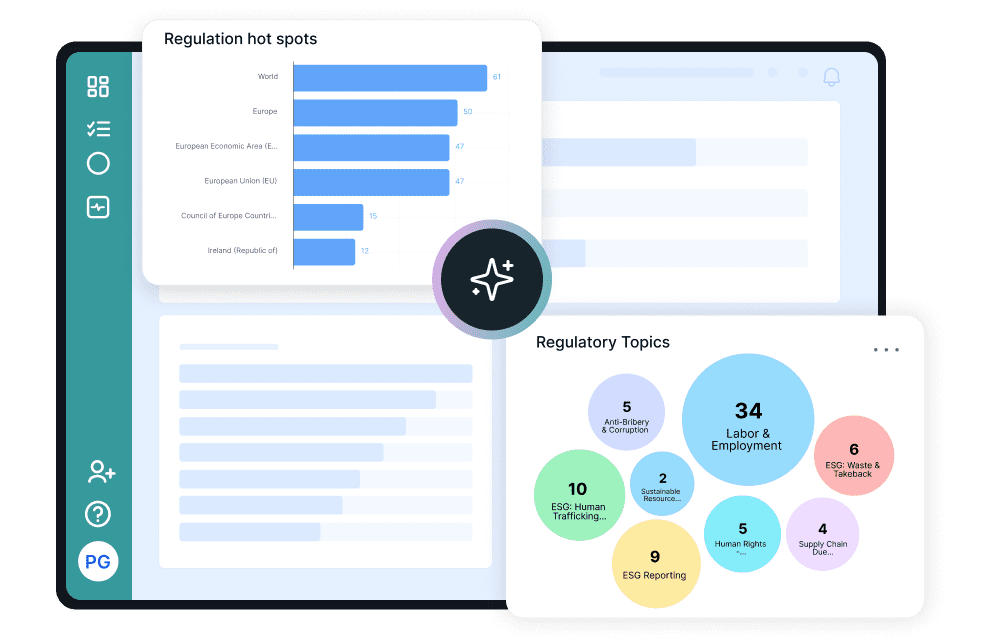
Volume is what makes this hard to sustain manually. Adherent tracks an average of 217 regulatory changes per month globally, and assembling four decision inputs for each change that touches your portfolio is the work that decides whether product teams get a usable shortlist or an inbox. A structured regulatory intelligence workflow is what makes the difference.
How do you test whether a compliance change is feasible?
Run it against four constraints before it enters the spec: technical, supply chain, cost, and timeline. Fail any one and you are back to choosing a different resolution pattern, which is a much cheaper place to be than mid-build.
Technical. Can the product be designed and built this way without breaking performance, safety, or another requirement? Compliance changes that create new conflicts are common, particularly around materials, which is where the material-specific technical blueprint earns its keep.
Supply chain. Do current suppliers have compliant materials, at what price, at what lead time, and with what evidence? This gate fails most often, and it fails late because nobody asks until the design is settled.
Cost. Does the margin survive at the volume the market actually justifies?
Timeline. Can it ship before the effective date, working backwards through design, validation, tooling, and production changeover?
Position this at spec reconciliation, before tooling is committed. Feasibility discovered after commitment is not feasibility testing, it is a change order, and the cost difference between the two is the entire argument for doing it early. Compliance-by-design covers what building the gate into the lifecycle looks like in practice.
Validate with pre-compliance testing where the requirement is testable. A prototype checked against the threshold before design freeze converts an assumption into a fact at a fraction of the cost of finding out later.
Get supplier confirmation in writing, with lead times. A verbal yes on material availability is the single most expensive assumption in this process, and traceability systems are what make the resulting claim provable rather than asserted.
Where a change is genuinely infeasible, fall back to segment or descope deliberately. Infeasibility is information, and forcing an infeasible change through the spec produces a product that fails at a later and more expensive gate.
Document the feasibility findings. The trade-off decision has to rest on evidence, and the evidence is what makes the decision reviewable when circumstances change.
How do you make compliance trade-offs explicit instead of implicit?
A trade-off is explicit when it is written down, owned by a named person, and its rejected alternatives are recorded. Anything short of that is a default, and defaults are invisible until they cause a problem.
Record four things per resolved conflict: the conflict itself, the pattern chosen, the alternatives rejected and why, and the owner. That record turns a silent engineering compromise into a governed decision, and it is what allows the decision to be revisited when a market, a cost, or a rule changes.
The rejected alternatives are the part teams skip and the part that carries most of the value. Knowing that segmentation was considered and rejected on variant overhead is what stops the same debate reopening every cycle, and it is what makes the reasoning legible to whoever inherits the product.
Name a single owner per trade-off. Shared ownership of a compromise reliably means nobody revisits it.
Put the record where the spec lives rather than in a compliance system nobody in product opens. A trade-off log that engineering cannot see is documentation rather than alignment.
Set a review trigger, not a review date. These decisions should be re-tested when something moves: a new market, a cost change, a supplier change, or an amendment to the rule that drove the conflict. Calendar reviews of unchanged decisions waste attention; trigger-based reviews catch the ones that actually went stale.
FAQ
- Is it always better to build to the strictest requirement?
No. It is operationally simplest, which is not the same thing. It makes sense when the cost delta is small or the strict market is large. When a small market drives a big cost across your whole volume, segmentation or descoping can be the better answer. - Who owns the reconciliation, compliance or product?
Compliance owns the requirement set and the conflict analysis. Product owns the specification and the trade-off decision. Compliance identifies that two rules cannot both be met; product decides what to do about it. - What if a conflict is discovered after design freeze?
Treat it as a change with its own feasibility test rather than forcing it through. The patterns are the same, but the options narrow, which is precisely why the analysis belongs at spec time. - How do you keep product teams from ignoring compliance requirements?
Deliver them as ordinary product requirements with dates, thresholds, and verification methods, and with legal force distinguished from preference. Requirements that arrive as escalations get treated as interruptions. - How many conflicts should we expect?
Fewer than the requirement count suggests. Most multi-market requirements are additive. Grouping by product attribute rather than by market usually reduces an intimidating list to a handful of genuine decisions.
See Adherent in Action
Discover how agentic AI is reshaping product compliance for global enterprises.

The Ultimate Product Compliance Playbook
What the World’s Leading Product Organizations Have Figured Out About Product Compliance