Compliance Was Always a Growth Engine

This blog was originally posted on 24th June, 2026. Further developments may have occurred after publication. To keep up-to-date with the latest compliance news, sign up to our newsletter.
AUTHORED BY SHANE O’CALLAGHAN, SENIOR PRODUCT MANAGER, ADHERENT
Why compliance is strategic and how the tools have finally caught up.
Eighteen months ago, we set out to build a new agentic AI product compliance platform from the ground up. As Senior Product Managers, Meg O’Keeffe and I have spent the last six years here trying to solve this problem with the technologies we had available at the time – and we understood, better than most, why they fell short.
We understood our customers deeply. We understood the challenges: the cost of getting compliance wrong, the pressure to do more with less, a function too often treated as overhead when it is anything but. The technology of the time simply could not deliver at the scale and accuracy the problem demanded.
When AI changed what was possible, we committed to building something new from first principles. Compliance leaders from some of the largest consumer brands in the world joined us throughout that process as design partners, committing to work with us weekly to shape what we were building. This is what they taught us – and how it became Adherent.
Part One: The Cost of Getting It Wrong
The oldest lesson in product compliance came up in every conversation. Get it right and it is a silent note for the books, get it wrong and the cost lands in places nobody forecasts. We opened each call with the question that gets us there: what does it cost you when you miss something? The answers were the most honest moments of every call.
A compliance principal at a leading consumer electronics company didn’t reach for an abstraction.
“I’ll give you guys a recent example that happened in January where we missed the regulation in one of our jurisdictions. We had to stop the line from producing more of the product. We had to rework the units that were already produced and we had to scrap some of the packaging. Then we also had to sell the product not in the original jurisdiction it was intended for. There’s a very quantifiable monetary impact if we miss a regulation.”
The head of product compliance at a leading apparel company said it differently.
“The effect is a lot of stress. Because if it’s impacting the product that means the change might be too short to be able to do.”
Same point, framed two ways.
This is the part that rarely makes it into a finance review. Compliance is treated as overhead until the moment something slips, and then the math gets real – fast. The function that was budgeted as a cost line becomes the function that absorbs the consequences.
This isn’t a new story. Anyone who has been in product compliance for a decade has watched it play out. The cost of getting it wrong is the constant – what has changed is the context around it. The volume of regulation is up. Revenue is under sharper scrutiny than it has been in years. The business demands that compliance not be the reason a product slips. Until recently, the tooling to keep up hadn’t moved at all.
Part Two: The Value is Invisible When it is Working
The second pattern was the operating reality compliance teams have been handed. Doing more with less is the line every function has heard for the last two years. Compliance has heard it harder than most. A senior compliance lead at a leading consumer products company described what happens when the team shrinks:
“Unfortunately it’s had a decrease recently because we lost a few team members. So we’re down to kind of a skeleton crew. It’s unfortunate that when that happens, monitoring is one of the first things to go.”
In the same breath he told us his company launched 30 new master SKUs last year and is targeting 45 this year. Launches up. Headcount down. Monitoring quietly dropped.
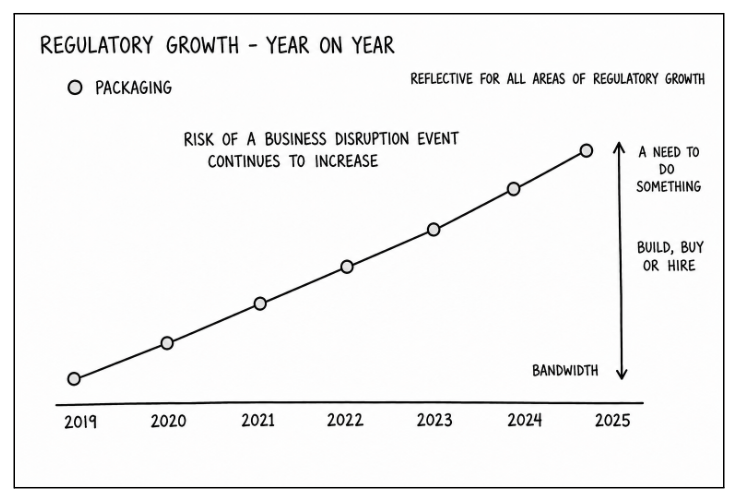
The same story showed up at the other end of the company size scale. A head of design at a fast-growing apparel company told us two people cover all of compliance there, alongside other roles. “We don’t have that much time between us with everything we’re doing.”
Compliance is one hat among several, worn part-time, with no slack in the system. A head of product compliance at a leading apparel company named the budget pressure underneath: in a cost reduction situation, “if you cannot justify that you get the best of each tool, you’re going to lose the budget.”
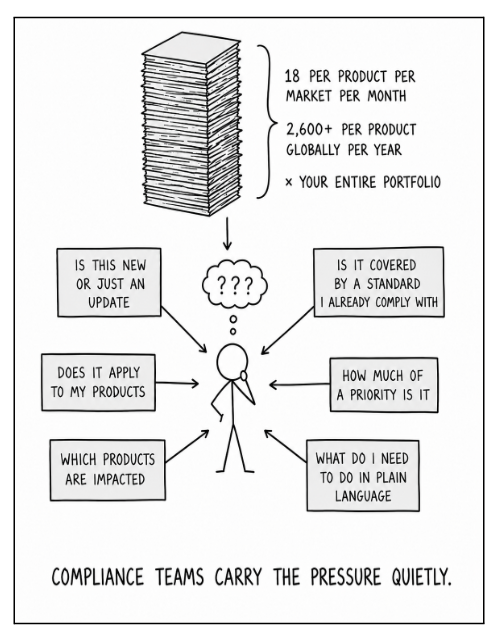
The work has become untenable. Slowly, then all at once, with the team carrying it as long as they can – until something gets dropped. Monitoring is usually the first to be dropped.
The reason monitoring goes first is the same reason compliance gets labelled overhead. The value of the function is invisible when it’s working.
The function shows up in what doesn’t happen. The recall that didn’t land. The fine that wasn’t levied. The launch that wasn’t delayed. The market that opened on schedule. Functions that show up in absence are notoriously hard to measure, and they tend to get labelled overhead by default.
This is a category error.
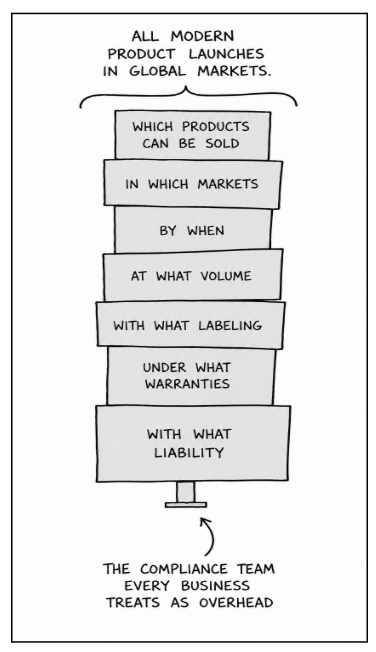
Compliance is the function that decides whether a product can be sold, where, and when. Every launch passes through it. Every new market depends on it. Every recall is a failure mode of it. The function gates revenue at the front end and absorbs liability at the back end.
The consumer electronics principal’s January example wasn’t a cost incident, but a strategic failure. None of that shows up neatly on the compliance team’s budget line. All of it shows up on the company’s P&L.
Compliance is one of the few functions in a product company that operates on both sides of the revenue equation at once. In any reasonable accounting, compliance is a growth engine. It doesn’t just protect revenue, it grows it. When compliance works well, teams can spot new markets that require little or no extra compliance effort, move faster on the next product generation by knowing exactly what’s required before design even starts, and eliminate most reworks by building compliant products from the very first prototype.
The cost center label is a measurement artifact – not a description of the work.
Part Three: The Three Things That Had to Change
For compliance to be a growth engine, the tooling has to act like one. Three core things came up in every conversation:
- What regulations apply?
- Which ones are more important?
- What do I need to do?
Each one is a gap in the tools that exist. Each one a piece of what an agentic AI solution would need to do.
1. What Regulations Apply to Me?
The first is applicability. Everything else depends on getting this right. Not every regulation that affects your product is your obligation. Some sit with the companies that have the responsibility of supplying components, some sit with those who manufacture. Some don’t apply to you at all.
“Understanding which parts of those regulations impact our products and which ones do not. A lot of times some of those actions are actually taken by manufacturers or material suppliers as opposed to somebody in our position.”
— Senior Compliance Lead, leading consumer brand
The system has to know who owns what, and what doesn’t apply to you at all.
So we built applicability the way they described it. A real assessment of whether a regulation applies to a product, taking into account substances, attributes, responsibilities, and exclusions, rather than a mere keyword match against a regulation title.
What makes it possible?
- Our content.
- For more than two decades we have built the richest set of regulatory data in existence. 120,000+ regulations across global markets and multiple sectors, kept current by our global regulatory experts. That curation is what separates real applicability from keyword matching.
- Our architecture.
- We moved into building an AI based agentic architecture, with Ari, the intelligence the compliance lead actually works with, orchestrating a team of specialist agents that carry out the work that no compliance team can do by hand at scale. A Product Intelligence Agent captures what a product actually is and understands deeply which parts of it are regulated: components, chemicals, use, packaging, and markets. An Assessment Agent determines applicability against that reality.
2. Which Regulations are Most Important?
The second is prioritisation. The consumer electronics principal told me the criteria she actually uses.
“Regulations with enforcement dates in six months or less. Effort to implement and a time factor.”
A compliance lead at another leading consumer electronics company sharpened it. His company has fully restricted Mercury, with no exemption. When the system surfaces a Mercury regulation as high priority, the call is actively wrong for them. Priority isn’t a property of the regulation. It is a property of the business meeting the regulation.
So, prioritisation in the product runs through the same way applicability does. It scores each regulation against what actually matters: how soon the regulation enters into force, how much of the customer’s product portfolio it touches, and the effort it would take to comply. Each regulation lands in a priority band with reasoning attached. The same regulation can rank high for one company and irrelevant for another. Computing that across thousands of regulations at once is the part no compliance team can (or should) do by hand.
3. What Do I Need to Do?
The third is actions – what actually needs to get done? This is the line that stayed with us longer than any other:
“We are always in the weeds. We’re always reading regulations. We want to talk about it all the time and we just can’t because people don’t care. How do you take all of that that you just spent hours reading, like multiple hundred page regulations, and say, give me a few sentences as to what we have to do. That’s really hard.”
— Senior Compliance Lead, leading consumer products company
We built our product to do exactly that. The Requirements & Actions Agent extracts every legal requirement from a regulation. Those requirements get personalized against the product profile already in the system. Anything tied to substances the product doesn’t contain falls away. Anything that belongs to a manufacturer falls away when the user is a brand owner. What remains gets grouped and converted into actions framed in product language. Every action, and the requirement underneath it, is linked back to the citation in the regulation. A compliance lead can verify the action against the source, defend it upstream, or dispute our interpretation. The work is shown.
Part Four: What Changes When the Tools Fit
What changes when compliance teams have the right tools that actually fit their work?
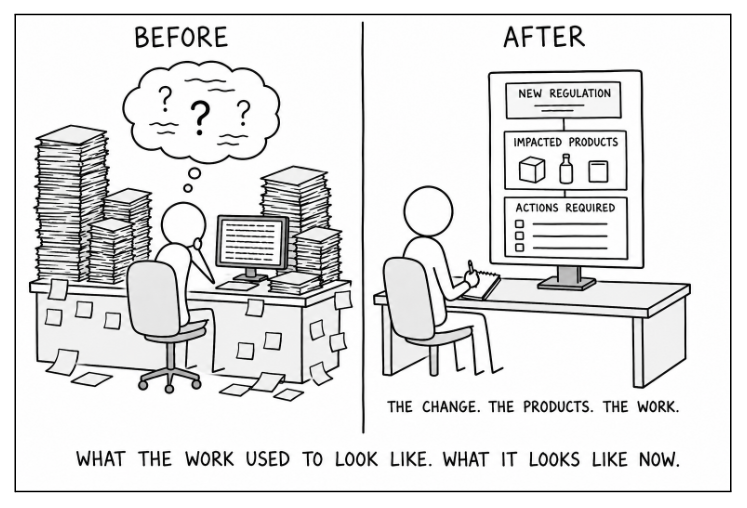
The team can do more with the time they have, because the work that consumed them before is the work our product does first. The hours that went into reading regulations now go into the work compliance has always wanted: setting product strategy across markets, getting efficient with regulatory change, sitting with product on decisions before they’re locked in. The team moves from reactive to proactive.
The cost of getting it wrong drops, because Ari catches what people miss. Applicability narrows tens of thousands of regulations to the ones that apply to a product. Prioritization surfaces the ones that need attention now based on the impact to the business. Actions translate the requirements that remain into product specific work, so the team can act faster with confidence.
The engine runs at full speed when the team is in front of the work, not behind it. More products. More markets. Faster launches. Less rework.
The early signals from the design partners say the bet is landing.
The consumer products lead picked up our product and used it to onboard a new team member based in Thailand, hired to cover Asia market expansion. He told us:
“This tool is going to be incredible for him.”
The work isn’t done. We are still learning what the next iteration looks like. Our design partners and the market will continue to be our greatest teachers.
If you’ve been in compliance long enough, you already know the function has been waiting for a product that actually gets it.
That’s exactly what we set out to build with the Adherent platform, and with Ari, the AI partner that lives inside it and becomes an extension of your team. Because when compliance teams finally have the right solution, companies can develop and launch safer products to market faster.
Compliance has always been a growth engine. The technology has finally caught up.
Welcome to Adherent.
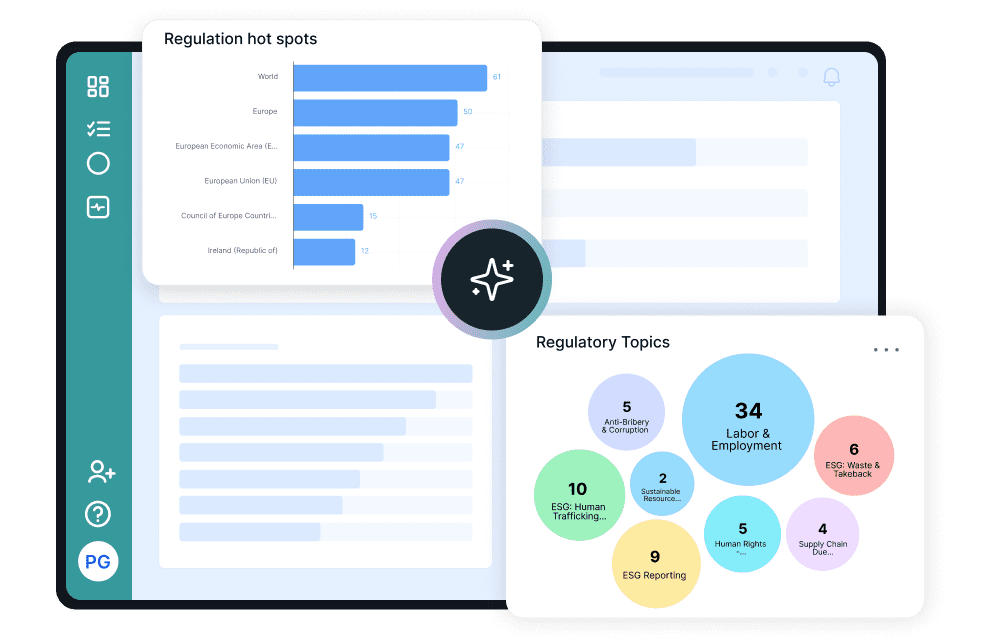
See Adherent in Action
Discover how agentic AI is reshaping product compliance for global enterprises.


The Ultimate Product Compliance Playbook
What the World’s Leading Product Organizations Have Figured Out About Product Compliance