

Regulatory Focus
Carbon Footprint

Carbon Footprint
195
Countries Covered
28
Languages
393
Regulatory Sources
A carbon footprint measures the total greenhouse gas emissions, including CO₂, generated directly and indirectly by activities, products, or organizations, covering emissions across production and transportation processes.
Carbon footprint management quantifies greenhouse gas emissions across operations and products, which often entails reporting obligations for both product lifecycles and corporate operations and informs decisions on low-emission manufacturing.
Companies are typically expected to measure, disclose, and manage greenhouse gas emissions associated with their operations and products. These obligations often span labeling, reporting, certification, and financial mechanisms designed to increase transparency, reduce emissions, and support climate mitigation objectives.
- Affix a carbon footprint label on their products to denote the CO2 emissions created as a by-product of manufacturing, transposing, or disposing of their products
- Certify that materials incorporated into a product or specific products are low carbon
- Report on the amount of greenhouse gasses produced in the manufacturing of specific products
- Provide information on the carbon footprint of a specific product
- Offset the amount of carbon used which involves reducing carbon or GHG emissions in order to compensate for or offset emissions made elsewhere
- Pay a carbon tax
Carbon footprint requirements are addressed through a combination of international standards, regional frameworks, and national laws governing quantification, reporting, labeling, and communication of greenhouse gas emissions. Our coverage focuses on lifecycle-based methodologies, disclosure obligations, and certification schemes applicable to organizations and products across global markets.
- Belgium: Carbon Border Adjustment Mechanism, Law, April 2024
- Brazil: Greenhouse Gas Emissions Trading System, Law No. 15042, 2024
- EU: Carbon Footprint Declaration Format for Batteries, Draft Regulation, April 2024
- EU: Methodology for the Calculation and Verification of the Carbon Footprint of Electric Vehicle Batteries, Draft Commission Delegated Regulation, April 2024
- EU: Establishing a Carbon Border Adjustment Mechanism, Regulation (EU) 2023/956
- EU: Establishing a Carbon Border Adjustment Mechanism (CBAM), Regulation (EU) 2023/956 – Amendment – (on simplifying and strengthening the carbon border adjustment mechanism) Regulation (EU) 2025/2083
- EU Greenhouse Gas Emission Allowance Trading, Directive 2003/87/EC (EU ETS Directive)
- France: Establishment of an Annual Collection of Environmental Data from Electronic Communications Operators, Data Centers, Terminal Manufacturers and Network Equipment Suppliers,Decision No. 2024-2545
- France: Banning Advertisements in Industries with a High Impact on Climate Change, Draft Law No. 1893, November 2023
- China: Solicitation for Comments on Draft Industry Standards on Product Carbon Footprint Product Category Rules of Single Frame and Modular Data Centers, Announcement, May 2024
- China: Energy Efficient and Low Carbon Product Certification, Order No.168, 2015
- China: Catalogue of Low-Carbon Certified Products, Second Batch, Announcement No. 5, 2016
- China: Implementation of Carbon Footprint Reporting for Automotive Power Batteries, Notice No. 551, 2025
- China: Guidelines for the Preparation of Product Carbon Footprint Accounting Standards, Notice No. 91, 2024
- South Korea: Standards for Low Carbon Products, Notice 2024-15
- South Korea: Standards for Low Carbon Products, Notice 2020-180 – Amendment – (on certification of products that have lower carbon emissions compared to the average emissions of similar products) Notice No. 2024-15
- Taiwan: Low Carbon Product Incentive Scheme, Order No. 1060050913, 2017
- UK: Carbon Border Adjustment Mechanism, Draft Financial Bill Measures, April 2025
- USA: Mandatory Greenhouse Gas Reporting, Final Rule, 40 CFR Part 98, 2009




Intelligent Resources




Automate the work of managing regulatory change.
Let AI agents do the heavy lifting of monitoring regulations, mapping requirements to products, extracting obligations, and surfacing the risks that need attention first.
Monitor Product Compliance
Stay Ahead of Regulatory Change
Get early visibility into changes that could affect your products, supply chain, or market access—so you can act proactively, not reactively.

Assess Regulatory Applicability
Map Regulations to Your Products
Eliminate manual research and cut through regulatory noise by surfacing only the requirements relevant to your business, markets, and product categories.
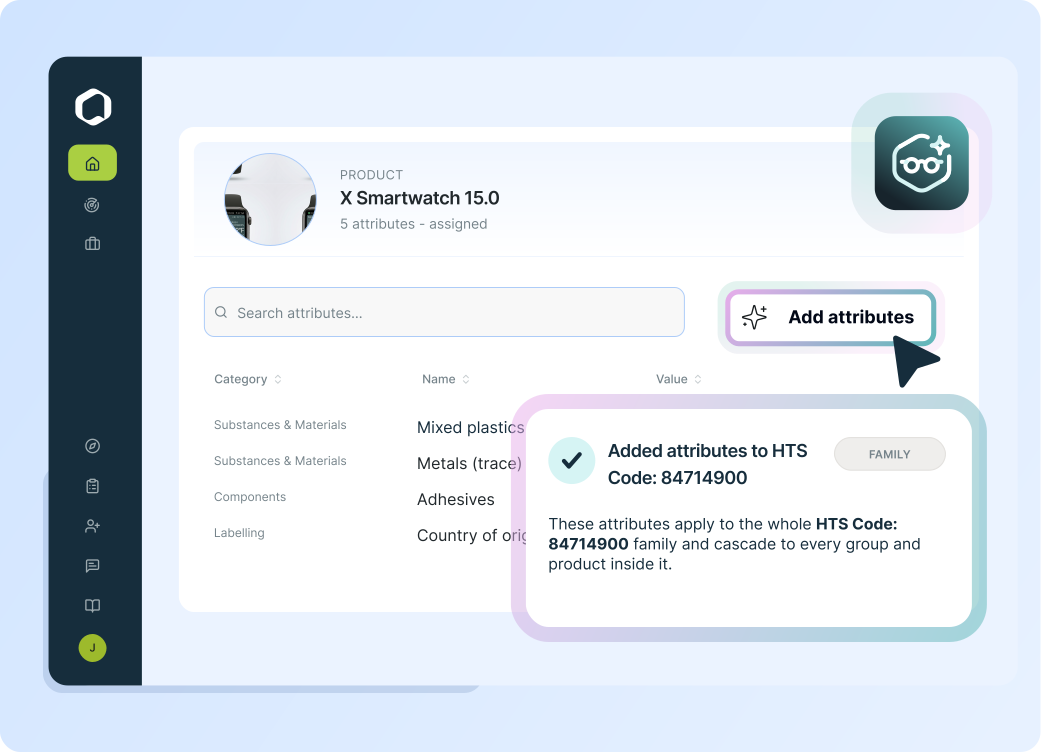
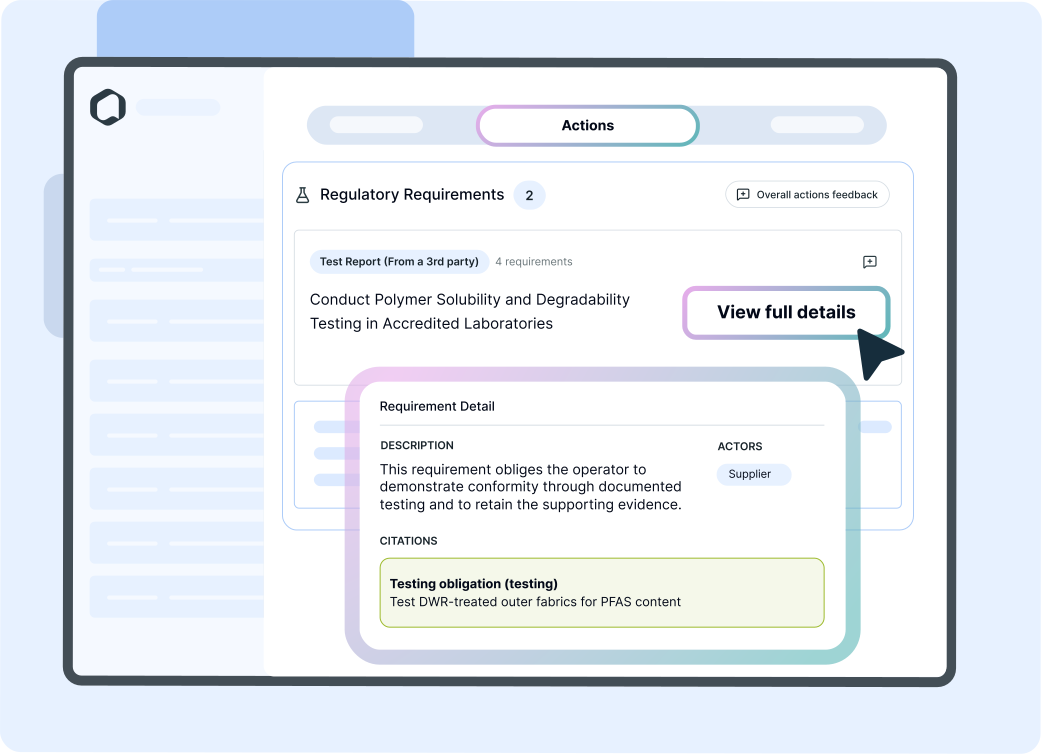
Identify Compliance Requirements
Turn complex regulations into clear, actionable tasks.
Give your teams instant clarity as AI agents transform dense legal and regulatory text into structured, easy-to-understand requirements.
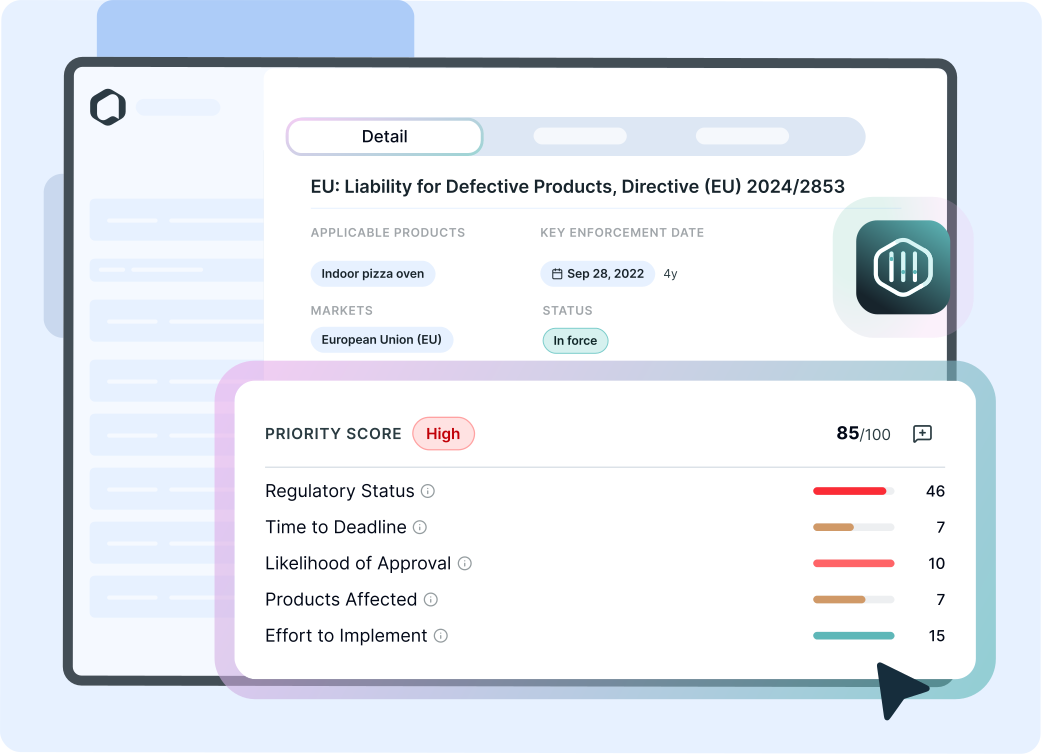
Prioritize Business Risk
Focus Where Risk Is Highest
Make faster, risk-informed decisions with confidence as AI agents automatically rank regulatory changes based on urgency, business impact, compliance deadlines, and product exposure.
Spotlight
Turning Compliance into Value


The State of Product
Compliance 2026
Discover how 500+ global leaders are shifting product compliance from a cost-centre into a strategic driver of growth, with key benchmarks like 69% of teams calling remediation their biggest challenge.
Frequently Asked Questions
-
A Corporate Carbon Footprint measures greenhouse gas emissions across an entire organization, including upstream and downstream activities, typically using the GHG Protocol. A Product Carbon Footprint assesses emissions across a specific product’s lifecycle, commonly aligned with ISO 14067 or equivalent national standards.
-
Requirements vary by jurisdiction. Some countries mandate carbon footprint labeling or disclosure through specific laws or certification schemes, while others rely on voluntary or standards-based approaches. Companies must assess applicable national regulations and referenced standards to determine labeling, reporting, or verification obligations.
-
The EU Carbon Border Adjustment Mechanism (CBAM) ensures a level playing field for carbon-intensive goods by equalizing the carbon price between domestic and imported products. By measuring the embedded carbon footprint of imports, CBAM applies a financial adjustment to goods produced under less stringent climate policies. Therefore, the accurate and fair measuring of carbon footprint of such products is central to CBAM’s functioning.
-
Not necessarily. Many voluntary regulations across jurisdictions encourage the provision of carbon footprint information for both products and companies and establish frameworks for certification and even financial incentives. This is particularly important for energy-intensive industries and for products that are part of an ecolabelling scheme.
-
It can be achieved organically by adopting low-carbon technologies, reducing energy consumption, and pursuing carbon offsetting activities including planting trees. Measures like purchasing verified carbon credits are also accepted by some jurisdictions. The key is to ensure verification and due diligence on the carbon offsetting efforts and remain compliant with the domestic legal frameworks.
More
Regulatory
Topics
Climate Change
Regulatory Focus Climate change 195 Countries Covered 28 Languages 5653 Regulatory Sources…
Environmental, Social and Governance (ESG) Reporting
Regulatory Focus ESG Reporting 195 Countries Covered 28 Languages 729 Regulatory Sources E…
Circular Economy Solutions
Regulatory Focus Circular Economy 195 Countries Covered 28 Languages 2748 Regulatory Sourc…
Sustainable Resource Use
Regulatory Focus Sustainable Resource Use 195 Countries Covered 28 Languages 533 Regulator…
Ecodesign
Regulatory Focus Ecodesign 195 Countries Covered 28 Languages 1406 Regulatory Sources Ecod…
Ecolabeling
Regulatory Focus Ecolabeling 195 Countries Covered 28 Languages 1115 Regulatory Sources Ec…