TÜV Rheinland Sustainability Summit: Key Takeaways

This blog was originally posted on 2nd July, 2026. Further regulatory developments may have occurred after publication. To keep up-to-date with the latest compliance news, sign up to our newsletter.
AUTHORED BY FREIDA WÜSCHNER GUBBINS, SENIOR REGULATORY COMPLIANCE SPECIALIST, ADHERENT
Key Insight
The regulatory landscape of the EU Green Deal is shifting rapidly, requiring businesses to navigate a massive volume of incoming sustainability compliance requirements over the next three years. While administrative burdens may be simplified, strict anti-greenwashing measures, third-party certifications, and accurate data collection remain non-negotiable for building a competitive advantage. Currently, gathering and retaining technical documentation stands as the single largest hurdle for companies attempting to meet these evolving obligations.
Table of Contents
- Opening Keynote: Supply Chain Resilience in a Shifting Geopolitical Landscape
- Panel 1: Product Carbon Footprint & LCA – From Substantiation to Competitive Advantage
- Expert Talk & Workshop: Navigating the EU Battery Regulation
- Panel 2: PPWR Updates, Timelines, and Design for Recycling
- Conclusion: The Ultimate Compliance Hurdle
- Frequently Asked Questions
Insights from the TÜV Rheinland Sustainability Summit Berlin
As the regulatory landscape shifts beneath our feet, staying ahead of compliance isn’t just about risk management—it’s a competitive advantage. At the recent TÜV Rheinland Sustainability Summit in Berlin, businesses and compliance experts gathered to dissect the future of the EU Green Deal, circular design, and the massive wave of incoming regulations.
Here are the key takeaways and actionable insights from the summit’s major sessions.
Opening Keynote: Supply Chain Resilience in a Shifting Geopolitical Landscape
Speaker: Dr. Joachim Bühler, TÜV Verband
Dr. Bühler opened the summit by bridging TÜV’s long history of safety and trust with its vital role in modern sustainability. His address focused on how the EU Green Deal has accelerated regulatory output from the European Commission, and how recent geopolitical events are impacting these environmental ambitions.
The Regulatory Tidal Wave
While the EU is aiming to streamline its agenda through new “Omnibus” initiatives, Dr. Bühler clarified that simplification does not mean a reduction in responsibility. Over the next three years, businesses face a massive volume of compliance requirements across multiple frameworks, including:
- CBAM (Carbon Border Adjustment Mechanism)
- PPWR (Packaging and Packaging Waste Regulation)
- EmpCO (Empowering Consumers for the Green Transition)
- EUDR (Deforestation Regulation)
- BATT2 (EU Battery Regulation)
- CSRD & CSDDD (Corporate Sustainability Reporting and Due Diligence Directives)
The Silver Lining: Despite political and corporate pushback, the economic incentives are massive. The global Green Economy is projected to reach $7 trillion by 2030, fueled by surging consumer demand for authentic, sustainable products.
The Power of Third-Party Certification
Subsequent discussions shifted to consumer trust. Deep dives into the Ecodesign for Sustainable Products Regulation (ESPR) and the Directive on the Repair of Goods revealed powerful consumer data:
- 86% of consumers support regulations that force companies to embed environmental criteria into product design.
- 64% actively look for certification marks when buying.
The Takeaway: While the EU may simplify reporting administration, anti-greenwashing measures and strict due diligence remain non-negotiable. Independent testing and third-party certification are now central to building a sustainable competitive advantage.
Panel 1: Product Carbon Footprint & LCA – From Substantiation to Competitive Advantage
This panel tackled the technical realities of greenhouse gas (GHG) emissions, the Circular Economy Action Plan, and implementation timelines.
Key Timelines & Methodologies
- Implementation Horizon: Because official delegated acts have not yet been adopted, experts predict the official implementation date for EU carbon footprint requirements will be early 2027.
- PCF vs. LCA: The panel compared Product Carbon Footprints (PCF) and Life Cycle Assessments (LCA). While an LCA offers a holistic environmental overview, it is highly complex and resource-intensive. Conversely, a PCF is more streamlined but risks oversimplifying carbon impact while overlooking other critical environmental factors.
The session concluded with an overview of TÜV Rheinland’s tailored certification solutions, which help businesses navigate these exact carbon and lifecycle management complexities.
Expert Talk & Workshop: Navigating the EU Battery Regulation
Battery supply chains face significant vulnerabilities. This session focused on how traceability, recycling, and strict compliance can actually build supply chain resilience.
The discussion focused heavily on the upcoming Digital Product Passports (DPP). Panelists openly addressed current compliance hurdles, including unresolved legal definitions, high fixed software implementation costs, and the massive infrastructure needed for ongoing data management.
Want to learn more about battery compliance in the EU and US? Download our guide.
Panel 2: PPWR Updates, Timelines, and Design for Recycling
“The PPWR isn’t a cookbook—it doesn’t give businesses a strict recipe to follow.” This sentiment set the stage for a deep dive into the Packaging and Packaging Waste Regulation.
Compounding the complexity are “grey areas” in the text and conflicting interpretations caused by translation differences across EU languages. Furthermore, experts predict that Digital Product Passports (DPP) will soon be integrated directly into packaging regulations.
An 8-Step Compliance Framework for the PPWR
To help businesses navigate the ambiguity, the panel outlined a practical roadmap:
- Define clear roles and responsibilities within your organization.
- Conduct a comprehensive packaging analysis and assessment.
- Ensure data availability across all packaging streams.
- Fulfill all packaging labeling obligations.
- Engage proactively with your packaging suppliers.
- Conduct formal conformity assessments.
- Establish a robust internal governance system.
- Monitor ongoing legislative developments closely.
Debunking Recycling Myths & Designing for the Future
The panel highlighted several common recycling misconceptions:
- Myth: Single-materials are always better.
- (Reality: Specific material characteristics must always be reviewed).
- Myth: A recyclable material guarantees a recyclable package.
- (Reality: Local recycling infrastructure dictates actual recyclability).
- Myth: Small components don’t matter.
- (Reality: All packaging components fall under the scope of the PPWR).
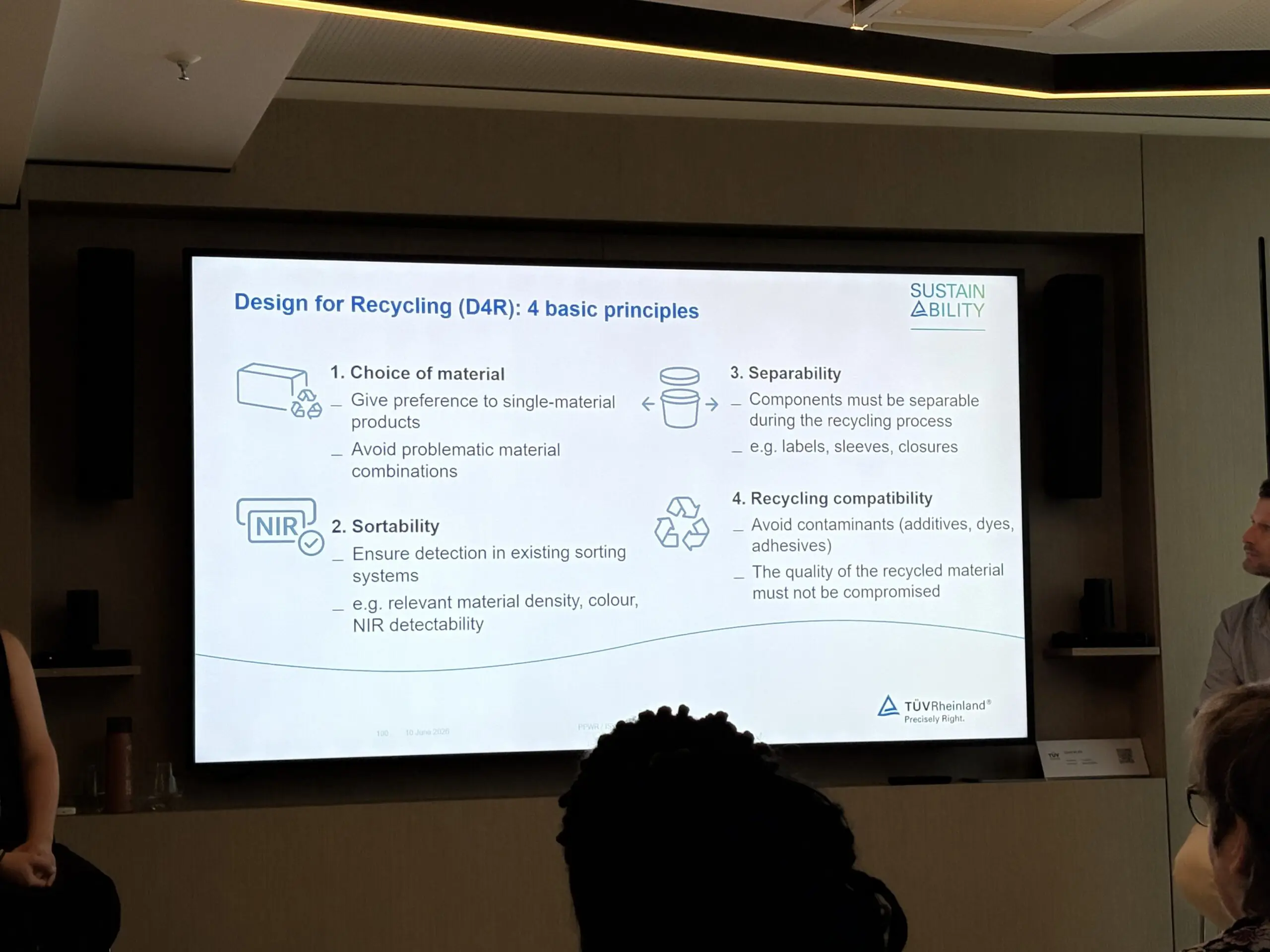
To counter these pitfalls, the panel recommended four core principles for circular design:
- Avoid problematic material combinations.
- Ensure packaging can be detected by Near-Infrared (NIR) sorting systems.
- Design components so they easily separate during the recycling process.
- Eliminate potential material contaminants.
For more on packaging in the EU, check out our whitepaper.
Conclusion: The Ultimate Compliance Hurdle
The overarching takeaway from the Berlin summit was clear: Data is your most valuable asset. Gathering, organizing, and retaining accurate information and technical documentation is currently the single biggest hurdle companies face regarding EU compliance. Audience queries made it obvious that businesses are particularly struggling to understand their immediate obligations under the PPWR.
Frequently Asked Questions
- When are the EU carbon footprint requirements expected to be officially implemented?
Experts predict the official implementation date for EU carbon footprint requirements will be early 2027, as official delegated acts have not yet been adopted. - What are the main hurdles preventing compliance with the upcoming Digital Product Passports (DPP) for batteries?
Current compliance hurdles for the DPP include unresolved legal definitions, high fixed software implementation costs, and the massive infrastructure needed for ongoing data management. - What are some common packaging recycling myths debunked at the summit?
The summit highlighted three major myths: first, that single-materials are always better (specific material characteristics must always be reviewed); second, that a recyclable material guarantees a recyclable package (local recycling infrastructure dictates actual recyclability); and third, that small components don’t matter (all packaging components fall under the scope of the PPWR). - What is currently identified as the single biggest hurdle for companies regarding EU compliance?
Gathering, organizing, and retaining accurate information and technical documentation is currently the single biggest hurdle companies face regarding EU compliance.
See Adherent in Action
Discover how agentic AI is reshaping product compliance for global enterprises.
Authors


Freida Wüschner Gubbins
Senior Regulatory Compliance Specialist
Helping companies meet their regulatory obligations regarding cosmetics, packaging, single-use plastics, and the transport of dangerous goods.


The Ultimate Product Compliance Playbook
What the World’s Leading Product Organizations Have Figured Out About Product Compliance