Understanding the EU AI Act’s Risk Levels
This blog was originally posted on 2nd September, 2026. Further regulatory developments may have occurred after publication. To keep up-to-date with the latest compliance news, sign up to our newsletter.
AUTHORED BY ANDREW O’NEILL, REGULATORY COMPLIANCE SPECIALIST, ADHERENT
Key Insight
Under the EU AI Act, risk is driven less by how sophisticated an AI system is and more by the power its use gives it over people, safety and fundamental rights. The greater the potential real-world consequence, the heavier the compliance burden making classification the critical first question for any organisation deploying AI.
Table of Contents
- Introduction
- Low or Minimal Risk AI
- Medium Risk: More Accurately, Limited or Transparency Risk
- High-Risk AI
- Unacceptable Risk: AI Practices That Are Prohibited
- Conclusion
Introduction
Artificial intelligence is not inherently high risk simply because it is powerful, complex or capable of making decisions. The real regulatory question is what the system is being used for, who can be affected, and what happens if something goes wrong. That is the logic at the centre of the European Union’s Artificial Intelligence Act, Regulation (EU) 2024/1689.
The EU could have attempted to regulate every AI system in the same way. Instead, it adopted a risk-based approach. This matters because AI is used across activities ranging from spam filtering to recruitment, medical devices and biometric identification. Imposing the same compliance burden on every use would be disproportionate, while leaving consequential systems lightly regulated would create obvious gaps.
The AI Act therefore matches the intensity of regulation to the intensity of the risk. The Regulation defines “risk” as the combination of the probability that harm will occur and the severity of that harm. Its recitals explain that the risk-based approach is intended to create proportionate and effective rules: some practices are prohibited, high-risk systems are subject to mandatory requirements, and certain other AI systems are subject primarily to transparency obligations.
The principle is straightforward: the greater the possible consequence of an AI system’s output, the stronger the safeguards that should surround it.
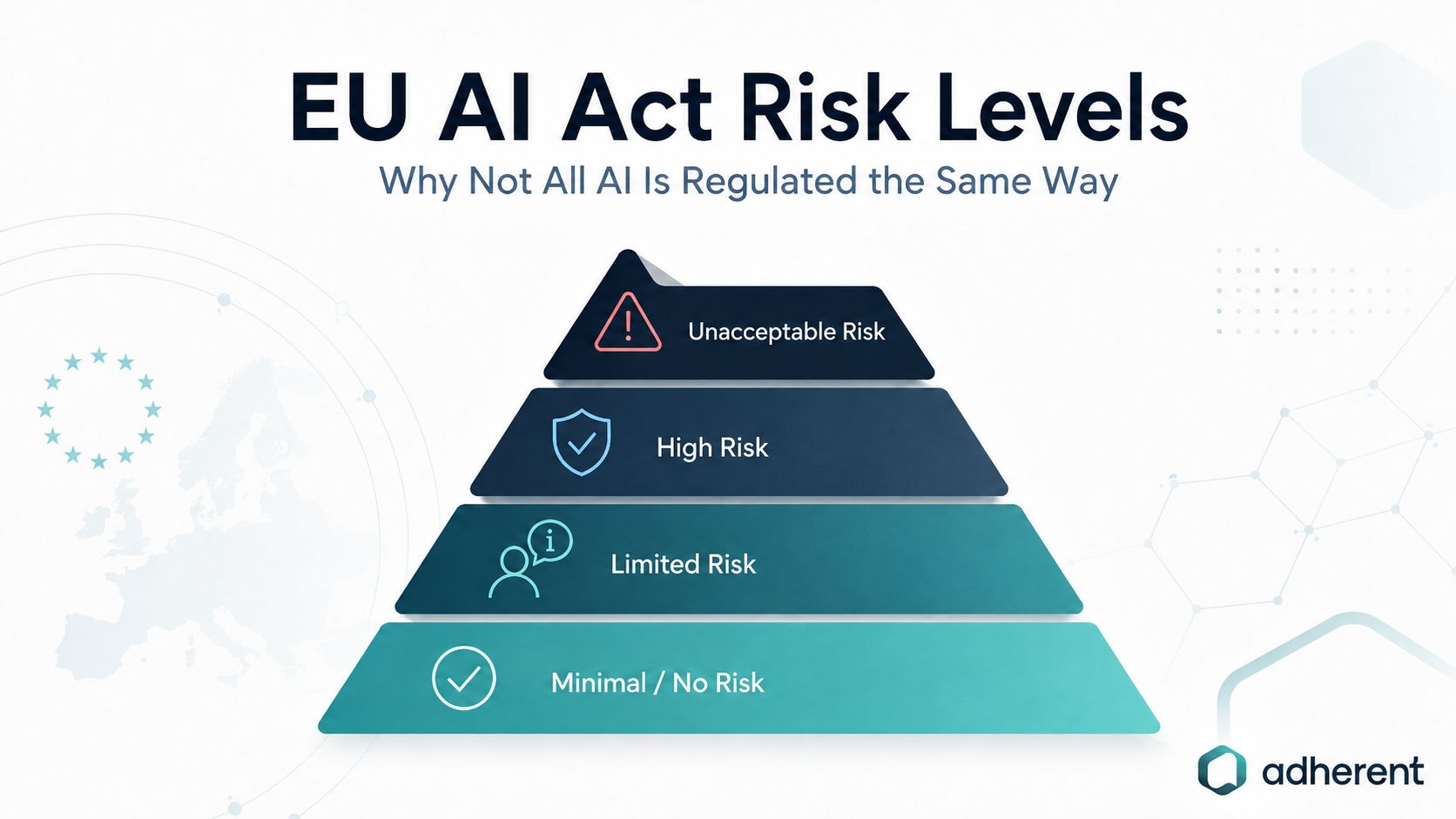
It is common to describe the AI Act using terms such as “low, medium and high risk”. That shorthand is useful, but it is not the exact legal structure used by the Regulation. In practice, the framework is better understood as four broad levels: minimal or low risk; limited or transparency risk; high risk; and unacceptable risk. General-purpose AI models are also regulated under separate provisions and should not simply be treated as another step on this ladder.
Want to find out more about global AI regulations? Check out our webinar-on-demand ‘AI Rules Are Changing: Key Regulatory Updates for 2025 & 2026’.
Low or Minimal Risk AI
At the lowest end are AI systems that do not fall into the prohibited, high-risk or specific transparency categories. These are often described as “minimal-risk” or “low-risk” systems.
Examples could include AI used to organise internal documents, filter spam, improve non-critical search results, assist with routine administrative work, or support entertainment functions where the output does not materially determine a person’s rights, safety or access to important services.
“Low risk” does not mean “no responsibility”. Other EU legislation can still apply, including data protection, consumer protection, product safety, employment and intellectual-property rules. The AI Act also encourages voluntary codes of conduct for AI systems other than high-risk systems, allowing providers and deployers to apply elements of the high-risk framework voluntarily.
This avoids turning ordinary, low-impact AI into an unnecessarily heavy compliance exercise.
Medium Risk: More Accurately, Limited or Transparency Risk
“Medium-risk AI” is not a defined category in the AI Act. What is often meant by the term is AI that does not meet the threshold for high-risk classification but creates a particular danger of deception, impersonation or misunderstanding. The Act addresses many of these systems through transparency obligations.
Where an AI system is intended to interact directly with a person, the provider generally has to ensure that the person is informed that they are interacting with AI unless that fact is obvious in the circumstances. This is highly relevant to chatbots and similar interactive systems.
The Act also imposes transparency requirements on systems that generate synthetic audio, images, video or text. Providers must, subject to the Regulation’s conditions and exceptions, ensure that artificially generated or manipulated outputs are marked in a machine-readable format and are detectable as such. Deployers of emotion-recognition or biometric-categorisation systems are also subject to information requirements where those uses are lawful.
This middle layer shows why the EU focuses on the nature of the risk rather than technical capability alone. A customer-service chatbot may not determine employment, healthcare or credit; its main risk may be that people are misled about whether they are communicating with a human. Transparency is therefore the proportionate control.
High-Risk AI
High-risk AI is where the regulatory requirements become substantially more demanding. Article 6 creates two principal routes into the high-risk category.
The first concerns AI used as a safety component of a product, or which is itself a product, covered by specified EU product-safety legislation where that product is required to undergo third-party conformity assessment.
The second route covers the use cases listed in Annex III. These include certain biometric systems; AI used as a safety component in critical infrastructure; systems used in education and vocational training; recruitment and worker-management systems; certain systems determining access to essential public or private services; and specified uses in law enforcement, migration, asylum, border control, the administration of justice and democratic processes.
These systems are treated differently because of their potential consequences. A recruitment tool can affect access to employment, a credit-scoring system can affect access to finance, and AI used in critical infrastructure can create physical safety consequences. Errors or bias can therefore have serious real-world effects.
Importantly, appearing in Annex III does not always end the assessment. Article 6 provides that certain Annex III systems will not be considered high-risk where they do not pose a significant risk of harm to health, safety or fundamental rights, including where they do not materially influence decision-making. Examples include narrow procedural tasks, preparatory tasks and systems that improve a previously completed human activity. However, an Annex III system that performs profiling of natural persons is always considered high-risk.
For high-risk systems, the Act moves beyond simple disclosure. Requirements include risk management, data governance, technical documentation, record-keeping, transparency and instructions for use, human oversight, accuracy, robustness and cybersecurity.
Human oversight is particularly important. The Regulation requires oversight measures to be proportionate to the system’s risk, autonomy and context of use. People assigned to oversight should be able to understand the system’s capabilities and limitations, recognise automation bias, interpret outputs and, where necessary, disregard, override, reverse or stop the system.
Unacceptable Risk: AI Practices That Are Prohibited
Above high risk is a category where the EU has concluded that controls are not enough. Certain uses are considered incompatible with EU values and fundamental rights and are therefore prohibited under Article 5, subject to the precise conditions and exceptions in the Regulation.
These include certain AI systems using subliminal, manipulative or deceptive techniques that materially distort behaviour and cause or are likely to cause significant harm; systems that exploit vulnerabilities linked to age, disability or particular social or economic situations; certain forms of social scoring; and criminal-risk prediction based solely on profiling or personality characteristics.
The Act also prohibits untargeted scraping of facial images from the internet or CCTV footage to create or expand facial-recognition databases, certain emotion-inference systems in workplaces and educational institutions, and particular biometric categorisation based on sensitive characteristics. The use of real-time remote biometric identification in publicly accessible spaces for law-enforcement purposes is also generally prohibited, although the Regulation establishes narrowly defined exceptions and safeguards.
The distinction between high risk and unacceptable risk is crucial. High-risk AI is not banned. It can be developed and used if the relevant legal requirements are satisfied. Unacceptable-risk practices cross a different threshold: the concern is that the particular use is considered fundamentally incompatible with the level of protection the EU intends to provide.
The Practical Question: What Can This AI Actually Do to a Person?
For organisations, the most useful starting point is not:
“How advanced is our AI?“
but:
“What is this AI used to do, and what consequences can its output have?”
The Regulation’s classification logic considers matters such as intended purpose, the nature and amount of data processed, the system’s autonomy, the possibility of human override, the scale and intensity of potential harm, whether affected people are dependent on the outcome, whether there is an imbalance of power, and whether the outcome can easily be corrected or reversed.
This makes the AI Act fundamentally a framework about consequences.
A relatively simple algorithm used to rank job candidates may attract more regulatory scrutiny than a sophisticated generative model used to create fictional images because the former can directly influence a person’s livelihood.
Conclusion
That is why the EU needs risk levels. AI is too broad a technology to regulate sensibly with a single set of rules. The risk-based model attempts to protect health, safety and fundamental rights without treating every AI application as equally dangerous. Indeed, the stated purpose of the Regulation is both to promote human-centric and trustworthy AI and to ensure a high level of protection while supporting innovation.
For businesses, the first compliance task is therefore classification: understand the intended purpose, identify who can be affected, determine the severity and likelihood of possible harm, and then establish which obligations follow.
Under the EU AI Act, the question is not simply whether a system uses artificial intelligence. The more important question is how much real-world power its use gives the system over people, safety and fundamental rights and whether the safeguards surrounding that power are proportionate to the consequences.
For more on the EU AI Act, check out our blog ‘AI Governance Under the EU AI Act: Risk Classification and Compliance Readiness for 2026’
See Adherent in Action
Discover how agentic AI is reshaping product compliance for global enterprises.
Authors


Andrew O'Neill
Regulatory Compliance Specialist
Global regulatory compliance for batteries and toys outside of Europe, interpreting and applying safety, chemical, labelling, sustainability, and market access requirements across North America, Asia, Latin America, Africa, and the Middle East.


The Ultimate Product Compliance Playbook
What the World’s Leading Product Organizations Have Figured Out About Product Compliance