

Regulatory Focus
Supply Chain Due Diligence

ESG: SUPPLY CHAIN DUE DILIGENCE
28
Languages Supported
28
Languages
600
Regulatory Sources
Supply Chain Due Diligence covers mandatory laws, regulations and standards, proposed, enacted & amended, as well as voluntary frameworks, guidance documents, factsheets and more concerning the obligations of undertakings to carry out supply chain due diligence.
Due diligence is the process by which undertakings identify, prevent, mitigate and account for actual and potential adverse impacts on human rights, including forced labor, and the environment in the company’s own operations, its subsidiaries and in its value chains.
Due diligence requirements typically require undertakings to:
- Integrate due diligence practices in their corporate policies,
- Identify actual and potential adverse impacts on human rights and the environment,
- Prevent and mitigate potential adverse impacts, bringing actual adverse impacts to an end and minimizing their extent,
- Establish and maintain a complaints procedure,
- Monitor the effectiveness of their due diligence policy and measures, and
- Report and publicly communicate on due diligence.
Sources covered include, but are not limited to:
- EU: Corporate Sustainability Due Diligence (CSDDD), Directive (EU) 2024/1760
- EU: Sustainability Reporting Standards (ESRS), Regulation 2023/2772
- EU: Corporate Sustainability Due Diligence (CSDDD), Directive (EU) 2024/1760 and Others – Amendment – (on reducing companies in scope and deleting sector specific ESRS requirement) Directive (EU) 2026/470 (Omnibus Content Amendment)
- EU: Omnibus Package, Q&A Document, February 2025
- EU: Batteries and Waste Batteries, Regulation (EU) 2023/1542
- EU: Batteries and Waste Batteries, Regulation (EU) 2023/1542 – Amendment – (on postponing the application date of battery due diligence obligations by 2 years) Regulation (EU) 2025/1561
- EU: Making Available on the Union Market and Export from the Union of Certain Commodities and Products Associated with Deforestation and Forest Degradation, Regulation (EU) 2023/1115
- EU: Making Available on the Union Market and Export from the Union of Certain Commodities and Products Associated with Deforestation and Forest Degradation, Regulation (EU) 2023/1115 – Amendment – (on delay and simplified measures for small enterprises) Regulation (EU) 2025/2650
- EU: Making Available on the Union Market and Export from the Union of Certain Commodities and Products Associated with Deforestation and Forest Degradation, Regulation (EU) 2023/1115 – Proposed Amendment – (on clarifying the list of relevant products) Draft Delegated Act, April 2025
- EU: Prohibiting Products Made with Forced Labour on the Union Market, Regulation (EU) 2024/3015
- France: Duty and Vigilance of Parent and Subcontracting Companies, Law No. 2017-399
- Germany: Corporate Due Diligence In Supply Chains Act, BGBl. 2959, 2021
- Germany: Corporate Due Diligence In Supply Chains Act, BGBl. 2959, 2021 – Proposed Amendment – (on reporting and penalties) Draft Law, August 2025
- Netherlands: International Corporate Responsibility, Draft Act, November 2024
- Norway: Business Transparency and Work on Fundamental Human Rights and Decent Working Conditions, Act No. 99, 2021
- Sweden: Due Diligence in the Supply Chain, Regulation SFS 2020:1187
- Switzerland: Due Diligence Obligations and Transparency Regarding Minerals and Metals from Conflict Areas and Child Labour, Ordinance, December 2021
- Switzerland: Corporate Sustainability Reporting and Supply Chain Due Diligence, Draft Law, April 2026
- UK: Modern Slavery Act, 2015
- UK: Modern Slavery Act, 2015 – Proposed Amendment – (on expanding the content of the modern slavery statement and introducing a new deadline for submission) Draft Act, June 2026
- Australia: Strengthening the Modern Slavery Act, Consultation Paper, July 2025
- Canada: Fighting Against Forced Labour and Child Labour in Supply Chains Act, c. 9, 2023
- USA: Prevention of Forced Labor in Xinjiang Uyghur (UFLPA), House Bill 6256 Enacted, 2021
- USA: Prohibition on Participation in Foreign Sustainability Due Diligence Requirements, Senate Bill 985, 2025
- Colombia: Human Rights Framework for Companies, Draft Law, July 2025
- Brazil: National Framework for Human Rights and Business, Bill PL 572/2022
- South Korea: Human Rights and Environmental Protection for Sustainable Corporate Management, Draft Law, November 2025
- ILO: Combating Forced Labour: A Handbook for Employers and Business, Guidelines, November 2025
- OECD: Multinational Enterprises on Responsible Business Conduct in a Global Context, Guidance Document, June 2023
We cover key ESG standards related to the content areas in your subscription as a part of our Corporate Sustainability Solution.
Connection with other Content Areas:
Human Trafficking and Slavery (HT&S)
Whilst HT&S legislation may require companies to undertake due diligence on their suppliers, agents and contractors in order to eradicate HT&S from their supply chains, the HT&S content area also covers additional requirements including (i) reporting on efforts to eradicate slavery from the supply chain; (ii) certifying that materials incorporated into products comply with human trafficking laws (iii) provision of training on mitigating human trafficking for employees and management responsible for supply chains; and (iv) drafting modern slavery statements and registering them with a Modern Slavery Statements Register. The Supply Chain Due Diligence content area, on the other hand, is focused solely on due diligence requirements.
Regulations that require companies to undertake due diligence on their suppliers, agents, and contractors in order to eradicate HT&S from their supply chain may fall under both HT&S and Supply Chain Due Diligence. However, regulations that require companies to report on their efforts to eradicate slavery from the supply chain, or certify that materials incorporated into products comply with human trafficking laws or train employees on human trafficking regulations – and that do not contain any due diligence obligations – fall under HT&S only.
Labor & Employment
Supply Chain Due Diligence may also overlap with our Labor & Employment content area which may also include due diligence obligations for companies with regards to the protection of work-related rights for their workers. These include working conditions such as maximum working hours, breaks, secure employment, work-life balance, adequate wages, freedom of association as well as equal treatment and opportunities irrespective of gender, religious or racial considerations. These work-related rights may also include child labor and forced labor within the workplace.
In this respect, regulations that require companies to undertake due diligence on their workforce or workers in their supply chain may fall under both Labor & Employment and Supply Chain Due Diligence. However, Labor and Employment regulations that do not contain any due diligence obligations fall under Labor and Employment only.
ESG Reporting
ESG Reporting requires undertakings to report on their overall environmental, social and governance risks, impacts, policies and measures which may include an obligation to disclose information on their due diligence policies and practices.
Supply Chain Due Diligence, on the other hand, requires undertakings to conduct due diligence and does not necessarily contain an obligation to report on it.
Sources requiring companies to report on their due diligence processes alongside with other environmental, social and governance matters may fall under both ESG reporting and Supply Chain Due Diligence.
Conflict Minerals
Our Conflict Minerals content area applies to regulations that cover the ‘3TG’ minerals only i.e., tin, tungsten, tantalum and gold. Specifically, it covers regulations that require companies in the supply chain to ensure they import tin, tungsten, tantalum and gold from responsible and conflict-free sources only and to put in place more specific mechanisms for conducting due diligence, e.g. independent third-party audit of supply chain due diligence. The scope of due diligence requirements under the Conflict Minerals content area is therefore limited to conflict minerals such as gold, tungsten, tantalum or tin.
Supply Chain Due Diligence, on the other hand, applies to value chains of additional minerals that are
not covered in our Conflict Minerals content area but that produce human rights, climate and environmental adverse impacts.
In this respect, regulations that require companies to undertake due diligence on the 3TG minerals may fall under both Conflict Minerals and Supply Chain Due Diligence. However, Supply Chain Due Diligence regulations that apply to other minerals fall under Supply Chain Due Diligence only.
Illegal Logging
The Illegal logging content area covers laws and regulations that focus on certain commodities and product supply chains that require companies to undertake due diligence to ensure the products they supply are not made from illegally harvested timber. These regulations are specifically designed to reduce the impact of consumption and production on deforestation and forest degradation and typically do not require companies to remedy any harm that they may cause.
By contrast, Supply Chain Due Diligence is broader and is not focused on products or processes made or supplied from illegally harvested timber. Instead, it requires companies to undertake due diligence regarding the human rights, environmental and governance impacts that all of their processes or products may have and to remedy any harm that they may cause. It focuses on value chain due diligence related to activities that are not covered by regulations on deforestation-free or illegal logging products but might be directly or indirectly leading to deforestation.
Sources that contain due diligence requirements relating to the consumption and production of illegally harvested timber and/or wood may fall under both Illegal Logging and Supply Chain Due Diligence. Sources that contain due diligence requirements relating to activities that are not covered by regulations on deforestation-free or illegal logging products fall under Supply Chain Due Diligence only.



Intelligent Resources

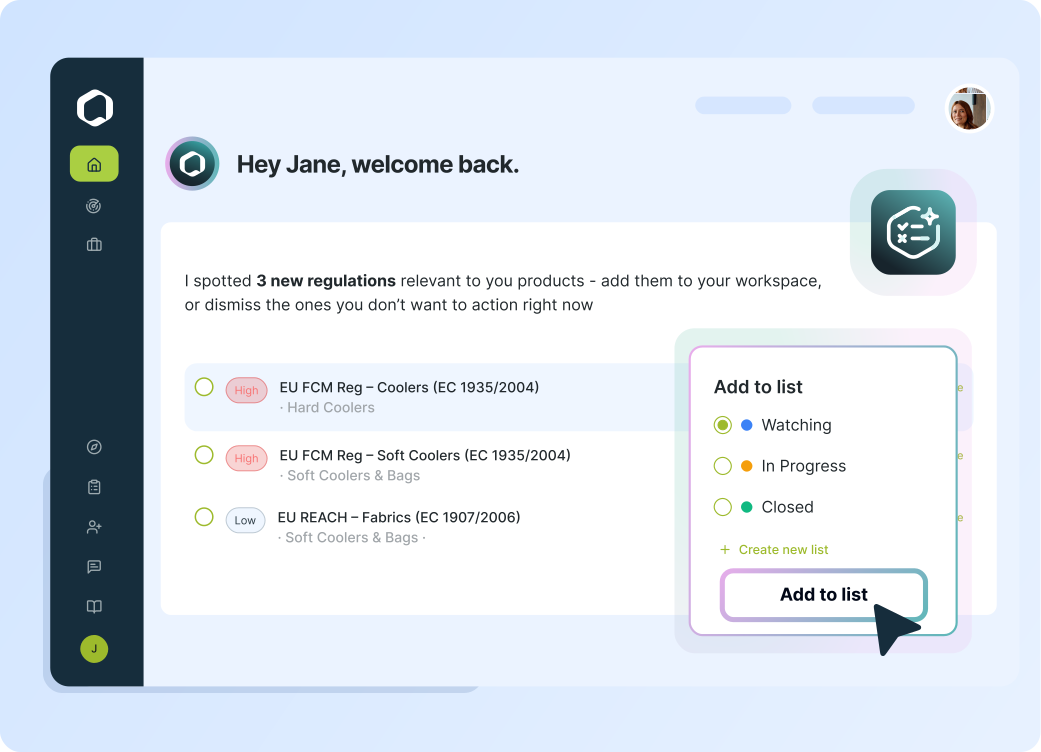
Automate the work of managing regulatory change.
Let AI agents do the heavy lifting of monitoring regulations, mapping requirements to products, extracting obligations, and surfacing the risks that need attention first.
Monitor Product Compliance
Stay Ahead of Regulatory Change
Get early visibility into changes that could affect your products, supply chain, or market access—so you can act proactively, not reactively.
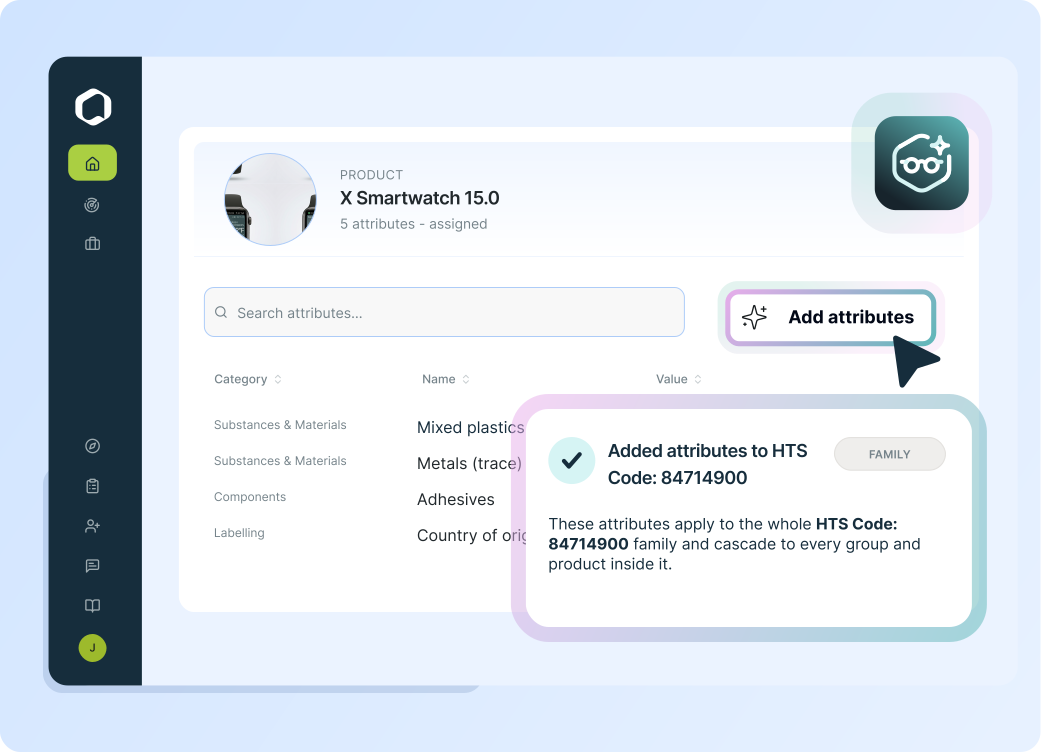
Assess Regulatory Applicability
Map Regulations to Your Products
Eliminate manual research and cut through regulatory noise by surfacing only the requirements relevant to your business, markets, and product categories.
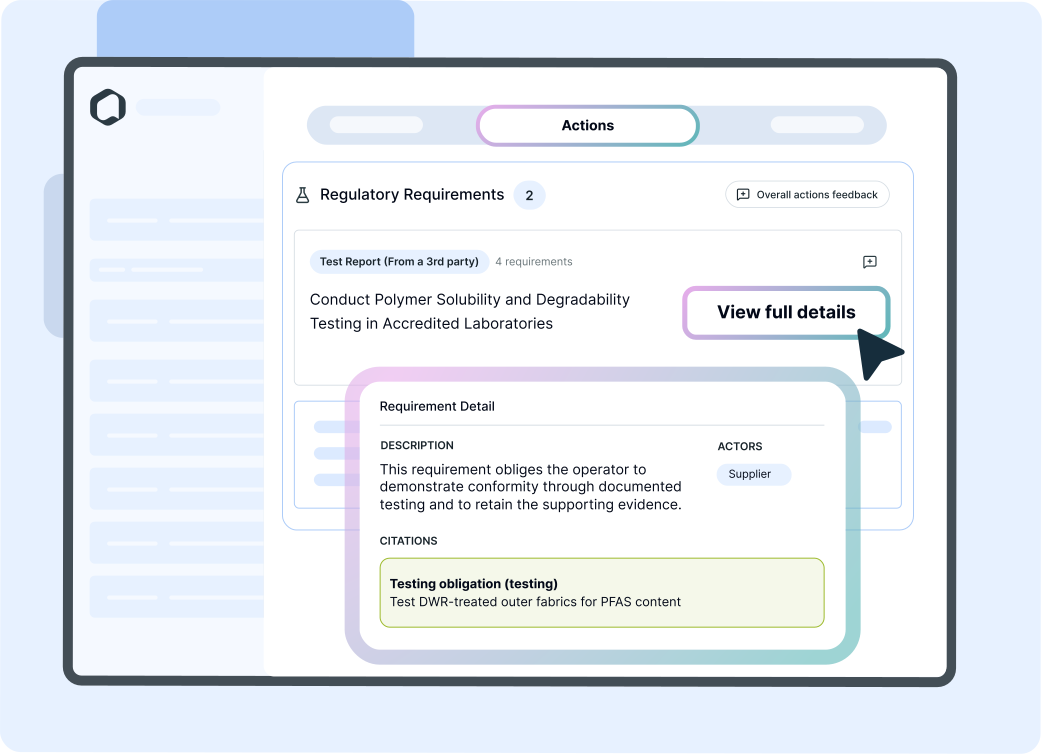
Identify Compliance Requirements
Turn complex regulations into clear, actionable tasks.
Give your teams instant clarity as AI agents transform dense legal and regulatory text into structured, easy-to-understand requirements.
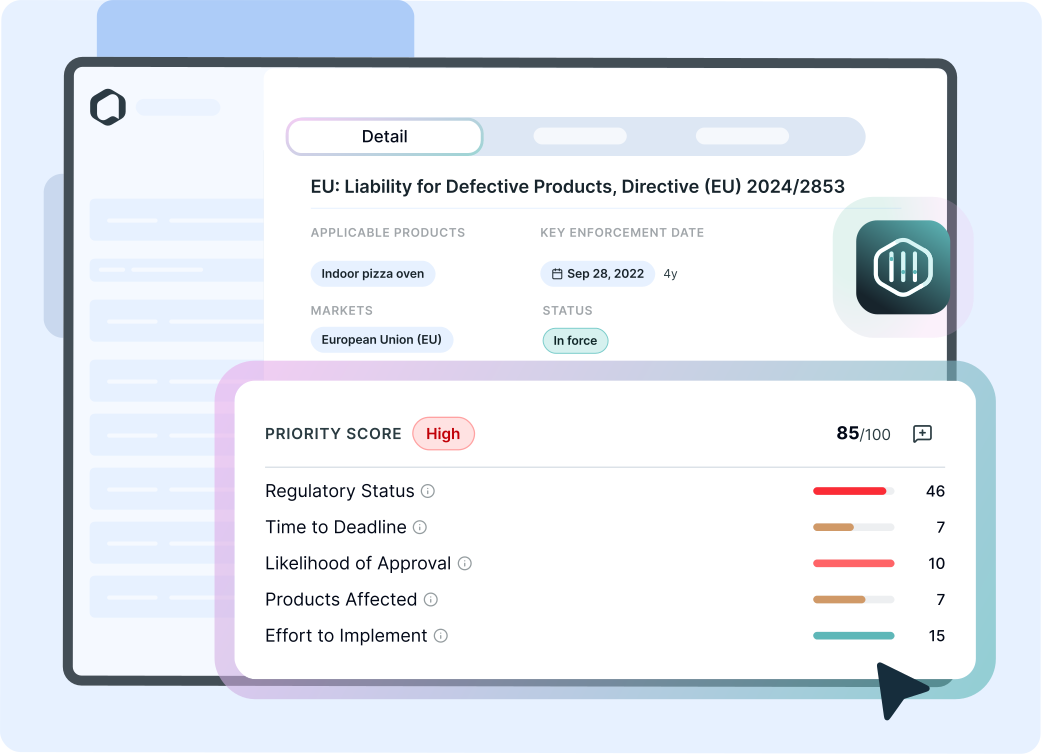
Prioritize Business Risk
Focus Where Risk Is Highest
Make faster, risk-informed decisions with confidence as AI agents automatically rank regulatory changes based on urgency, business impact, compliance deadlines, and product exposure.
Spotlight
Turning Compliance into Value


The State of Product
Compliance 2026
Discover how 500+ global leaders are shifting product compliance from a cost-centre into a strategic driver of growth, with key benchmarks like 69% of teams calling remediation their biggest challenge.
Frequently Asked Questions
-
Mandatory supply chain due diligence laws typically apply to large corporations that meet specific thresholds regarding their annual turnover and total number of employees. While most supply chain due diligence frameworks target large corporations, smaller entities may find themselves indirectly affected as they are asked by their larger corporate partners to provide information on their operations. Certain sector-specific due diligence rules focusing on forest products or batteries often also capture smaller companies.
-
Voluntary standards such as the UN Guiding Principles and OECD Guidelines describe what responsible human rights and environmental due diligence should look like, but they are not directly enforceable by regulators. Many new laws explicitly build on these frameworks and “hard‑wire” their concepts into legislation, turning previously soft‑law expectations into legal duties for companies within scope. As a result, companies that already followed UNGP/OECD approaches are often better prepared to comply with emerging statutory requirements.
-
While the primary focus of many supply chain due diligence laws is on companies headquartered within the regulating jurisdiction, the CSDDD extends its scope to foreign firms that generate at least 1.5 billion net turnover annually in the EU, forcing global entities to align their entire international operations with European human rights and environmental standards.
-
Companies are expected to embed due diligence into policies and governance, identify and assess human rights and environmental risks in their operations and value chains, take measures to prevent or mitigate adverse impacts, provide grievance mechanisms, monitor effectiveness, and publicly report on actions and outcomes, often aligned with EU sustainability reporting standards.
-
Sanctions range from administrative fines based on turnover, through confiscation of non‑compliant products or revenues, to exclusion from public procurement and access to public funding. Some frameworks, like France’s Duty of Vigilance Law and the CSDDD, also open the door to civil liability claims if companies fail to meet their due diligence obligations and harms occur. In parallel, trade‑based measures such as bans on products made with forced labour or linked to deforestation give authorities the power to stop goods at the border.
More
Regulatory
Topics
Supply Chain Due Diligence
Regulatory Focus ESG: SUPPLY CHAIN DUE DILIGENCE 28 Languages Supported 28 Languages 600 R…
Sustainable Resource Use
Regulatory Focus Sustainable Resource Use 195 Countries Covered 28 Languages 533 Regulator…
Anti Bribery & Corruption
Regulatory Focus ESG: Anti Bribery & Corruption in C2P 195 Countries Covered…
Labor & Employment
Regulatory Focus Labor & Employment 195 Countries Covered 28 Languages 5166 Regulatory…
Human Rights – Affected Communities
Regulatory Focus Human Rights – Affected Communities 195 Countries Covered 28 Languages 26…
Climate Disclosures
Regulatory Focus Climate Disclosures 195 Countries Covered 28 Languages 670 Regulatory Sou…
Environmental, Social and Governance (ESG) Reporting
Regulatory Focus ESG Reporting 195 Countries Covered 28 Languages 729 Regulatory Sources W…
Illegal Logging Requirements
Regulatory Focus Illegal Logging 195 Countries Covered 28 Languages 313 Regulatory Sources…
Battery Regulatory Compliance
Regulatory Focus Batteries 195 Countries Covered 28 Languages 3216 Regulatory Sources Batt…
Textiles
Regulatory Focus Textiles 195 Countries Covered 28 Languages 3333 Regulatory Sources Adher…