

Regulatory Focus
Textiles
Textiles
195
Countries Covered
28
Languages
3333
Regulatory Sources
Adherent’s textiles regulatory content contains laws, regulations and standards governing the textile industry that establish legal requirements and good practice guidelines on aspects such as the safety, testing, certification and labeling of fashion and home products, including apparel, footwear, sleepwear, and carpets (e.g. by laying down rules governing the labeling of products in relation to their textile fibre content).
Our textile content contains state, national, regional and international instruments related to the area, focusing on restricted substances and labeling particulars, along with packaging, certification, testing and safety requirements. We also track requirements that specifically relate to products for children and infants. Waste of textiles is also covered.
Our coverage of restricted substances and materials includes, but is not restricted to azocolorants and aromatic dyes, chromium VI, flame retardants, lead, nickel, formaldehyde, pentachlorophenol, dimethyl fumarate, organotin compounds, phthalates, PFAS and cat & dog fur. We track labeling requirements in relation to care instructions, country of origin, wool, faux and real leather disclosures, CPSIA Tracking Labels, and country and regional marking such as the CE, EurAsEC and GCC marks. Our product safety coverage includes physical and mechanical hazards, product specific requirements and drawstring restrictions.
Our coverage encompasses the following product categories:
- Adult and children’s – Apparel, Footwear, Sleepwear, Accessories
- Home textiles (bedding, curtains, oven mitts, towels, etc.)
- Mattresses and mattress pads
- Carpets and rugs
- Tents, and
- Umbrellas
Adherent’s coverage of textiles regulations is historically comprehensive and includes, but is not limited to:
- Argentina: Labelling Requirements for Footwear, Resolution No. 465/2018
- Australia: Goods (Care Labelling) Information Standard 2023
- Brazil: Approving Technical Regulation on Footwear Labelling, Portaria No. 459, 2025
- Canada: Textile Labelling Act, c.T-10, 1985
- Canada: Textile Labelling and Advertising Regulations, C.R.C., c. 1551, 2010
- Canada: Textile Flammability Regulations, SOR/2016-194
- California (USA): Responsible Textile Recovery, Senate Bill 707 Enacted, 2024
- Denmark: Ban on the Import and Sale of Clothing, Footwear and Waterproofing Agents that Contain PFAS, Order BEK No. 464, 2025
- EU: Labelling of Textile Products, Regulation (EU) No. 1007/2011
- EU: Labelling of the Materials used in the Main Components of Footwear for Sale to the Consumer, Directive 94/11/EC
- EU: Waste Directive, 2008/98/EC – Proposed Amendment – (on extended producer responsibility scheme for textiles) Draft Directive, July 2023
- EU: Strategy for Sustainable and Circular Textiles, Communication, March 2022
- EU: Framework for Setting Ecodesign Requirements for Sustainable Products (ESPR), Regulation (EU) 2024/1781
- EU: Exemptions to Prohibiting the Destruction of Unsold Apparel and Footwear as Prescribed in Annex VII to Regulation (EU) 2024/1781, Regulation 2026/296
- EAEU: On the Marking of Clothing, Accessories and Other Products Made from Natural Fur with Means of Identification, Decision No. 116, 2026
- France: Methods of Calculation and Communication of Environmental Cost of Textiles, Draft Decree, November 2024
- France: Per- and Polyfluoroalkyl Substances (PFAS) Restrictions, Law No. 2025-188
- France: Reducing the Environmental Impact of the Textiles Industry, Law No. 2026-602
- Indonesia: Mandatory Product Labelling in the Bahasa Language, Regulation No. 25/2021
- Italy: Extended Producer Responsibility for Textiles, Draft Decree, April 2025
- Japan: Textile Goods Quality Labelling Regulation, Notice No. 4, 2017
- Japan: JIS L 0001:2024 Textiles – Care Labelling Code Using Symbols, 2024
- Mercosur: Approving Technical Regulations on Labelling of Textile Products, Resolution, MERCOSUR/GMC/RES. N.62/18
- Mexico: Commercial Information for Labelling of Textile Products, Garments and Household Linen, Standard NOM-004-SE-2021
- Mexico: Prevention and Management of Waste, General Law, October 2003 – Proposed Amendment – (on addition of textile waste) Draft Decree, August 2025
- New Zealand: Consumer Information Standards (Fibre Content Labelling) Regulations, SR 2000/154
- New Zealand: Consumer Information Standards Country of Origin (Clothing and Footwear) Labelling, Regulations SR 1992/360
- Russian Federation: Labelling of Footwear Products by Means of Identification, Resolution No. 620, 2018
- Russian Federation: Rules for Marking Footwear Products by Means of Identification and the Implementation of the State Monitoring Information System, Resolution No. 860, 2019
- Saudi Arabia: Textile Products, Technical Regulation, January 2024 – Proposed Amendment – (on updating the current textile products technical regulation) Draft Technical Regulation, March 2026
- Slovak Republic: Labelling of the Materials Used in the Main Components of Footwear, Decree No. 112/2026
- Switzerland: Reduction of Risks Linked to Use of Dangerous Substances Preparations and Articles Ordinance, May 2005 – Amendment – (on PFOA, PFOS, PFHxA, lead, ODS, etc) Ordinance, October 2025
- Taiwan: Mandatory Commodity Inspection of Non-Baby Textile Products (Garments, Sweaters, Swimwear and Hosiery), Notice No. 10120009680, 2012
- Taiwan: Labelling Criteria for Textiles, Announcement No. 10402435750, 2015
- Turkey: Conformity Assessment of Certain Products with Relevant Standards, Communiqué, May 2016 – Amendment – (on information and labelling requirements for consumer products containing parts of animal origin) Communiqué No. 32865, April 2025
- Turkey: Framework on Ecodesign Requirements for Sustainable Products, Draft Regulation, January 2026
- USA: Origin and Manufacturer Identification for Import of Textiles, 19 CFR 102.23, Rule, 2005
- USA: Textile Fiber Products Identification Labelling Act, 15 USC 70, 1958
- USA: Textile Fiber Products Identification Rules, 16 CFR 303
- USA: Wool Products Identification Labelling Rules, 16 CFR 300
- USA: Fur Products Identification Labelling Act, 15 USC 69
- USA: Fur Products Identification Labelling Rules, 16 CFR 301
- USA: Standards for Flammability in Clothing Textiles, Rule, 16 CFR Part 1610, 2008
- New Mexico (USA): Toxic PFAS in Consumer Products, NMAC 20.13.2, Rule, March 2026
We cover standards for our core products that are available from our partner Accuris. These are available through our Product Compliance Solution.
We track regulatory developments governing product recalls, specifically recall obligations that apply to manufacturers such as:
- The use of standardised notice templates
- Prescribed public-facing information and the channels through which it is communicated including formal notifications to regulators via centralised alert mechanisms
- Consumer remedy rights
- Maintenance of records demonstrating how a safety issue was identified, assessed, and resolved as well as records of all communications with regulators and supply chain partners
- Risk assessments justifying the recall
- Traceability data identifying affected products and their distribution
- Internal register of complaints, recalls and corrective measures taken
- Sanctions are also relevant and may include penalties for inadequate actions such as delayed incident reporting or failure to notify the authorities.
| Countries Monitored | ||
|---|---|---|
| Americas | EMEA | Asia Pacific |
| Argentina Antigua and Barbuda Barbados Belize Bolivia Brazil Canada (including Federal and provincial) Chile Colombia Costa Rica Dominica Dominican Republic Ecuador El Salvador Grenada Guatemala Honduras Jamaica Mexico Nicaragua Panama Paraguay Peru MERCOSUR Trinidad and Tobago Uruguay (from July 2024) United States* (includes Federal and state requirements) | Austria Bahrain Belarus Belgium Bulgaria Brunei Darussalam Croatia Cyprus Czech Republic Denmark Egypt Estonia EurAsEC/EAEU EU Finland France Germany Gibraltar Greece GCC Hungary Iceland Ireland Israel Italy Jordan Kazakhstan Kyrgyzstan Kuwait Latvia Lithuania Luxembourg Malta Monaco Netherlands Norway Oman Poland Portugal Qatar Romania Russian Federation Saudi Arabia Slovakia Slovenia South Africa Spain Sweden Switzerland Tajikistan Turkey UAE* UK Ukraine (from July 2024) | Australia Bangladesh Cambodia China (mainland, PRC) Hong Kong India Indonesia Japan Macao Malaysia Maldives Mongolia New Zealand Pakistan Philippines Singapore* South Korea Sri Lanka Taiwan (PRC) Thailand Vietnam (*Added July 2017 – monitored from this date) |




Intelligent Resources
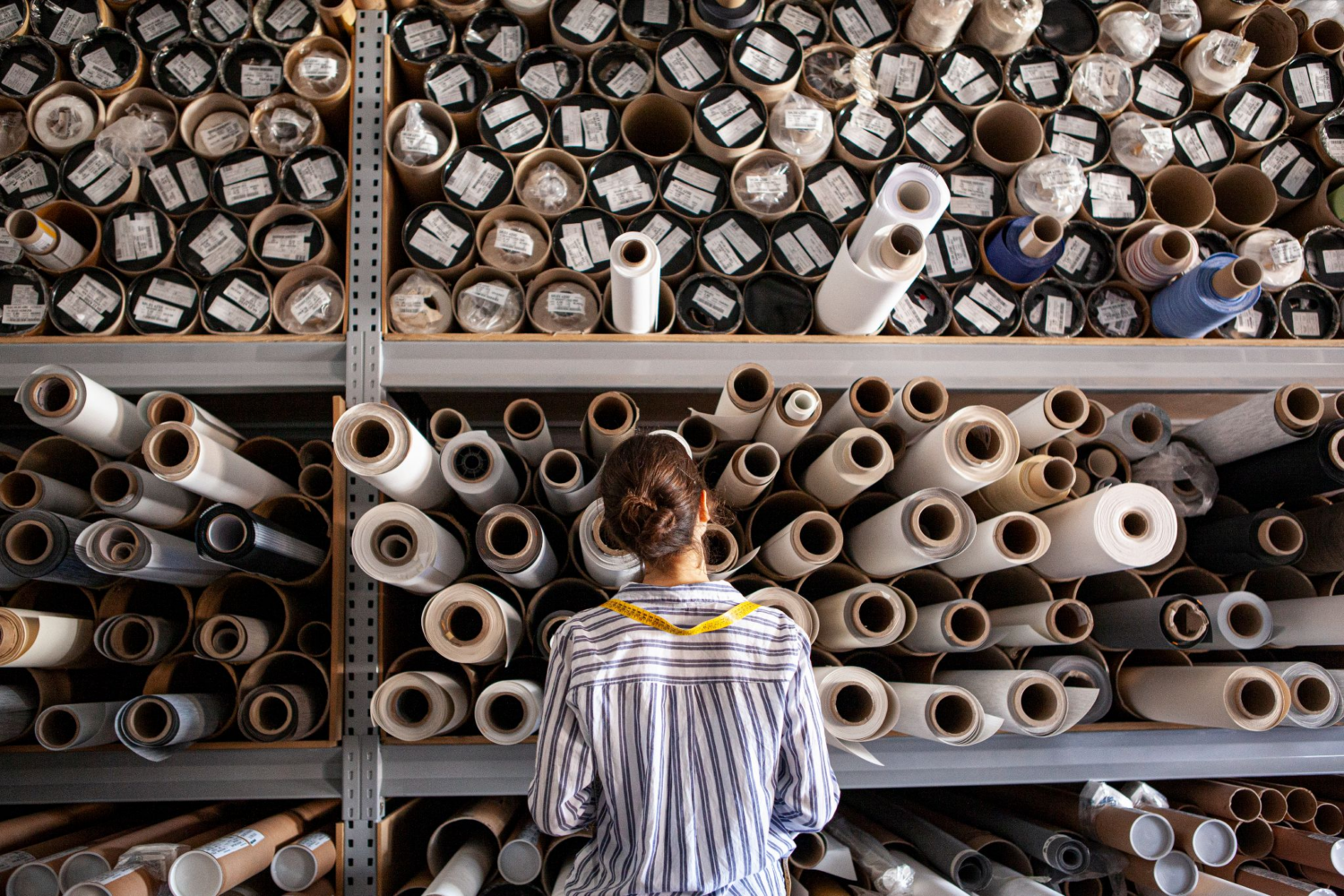



Automate the work of managing regulatory change.
Let AI agents do the heavy lifting of monitoring regulations, mapping requirements to products, extracting obligations, and surfacing the risks that need attention first.
Monitor Product Compliance
Stay Ahead of Regulatory Change
Get early visibility into changes that could affect your products, supply chain, or market access—so you can act proactively, not reactively.

Assess Regulatory Applicability
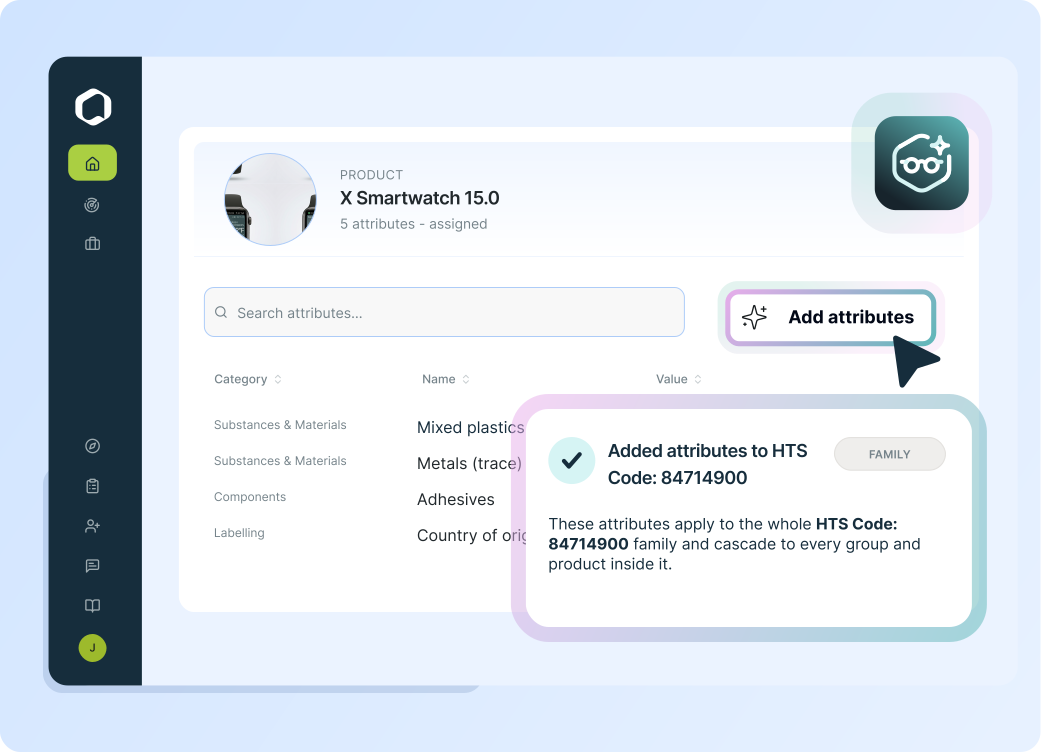
Map Regulations to Your Products
Eliminate manual research and cut through regulatory noise by surfacing only the requirements relevant to your business, markets, and product categories.
Identify Compliance Requirements
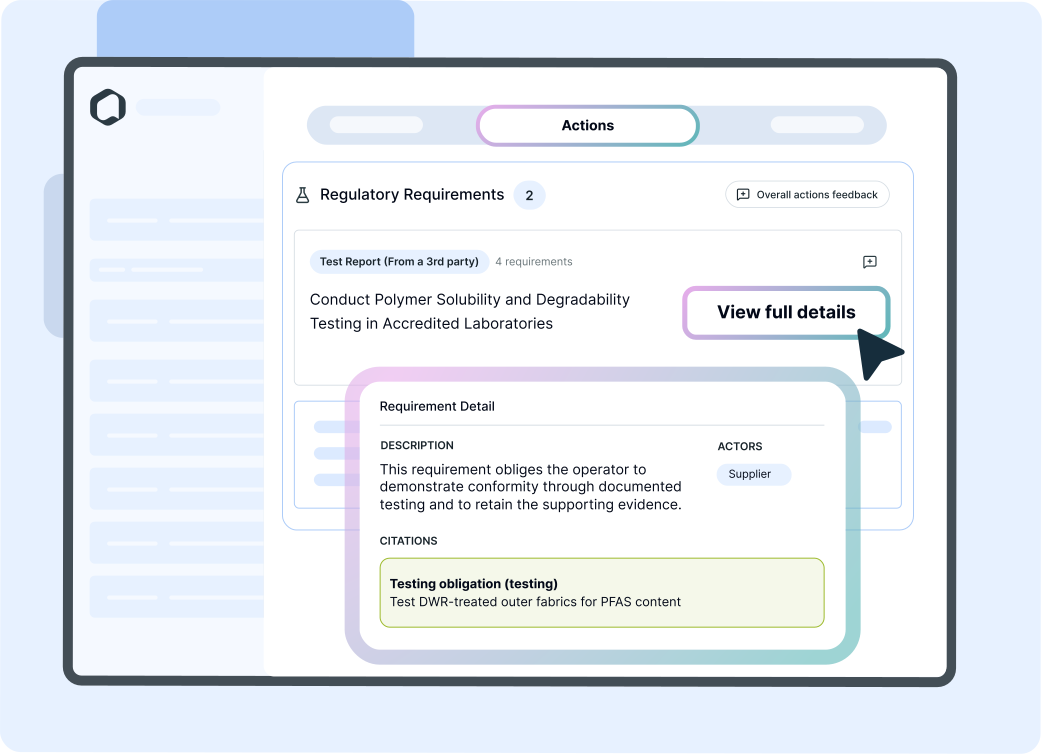
Turn complex regulations into clear, actionable tasks.
Give your teams instant clarity as AI agents transform dense legal and regulatory text into structured, easy-to-understand requirements.
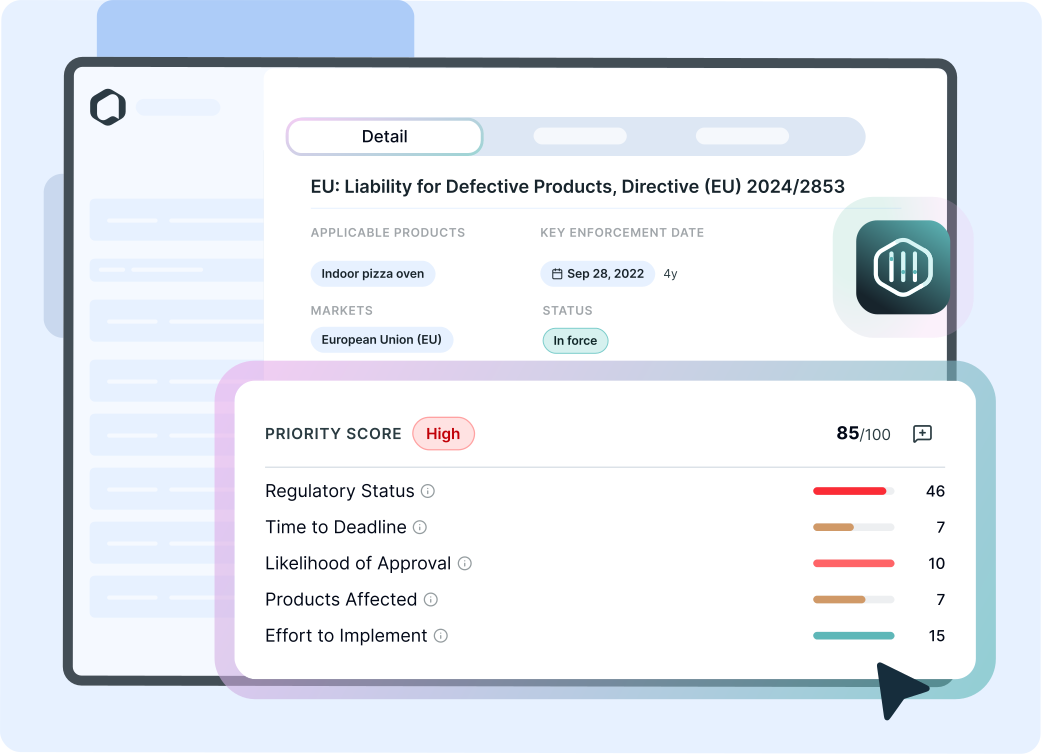
Prioritize Business Risk
Focus Where Risk Is Highest
Make faster, risk-informed decisions with confidence as AI agents automatically rank regulatory changes based on urgency, business impact, compliance deadlines, and product exposure.
Spotlight
Turning Compliance into Value


The State of Product
Compliance 2026
Discover how 500+ global leaders are shifting product compliance from a cost-centre into a strategic driver of growth, with key benchmarks like 69% of teams calling remediation their biggest challenge.
Frequently Asked Questions
-
Most jurisdictions require clear and accurate disclosure of fiber composition, care instructions, and manufacturer or importer identification. Additional obligations often include country of origin labeling and specific identification rules for wool, fur, and footwear materials, along with strict prohibitions on misleading claims.
-
Companies must comply with flammability standards, especially for children’s apparel and sleepwear, and restrictions on hazardous substances such as azo dyes, formaldehyde, heavy metals, phthalates, and PFAS. Non-compliance can trigger recalls, import bans, fines, and market withdrawal, making testing, documentation, and supply chain controls essential.
-
Key EPR obligations include registration with a PRO and payment of fees to cover the costs of collecting, sorting, reusing and recycling of textile waste. Producers are also required to report on product data and implement eco-modulation. To fully comply, manufacturers need to reshape product design, enhance supply chain transparency and integrate traceability and circularity across the product lifecycle.
-
Fashion brands need to prepare for full supply chain traceability as lawmakers introduce new disclosure obligations, including digital product passports, the display of environmental information and e-labelling. These measures demand far greater transparency, requiring companies to disclose details such as the origin of materials, product composition, recycling rates, economic operators’ identity, and more. As a whole, these tools are designed to provide clear indicators of a company’s environmental performance, who must invest in robust systems capable of accurately tracking, measuring and reporting data across the entire supply chain.
-
The most common enforcement trends in the fashion sector concern unfair commercial practices and violations of consumer protection laws, in particular:
- misleading environmental claims (greenwashing): unsubstantiated or inaccurate statements about product sustainability or a company’s environmental commitments;
- deceptive pricing and labelling practices;
- labour law and supply chain due diligence breaches, including unfair working conditions and inadequate oversight of suppliers.
More
Regulatory
Topics
Circular Economy Solutions
Regulatory Focus Circular Economy 195 Countries Covered 28 Languages 2748 Regulatory Sourc…
Chemicals In Products
Regulatory Focus Chemicals In Products 195 Countries Covered 10144 Regulatory …
PFAS
Regulatory Focus Chemicals In Products 195 Countries Covered 28 Languages 1259 Regulatory …
Consumer Protection
Regulatory Focus Consumer Protection 195 Countries Covered 28 Languages 4804 Regulatory So…
Supply Chain Due Diligence
Regulatory Focus ESG: SUPPLY CHAIN DUE DILIGENCE 28 Languages Supported 28 Languages 600 R…
Sustainable Resource Use
Regulatory Focus Sustainable Resource Use 195 Countries Covered 28 Languages 533 Regulator…