

Regulatory Focus
EH&S: Environment

EH&S: Environment
195
Countries Covered
28
Languages
19838
Regulatory Sources
Environmental legislation in C2P covers laws and regulations designed to prevent environmental harm by controlling pollution, managing chemicals and waste, conserving resources, and protecting ecosystems.
Environmental laws regulate facility impacts on soil, climate, water, and public health, requiring permits, ongoing compliance, monitoring, and risk management to avoid violations.
Companies must comply with facility-level requirements governing emissions, waste, water, soil protection, hazardous materials, energy use, and emergency preparedness, as defined in applicable permits and laws. Obligations typically apply to manufacturing sites, offices, laboratories, and combustion plants, and require ongoing monitoring, controls, and documented compliance.
- Technical control, monitoring, and reporting of facility air emissions based on permit;
- Designated and segregated waste storage areas;
- Waste accumulation limits;
- Waste documentation & digital tracking;
- Water discharge and pretreatment permits with direct or indirect discharge limits;
- Wastewater treatment and monitoring requirements;
- Water use and intake requirements;
- Primary & secondary containment for hazardous materials;
- Drainage & runoff management;
- Protected hazardous material loading and unloading zones;
- Hazard communication & training;
- Hazardous materials management plan & reporting;
- Safety equipment & emergency preparedness;
- Technical infrastructure, management & operational requirements for energy use;
- Mandatory source separation and digital tracking of food waste.
Our regulatory content covers facility-level environmental laws and standards that govern air emissions, waste management, water use and discharge, soil protection, hazardous materials, energy use and efficiency, and emergency preparedness. This includes environmental obligations, such as industrial emissions rules, waste and water discharge limits, and pollution prevention measures, as well as broader requirements like environmental reporting and pollution-related criminal liability. We focus on light manufacturing facilities, offices, labs, and small to medium combustion plants, with coverage tailored to the regulations and guidance relevant to these operations.
- Amsterdam (Netherlands): 2026 Waste Tax and Industrial Cleaning Duty Ordinance, December 2025
- Canada: Environmental Protection Act, c. 33, 1999
- Canada: Environmentally Sound Management of Chemical Substances in the Chemicals, Plastics and Rubber Sectors, Code of Practice, February 2024
- Canada: Designation of Certain Excluded Classes of Projects from Environmental Impact Assessment, Order SOR/2025-60
- China: Ecological and Environmental Code, Draft Code, April 2025
- Denmark: Environmental Requirements for Medium-sized Combustion Plants, Executive Order No. 1408, 2023
- Denmark: Energy Labelling of Buildings, Order No. 549, 2023
- EU: Industrial Emissions Directive (IED) 2010/75/EU
- EU: Industrial Emissions Directive (IED) 2010/75/EU and Other – Amendment – (on emission limits, planning and operator conformity) Directive (EU) 2024/1785
- EU: Protection of the Environment through Criminal Law, Directive (EU) 2024/1203
- EU: Energy Efficiency, Directive (EU) 2023/1791
- EU: Waste Directive, 2008/98/EC
- EU: European Sustainability Reporting Standard (ESRS) E2 Pollution, Standard, July 2023
- EU: European Sustainability Reporting Standard (ESRS) E2 Pollution, Standard, July 2023 – Proposed Amendment – (on simplification and reduction of data points) Draft Standard, July 2025
- France: Analysis of PFAS in Aqueous Discharges from Installations Classified for Environmental Protection, Guidance Document, February 2024
- France: Per- and Polyfluoroalkyl Substances (PFAS) Restrictions, Law No. 2025-188
- France: National Trajectory for the Progressive Reduction of PFAS in Industrial Aqueous Discharges, Decree No. 2025-958
- France: Approving the List of Industrial Sites for the Accelerated Connection of Renewable Energy Installations to the Public Electricity Transmission Network, Decree No. 2024-281
- France: Accelerating the Production of Renewable Energy, Law No. 2023-175
- Italy: Promotion of the Use of Energy from Renewable Sources, Decree, August 2024
- New York (USA): PFAS Discharge Disclosure Act, Senate Bill 227B, January 2023
- Spain: Air Quality, Decree 34/2023
- USA: Clean Air Act including Amendments (CAAA), 42 U.S.C. Section 7401 et seq., 1990
- New York (USA): PFAS Discharge Disclosure Act, Senate Bill 4574B, February 2025
- China: Environmental Protection Law, 2014
- China: Emission Standard of Air Pollutants for Refractory Industry, Draft Standard, February 2025
- Portugal: Setting Targets for the Integration of Energy from Renewable Sources, Decree-Law No. 85, 2025
- Russian Federation: Approving Criteria for Classification of Industrial Activities Having a Negative Impact on the Environment, Resolution No. 1029/2015
- Russian Federation: Requirements for Automatic Means of Measuring and Recording Pollutant Emissions and Discharges, Resolution No. 778, 2025
- Spain: Regulating Heating and Cooling Networks and Thermal Origin Guarantees, Draft Royal Decree, August 2025
- UK: Environmental Targets (Fine Particulate Matter) (England) Regulations, SI No. 2023/96
- UK: Pollution Prevention for Businesses, Guidance Document, Revision, May 2023
- Ontario (Canada): Spill Prevention and Contingency Plans under the Environmental Protection Act, Regulation, O. Reg. 224/07, 2007
- Taiwan: Wastewater Effluent Discharge Standards, 2019
- Thailand: Controlling Wastewater from Buildings, Announcement, B.E. 2567, 2024
- Thailand: Management of Waste or Unused Materials, Announcement, B.E. 2566, 2023
- Turkey: Industrial Emissions Management, Regulation, January 2025
- Vietnam: Water Resources Management and Licensing, Decree No. 02/2023/ND-CP
- Vietnam: Water Resources, Law No.28/2023/QH15
- Washington (USA): Air Quality Fees, Rule, WAC 173-455, 2023



Intelligent Resources

Automate the work of managing regulatory change.
Let AI agents do the heavy lifting of monitoring regulations, mapping requirements to products, extracting obligations, and surfacing the risks that need attention first.
Monitor Product Compliance
Stay Ahead of Regulatory Change
Get early visibility into changes that could affect your products, supply chain, or market access—so you can act proactively, not reactively.

Assess Regulatory Applicability
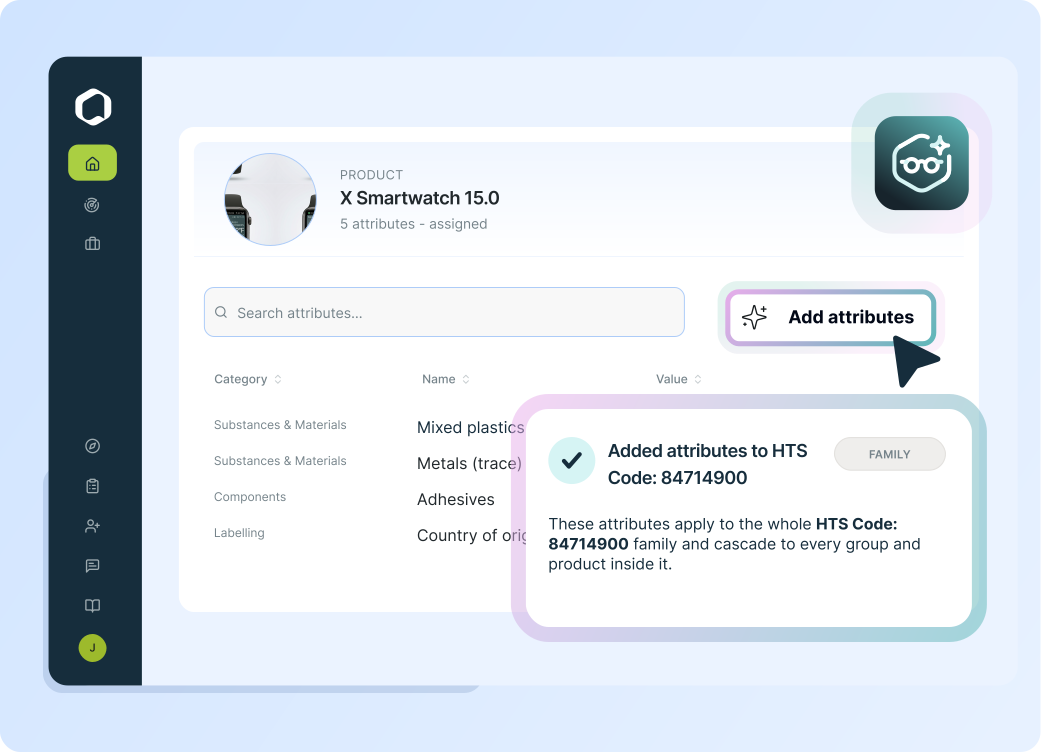
Map Regulations to Your Products
Eliminate manual research and cut through regulatory noise by surfacing only the requirements relevant to your business, markets, and product categories.
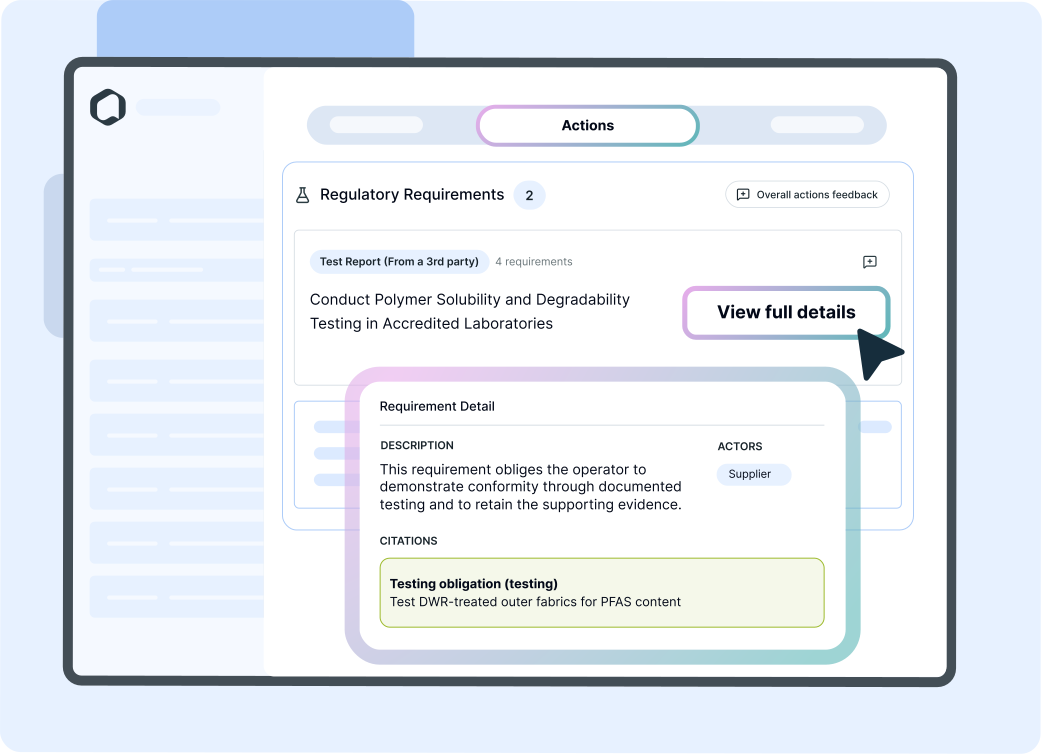
Identify Compliance Requirements
Turn complex regulations into clear, actionable tasks.
Give your teams instant clarity as AI agents transform dense legal and regulatory text into structured, easy-to-understand requirements.
Prioritize Business Risk
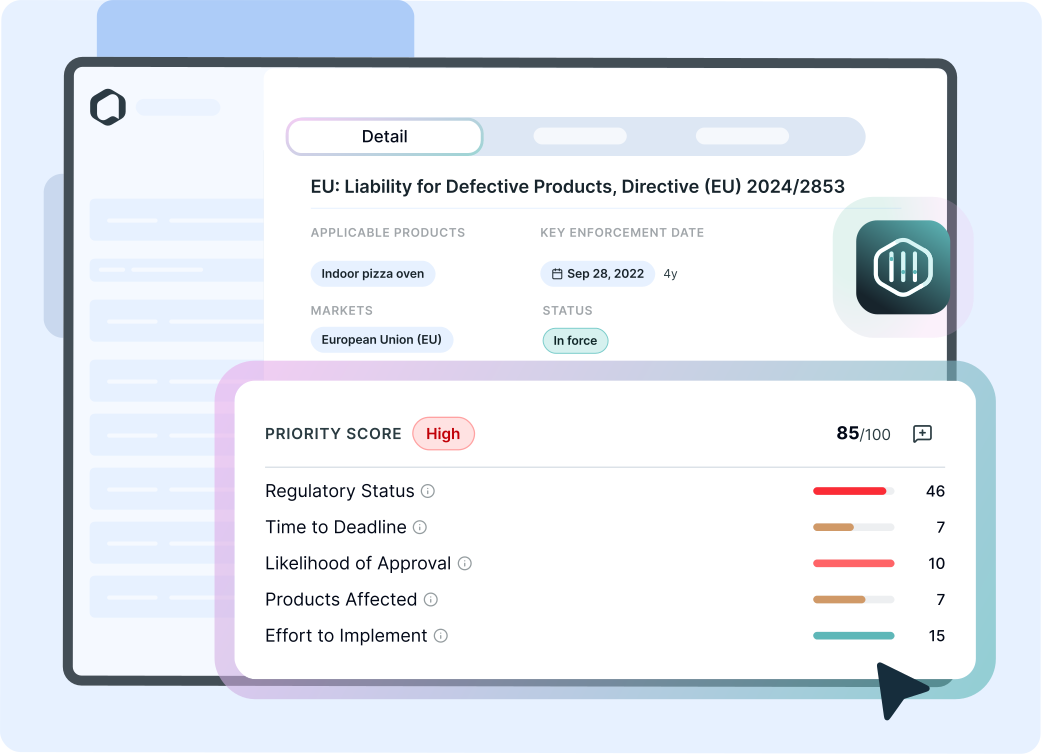
Focus Where Risk Is Highest
Make faster, risk-informed decisions with confidence as AI agents automatically rank regulatory changes based on urgency, business impact, compliance deadlines, and product exposure.
Spotlight
Turning Compliance into Value


The State of Product
Compliance 2026
Discover how 500+ global leaders are shifting product compliance from a cost-centre into a strategic driver of growth, with key benchmarks like 69% of teams calling remediation their biggest challenge.
Frequently Asked Questions
-
Manufacturing facilities generally need to manage air emissions (including dust, noise, odor, light, and radiation), handle and dispose of solid and hazardous waste safely, and control water use and discharge (including sewage, stormwater, and spill prevention). Many jurisdictions also require energy management, emergency preparedness plans for accidental releases, and adherence to pollution prevention rules. These obligations are often implemented through permits and compliance reporting.
-
C2P’s EH&S Environment coverage does not include sectors or facility types such as building construction, data centers, healthcare, mining, oil & gas, transport, shipping, heavy industry, power plants (except small/medium combustion plants <50 MW in EU/EEA/UK), waste treatment facilities, contaminated site remediation, nature conservation, and greenhouse gas emissions (covered under Climate Change). It also excludes regulatory requirements related to radioactive waste, nuclear, military sectors, and obligations tied to managing product end-of-life waste.
-
While traditional facility management focuses on utility and maintenance (keeping the lights on and the AC running), environmental facility management prioritizes resource efficiency and impact reduction, e.g. traditional management responds to a broken boiler, environmental management upgrades to a high-efficiency heat pump to reduce carbon footprint and long-term energy costs.
-
Most facilities start with operational tuning and “low-hanging fruit” like installing occupancy sensors so lights and HVAC aren’t running in empty conference rooms, swapping out old bulbs with LEDs to see a fast Return on Investment (ROI), or using software to schedule equipment run-times based on actual building usage patterns.
-
To prove a facility is actually “green,” managers often aim for third-party certifications. The “Big Three” are:
- LEED (Leadership in Energy and Environmental Design) | Comprehensive building sustainability (Energy, Water, Waste).
- BREEAM (Building Research Establishment Environmental Assessment Method) | Science-based sustainability standards for master planning and buildings.
- WELL Building Standard | Specifically focused on human health and wellness within the space.
- LEED (Leadership in Energy and Environmental Design) | Comprehensive building sustainability (Energy, Water, Waste).
More
Regulatory
Topics
Climate Change
Regulatory Focus Climate change 195 Countries Covered 28 Languages 5653 Regulatory Sources…
Chemicals & EH&S: Environment
Regulatory Focus Chemicals & EH&S: Environment 195 Countries Covered 28 Languages …
Transport of Dangerous Goods
Regulatory Focus Transport of Dangerous Goods 195 Countries Covered 28 Languages 1457 Regu…
Carbon Footprint
Regulatory Focus Carbon Footprint 195 Countries Covered 28 Languages 393 Regulatory Source…
Environmental, Social and Governance (ESG) Reporting
Regulatory Focus ESG Reporting 195 Countries Covered 28 Languages 729 Regulatory Sources W…
Sustainable Resource Use
Regulatory Focus Sustainable Resource Use 195 Countries Covered 28 Languages 533 Regulator…
Human Rights – Affected Communities
Regulatory Focus Human Rights – Affected Communities 195 Countries Covered 28 Languages 26…
Chemicals Management Regulatory Compliance
Regulatory Focus Chemicals Management 195 Countries Covered 28 Languages 5979 Regulatory S…
EH&S: Occupational Health & Safety
Regulatory Focus EH&S: Occupational Health & Safety 195 Countries Covered 28 Langu…